There are debates that behave like weather—rolling in, loud for a moment, and then fading into fog. The Mazda3 vs Subaru Impreza comparison rarely does that. It lingers. It returns. It makes people ask a different question than “Which is faster?” because the real tension hides beneath the surface: what kind of driver do you want to become, and what do you expect from the road when it decides to misbehave?
In the compact AWD arena, the Mazda3 and Impreza stand as opposites in philosophy. One leans toward poise, refinement, and the subtle persuasion of design. The other is a specialist in traction, utility, and the confidence that comes from engineering built for slippery realities. The promise here isn’t simply choosing a car. The promise is a shift in perspective—an invitation to view daily driving like a set of conditions you can actually prepare for.
And once that lens clicks into place, curiosity takes over. Why does a compact AWD matter so much in the first place? How do these two models translate “all-wheel drive” into character? Let’s step into the cockpit of the debate and follow where it leads.
First Impressions: Temperament Before Specs
Most comparisons begin with horsepower, but temperament is the real headline. The Mazda3 tends to arrive with an almost cinematic calm. Its lines read like intent, not decoration. Even when it’s parked, it feels composed—like it’s waiting for you to drive thoughtfully rather than merely quickly.
The Impreza enters differently. It feels purpose-built, an object designed to keep going when the day throws grit, rain, or poorly lit roads into the mix. The look is a little more earnest, a little more functional. It doesn’t beg for attention; it quietly earns it.
This matters because AWD doesn’t only distribute torque. It also changes how you feel about risk. One car can make you drive with serenity. The other can make you drive with preparedness.
AWD Fundamentals: What “All-Wheel Drive” Really Means
AWD is often described like a checkbox, but it’s closer to a promise contract. It says: “When the road argues back, I’ll respond.” Yet AWD systems vary in how they apportion grip and how they behave in sudden transitions—like when a turn tightens unexpectedly, or when traction falls off a cliff at the edge of a puddle.
In practice, the Subaru Impreza’s AWD identity is well known for providing traction confidence across changeable surfaces. It’s built for the feeling that the car is reading the road with a kind of practical vigilance. That vigilance can be comforting during commutes where the weather seems to switch personalities every hour.
The Mazda3’s approach to AWD is typically more about integrating power delivery into a driver-focused experience. It often aims for predictable behavior and smooth composure. Instead of making you feel like the car is fighting for traction, it can make you feel like it’s cooperating with your inputs. That nuance can transform how you interpret steering effort and throttle response in real time.
Handling and Steering Feel: The Battle of Confidence vs Poise
If you’ve ever driven through a twisty on-ramp after a light rain, you know confidence is not just about grip—it’s about communication. Steering feel becomes a language, and suspension tuning becomes vocabulary.
The Impreza often wins the argument of reassurance. It can make slippery maneuvers feel less like calculations and more like momentum with guardrails. There’s a reassuring steadiness to how it approaches compromised traction. You sense that the car is designed to be dependable, even if the conditions aren’t.
The Mazda3, by contrast, tends to deliver poise. It often feels more eager to play with the road—responsive in a way that encourages engagement. The suspension can deliver a controlled ride while still allowing the driver to feel connected to what the tires are doing. That connection can be intoxicating on dry pavement and still surprisingly capable when conditions turn.
Ride Quality: Comfort Isn’t the Same as Compliance
Ride quality is the quiet mediator of daily life. It handles the potholes you don’t plan for, the rough patches you forget about, and the long stretches that test patience.
The Impreza usually prioritizes a pragmatic compliance—absorbing road irregularities while maintaining traction behavior. On imperfect surfaces, this can create a sensation of steadiness, like the car is smoothing your route even when the road won’t cooperate.
The Mazda3 typically aims for a more refined balance. It often strives to reduce harshness and deliver a composed ride that feels more “finished” over varying pavement. If your commute includes sharper edges and frequent tempo changes—like speed bumps and patchwork lanes—the Mazda3’s refinement may feel particularly satisfying.
Interior Atmosphere: Where Mindset Becomes Mood
Cars influence psychology in small ways. The layout, the visibility, and even the texture of the driving environment can change how you experience stress.
The Impreza’s interior is often straightforward and function-forward. It encourages a no-nonsense mindset. You get the feeling that you’re in a vehicle designed to do a job well, day after day, weather permitting.
The Mazda3’s cabin generally leans toward tasteful ergonomics and a more premium atmosphere. It can feel like the cockpit of a car that expects you to enjoy the drive, not just endure it. For drivers who value aesthetics and calm tactile feedback, that shift can matter more than any spreadsheet number.
Technology and Driver Assistance: The Art of Anticipation
When roads become unpredictable, technology becomes less about novelty and more about anticipation. Driver assistance systems can reduce cognitive load, translating hazard patterns into warnings and adjustments you can trust.
The Impreza’s tech often complements its AWD identity—aimed at helping you manage variable conditions. Features can support lane guidance and collision avoidance, forming a safety net that feels aligned with its confidence narrative.
The Mazda3’s approach to tech frequently emphasizes clarity and driver-centric interface design. Rather than overwhelming, it tends to support the driver with information that’s easier to absorb at a glance. That can be invaluable on congested commutes where attention is a scarce resource.
Practicality: Storage, Visibility, and Everyday Realism
Compact cars live or die by how they handle real life. Groceries, sports gear, odd-shaped errands, and the everyday chaos that never appears in advertisements—this is where the Impreza and Mazda3 reveal their priorities.
The Impreza’s strengths often surface in its utilitarian presence. AWD plus practicality can be a potent combo for people who want one car to handle everything: commuting, weekend excursions, and even occasional off-the-beaten-path routes.
The Mazda3 counters with a more streamlined everyday usability—efficient packaging and a cabin that often feels thoughtfully arranged. It may not position itself as rugged-first, but it can still satisfy the routine needs of an active lifestyle.
Fuel Economy and Efficiency: The Cost of Confidence
AWD adds complexity, and complexity can influence fuel economy. Yet the real question is how often you’ll actually benefit from AWD—and what the “cost” buys you in return.
In colder regions, the Impreza’s traction-forward identity can justify its presence quickly. When weather turns slick, AWD can help you avoid hesitation, wheelspin, and traction-limited outcomes that sometimes feel like a tax on your confidence.
The Mazda3’s efficiency advantage may appeal to drivers who want AWD without sacrificing too much economy. Its tendency toward refinement and predictable drivability can make it easier to drive efficiently—smoother throttle habits, stable motion, and a more controlled sense of momentum.
Two Philosophies, One Road: Which Shift Fits You?
Here’s the pivot point. Choosing between these two isn’t only about capability; it’s about the kind of agreement you want between car and driver.
If you want AWD that behaves like an insurance policy—there when conditions turn unpredictable, steady when the road becomes slick—then the Subaru Impreza often feels like a match for that mindset. It encourages a shift toward preparedness.
If you want AWD that feels integrated into a more refined, driver-focused experience—encouraging engagement while still maintaining controlled traction—then the Mazda3 can feel like the more harmonious choice. It offers a shift toward poise.
Visual Clarity: Side-by-Side Energy
The difference between these cars isn’t only measured; it’s perceived. Pay attention to how the stance suggests purpose versus elegance, and how the overall presence frames the idea of driving comfort in motion.
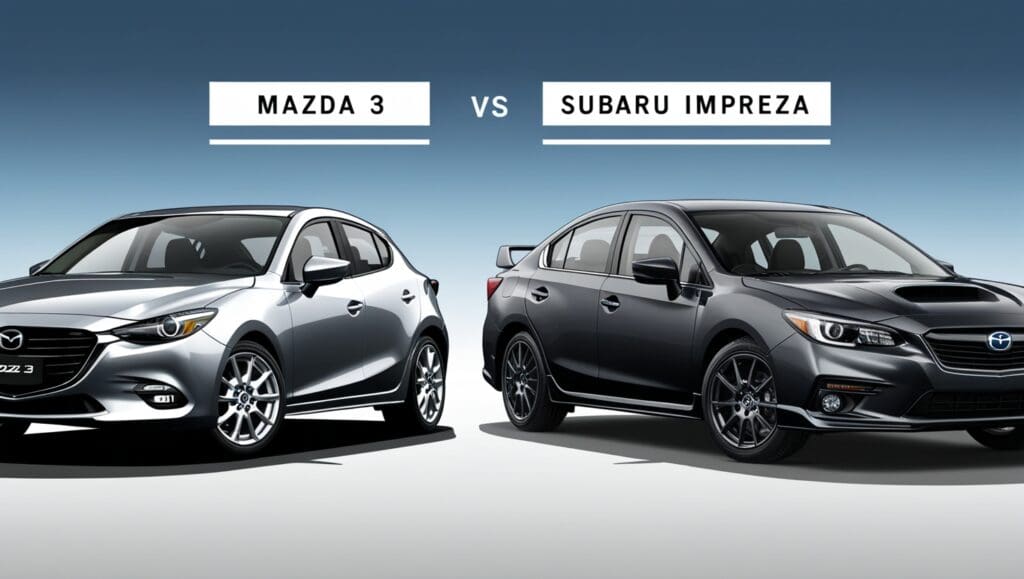
Even when the cars look similar at a distance, their energy diverges up close: one emphasizes stylish restraint, the other leans into practical certainty.

The Final Test: A Drive That Answers the Real Question
The best way to settle the Mazda3 vs Subaru Impreza debate is not to scroll through opinions—it’s to create a controlled day of truth. Try the cars in light rain if possible. Or, if weather won’t cooperate, simulate the experience with varied surfaces: wet parking lots, bumpy roads, and stop-and-go traffic.
Notice how the AWD changes your sense of control. Notice the steering feel at low speed. Listen to the cabin—how it handles noise, how it manages vibrations, how it makes time pass during traffic. Then ask yourself a quiet question: do you want your confidence to feel like readiness, or like composure?
Because once you know that, the decision becomes surprisingly clear.
Outro: The AWD Choice as a Personal Philosophy
Mazda3 vs Subaru Impreza isn’t really a matchup of winners and losers. It’s a comparison of intentions. The Impreza often champions preparedness—an AWD worldview built for real weather and real variability. The Mazda3 often champions poise—an AWD worldview designed to keep the driving experience smooth, engaging, and composed.
Choose the car that matches how you want the world to feel when the road turns tricky. Choose the one that changes your driving mindset for the better. And when you finally settle into the seat, steering straight, tires gripping the surface like a handshake—you’ll feel it.
That’s the shift in perspective the AWD battle was always aiming for.