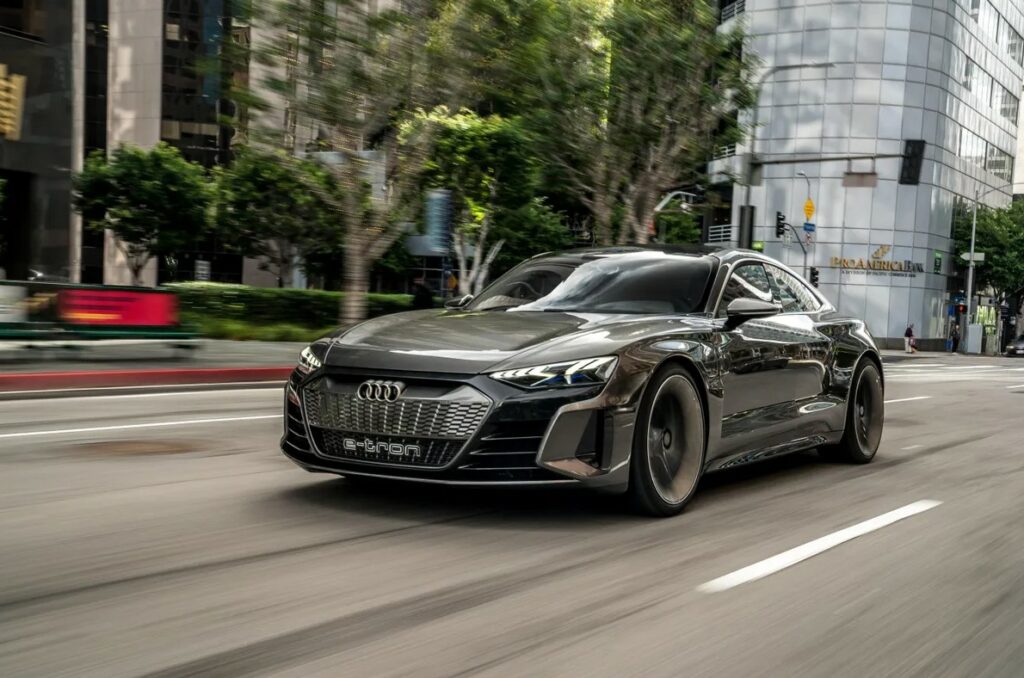
The first thing many people notice about the 2026 Audi e-tron GT isn’t the badge or the price—it’s the sensation that the car has been sculpted for speed, even before it ever moves. In photographs and in person, its stance reads like a luxury sedan that secretly studied race engineering. That contrast—executive comfort wearing supercar clothing—is the common observation. And yet, fascination doesn’t arrive from aesthetics alone. It’s also the quiet proof of intent behind the design choices: airflow discipline, power delivery character, and a chassis philosophy that treats electricity like a performance medium rather than a compromise.
There’s a reason the e-tron GT pulls at curiosity. People expect an EV to feel different in the obvious ways—instant torque, silent roll, digital interfaces. What they don’t always expect is the particular emotional temperature of driving it. The 2026 model amplifies that feeling. It offers refinement without erasing edge, and it makes the everyday roads feel slightly more theatrical.

Luxury That Doesn’t Apologize for Performance
Luxury is often associated with softness—gentle damping, hushed cabins, and steering that seems designed for comfort rather than communication. But the e-tron GT’s luxury is more sophisticated than that. It is controlled luxury. The cabin is calm, the materials are tactile, and the driver is surrounded by a sense of orchestration. Still, the car’s body language suggests readiness, as if it’s prepared to accelerate the conversation from polite to thrilling at the press of a pedal.
The deeper fascination comes from how Audi balances opposites. A supercar-like silhouette can’t be purely decorative; it must work. The 2026 e-tron GT’s aerodynamic profile aims to reduce turbulence while preserving stability at real-world speeds. That’s why it looks fast even when parked. Designers don’t just shape for the eye; they shape for airflow, for downforce management, and for the way a vehicle settles on its springs. The result feels like a sedan that learned to behave like a coupe at speed.
Then there’s the matter of silence. The absence of engine noise creates room for nuance—tire texture, suspension cadence, and the electric surge itself. That quietness is not merely relaxation; it becomes a canvas. The car’s performance is rendered with high fidelity, and your senses do more work than you’d expect.
Supercar DNA: Instant Torque and a Controlled Surge
Electric propulsion is famously immediate, but the experience varies dramatically among EVs. Some deliver torque like a blunt instrument—quick, but one-dimensional. The e-tron GT delivers it with a sense of measurement. The car doesn’t only pull; it organizes the pull. When acceleration begins, there’s a deliberate ramp-up that feels like traction management translated into an emotional narrative.
This matters because fascination isn’t only about how fast the car can go. It’s about how the speed arrives. The 2026 e-tron GT emphasizes traction, steering authority, and confident balance. Even when the car is demanding, it feels composed. That composure is a hallmark of supercar heritage: the belief that power should be harnessed, not merely unleashed.
In motion, the car’s front end tracks with intention. The rear follows with confidence. Weight distribution—refined through engineering choices and packaging—helps the vehicle feel planted rather than skittish. The effect is surprisingly addictive. Drivers start to anticipate the car’s reactions, and that anticipation deepens the bond. Every acceleration becomes a small event, every corner a question the chassis answers quickly.
The Chassis Philosophy Behind the Fascination
It’s tempting to reduce the e-tron GT to motor and battery specs, but the chassis is the hidden author. Luxury vehicles can be comfortable without being engaging, and sports cars can be engaging without being elegant. The 2026 e-tron GT aims for a rare midpoint: dynamic refinement. Suspension tuning, steering feel, and stability systems work together so the car feels predictable even when it’s being pushed.
Behind the scenes, the engineering philosophy treats drivability as a continuum. The car should not feel like it switches modes dramatically from “daily” to “sport.” Instead, it should progress smoothly, like a well-composed score. Short sentences happen in the steering. Long sweeps occur in the body’s roll behavior. That consistency encourages driver trust, and trust is often the difference between a fast drive and an unforgettable one.
Even the brakes play a role in the experience. Regenerative braking adds a distinct texture to deceleration, while conventional braking supplies the authority when you need abrupt stopping power. The blend is calibrated to feel natural rather than abrupt, which helps the car keep its composure through transitions.
Aerodynamics, Not Just Styling
The e-tron GT’s form is unmistakably performance-forward. But the performance-forward look isn’t the only point. Aerodynamics are a form of discipline, and the 2026 design uses that discipline to support stability, efficiency, and overall feel.
At higher speeds, aerodynamic drag and turbulence can quietly steal energy and comfort. Audi’s approach is to reduce those losses while keeping the vehicle’s behavior consistent. That’s why the car can feel eager and steady simultaneously. It doesn’t rely on drama alone; it relies on airflow behavior that keeps the car “tight” in the way it moves through wind.
The deeper fascination is that you can sense this from the driver’s seat. There’s less sense of the car fighting the air, more sense of it gliding. That subtlety turns the experience from a sprint into a sustained pursuit of velocity.
Inside the Cockpit: Digital Clarity with Human Comfort
Step into the cabin and the e-tron GT becomes something else entirely. The interface aims for clarity rather than clutter. Buttons and controls feel intentional, and the driving position encourages focus. It’s not sterile; it’s curated. Audi’s hallmark is the way it blends technology with tactile comfort—surfaces that feel premium, layouts that reduce friction between thought and action.
Because EVs are quiet, the cabin needs to do more than provide silence. It needs to provide atmosphere. The 2026 e-tron GT accomplishes this with lighting choices, material choices, and the way sound is managed. The result is a sanctuary that still feels sporty, like a private lounge with a launch control button hidden in plain sight.
That’s also where luxury becomes persuasive. The car doesn’t merely transport you; it reframes the journey. A commute becomes a sequence of sensations—smooth pedal modulation, calm cabin acoustics, and an interface that keeps you informed without demanding attention.
Range, Charging, and the New Kind of Convenience
EV skeptics often lead with a single concern: range anxiety. Yet fascination has a habit of appearing once the practical system becomes predictable. The 2026 e-tron GT is designed to fit into modern charging realities, and that changes the emotional math of ownership.
Charging infrastructure has improved, and the concept of “planning” can become less stressful when the car supports efficient routines. Fast-charging capability reduces downtime, while route awareness tools help drivers treat long trips as sequences instead of obstacles. Convenience is not only about hardware; it’s about confidence—confidence that the car will be ready when life demands mobility.
And there’s a quieter point many overlook: the EV experience encourages a different driving rhythm. Lift-and-coast habits, smoother throttle inputs, and regenerative braking become part of daily behavior. This is not moralizing; it’s just how the car teaches you to drive. People often discover they enjoy that learning curve.
Why the e-tron GT Feels Like a Supercar, Even as a Sedan
The common observation says the e-tron GT is a luxury EV with supercar DNA. But the deeper reason it lands so strongly is that it refuses to be one thing only. It’s a car that respects comfort, yet it speaks in the language of performance. That duality is rare. Most vehicles lean too hard toward one side of the scale.
In the 2026 model, the balance is purposeful. The styling signals speed without neglecting elegance. The powertrain offers immediacy without losing composure. The chassis supports spirited driving without turning the ride into punishment. It’s the kind of engineering that makes you pay attention—not because you have to, but because the car keeps delivering little confirmations of its intent.

Final Thoughts: The Real Luxury Is Intent
The 2026 Audi e-tron GT captivates because it treats electric propulsion as an opportunity, not a constraint. Its luxury isn’t just about softness, and its performance isn’t just about numbers. It’s about intent—how the car anticipates, stabilizes, and translates power into a drive that feels textured, responsive, and unmistakably premium.
Yes, it looks like a supercar in sedan form. But the fascination deepens when you realize that the resemblance is earned. Every choice—design discipline, chassis tuning, and the character of acceleration—conspires to create a vehicle that feels alive. The e-tron GT doesn’t ask you to lower expectations. It asks you to update them.