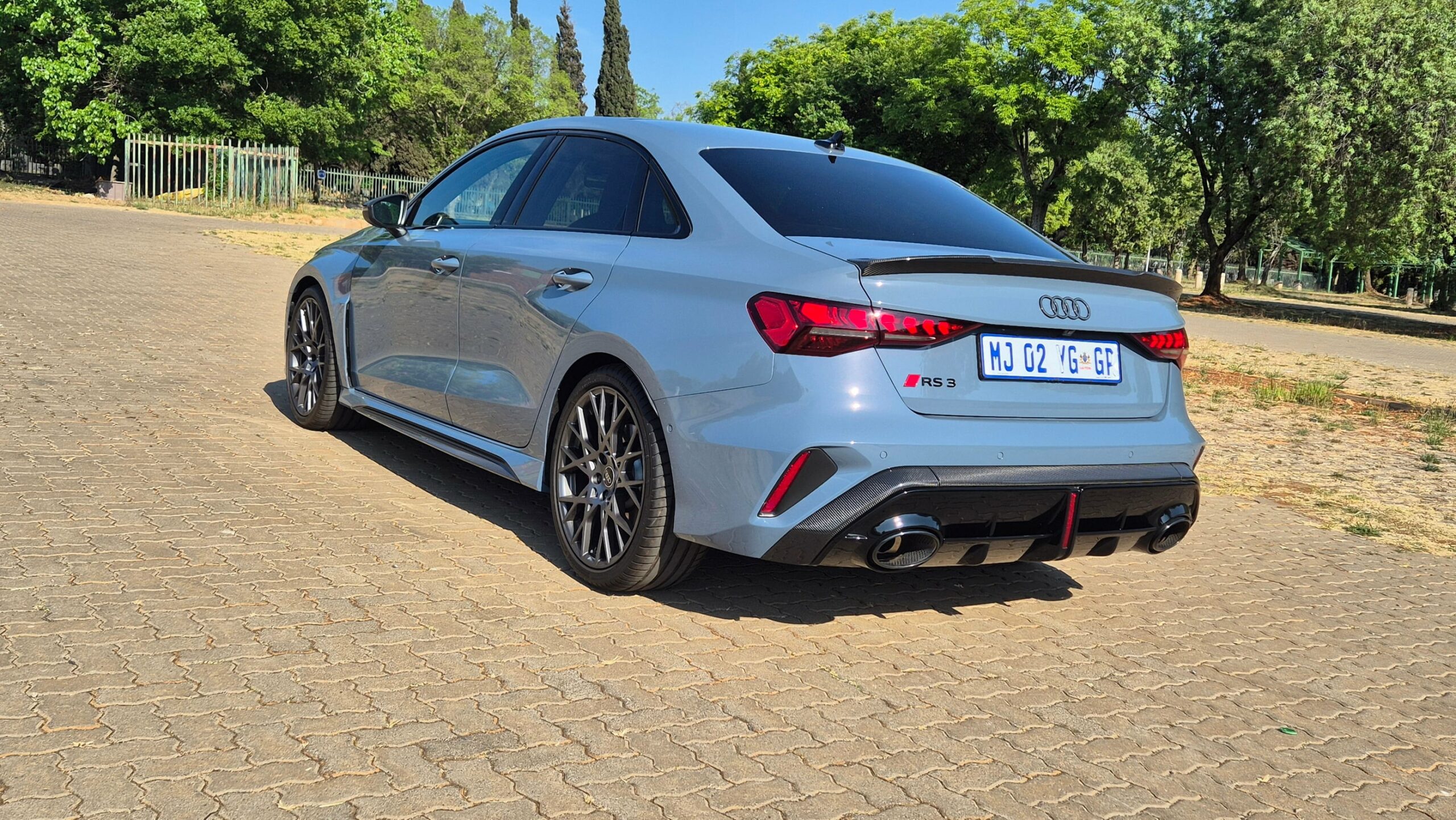
The Audi RS3 Sedan doesn’t simply arrive—it materializes, like a jet of quiet lightning trapped under an aerodynamic skin. One moment it’s just another five-door-shaped silhouette on the boulevard; the next, it feels as though the road has been given a pulse. Today’s test focuses on that pulse: a modern classic in the making, powered by a five-cylinder engine that sounds less like machinery and more like a carefully tuned instrument. It is an enthusiast’s argument for the romance of internal combustion—delivered with clean lines, confident stance, and a throttle response that refuses to be ignored.
In this review, the RS3 Sedan is treated the way it deserves: not as an appliance, but as a personality. Because the appeal of the RS3 isn’t only about speed. It’s about character—about how the car makes you want to drive it more intelligently, then immediately encourages you to drive it wilder.
Design that Hints at Velocity
From the front, the RS3 reads as purposeful, not decorative. The grille and intakes are shaped like intent—functional surfaces sculpted to suggest urgency even while standing still. Light clusters create sharp punctuation marks, especially at night. The sedan body, instead of dulling the experience, sharpens it. It’s the kind of design that feels grown-up and aggressive at the same time, like a suit tailored for a streetfight.
Look closer and the details begin to hum. The stance sits composed, yet ready to spring. In mirrors and reflections, you catch that unmistakable “RS” presence: a confidence that doesn’t need to shout because it knows what it’s capable of.

Cabin Atmosphere: Sporty Without Being Crude
Step inside and the RS3 Sedan feels like a workshop for sensations. Materials are tidy and purposeful, with design elements that lean toward function rather than theatrical clutter. The dashboard layout is driver-centric, angled to reduce distraction and increase engagement. Shorter reach to key controls makes every interaction feel immediate.
Seats hold you with a firm, supportive grip, the way good armrests support an enthusiastic conversation. Long journeys remain plausible, because the cabin doesn’t constantly demand that you brace yourself for chaos. Still, the atmosphere is unmistakably charged. The car is never entirely at rest—even when you’re cruising.
The Five-Cylinder Symphony: Sound as a Signature
The heart of the RS3 Sedan is the five-cylinder engine, and it is impossible to treat it as mere propulsion. It is percussion, melody, and mechanical storytelling in one. Under light throttle, it murmurs with a restrained confidence. Feed it harder and it becomes a crescendo—an aria that rises as the revs climb, punctuated by crisp pops and pulses that feel earned rather than engineered for attention.
What makes the sound special is its texture. It’s not only the volume. It’s the rhythm. The cadence carries character, like a drummer who knows exactly when to accelerate the mood without losing control of the groove.
Performance: Acceleration with Intent, Not Impulse
On the test drive, the RS3 Sedan demonstrates a peculiar kind of speed: briskness with discipline. Initial acceleration feels purposeful and linear, then suddenly more urgent. That transition is the trick—how the car builds momentum in a way that seems to anticipate your next input.
The steering and chassis communicate together, reducing the “disconnect” that can plague high-powered cars. Instead of feeling like a collection of separate systems, it feels like a single organism. You press the throttle, and the car answers with clarity. You corner, and it stays poised instead of becoming temperamental.
Power is only half the story; the other half is how it arrives. The RS3 makes acceleration feel like a plan rather than a gamble.
Handling: A Sedan That Drives Like a Secret
Curves are where the RS3 Sedan becomes most interesting. The chassis is tuned to remain stable while still offering feedback that invites precision. Body motion is controlled, but not sterilized. The suspension has that rare balance: it doesn’t just “work,” it talks.
Under spirited cornering, grip appears in layers—traction first, then composure, then a final surge of confidence as the car tightens its line. The car feels eager to rotate, yet reluctant to overwhelm. Even when you push the pace, the RS3 doesn’t turn into an unpredictable creature. It behaves like something trained.
That’s the seductive part. You start the drive thinking you’ll test it. Half an hour later, you realize it has tested you—your patience, your restraint, your willingness to brake a fraction later than usual.
All-Weather Usability: Performance That Doesn’t Vanish
One of the RS3 Sedan’s unique appeals is its practicality under real-world conditions. Wet roads, cool mornings, and imperfect surfaces don’t erase the fun. The drivetrain helps maintain traction, giving the car a dependable feel that encourages experimentation.
It’s the difference between a toy and a tool. You can drive it to work, sit in traffic without fatigue, and still have the confidence to attack a twisty road on the way home. The car’s charm isn’t confined to sunny track days. It extends into ordinary life, where surprise grip and predictable behavior turn commuting into a minor thrill.
Braking and Stability: Confidence at the Edge
When the road tightens, stopping power matters as much as going fast. The RS3 Sedan’s braking system delivers strong deceleration with a pedal feel that inspires trust. There’s a reassuring firmness under your foot, and the car stays composed in the middle of the excitement.
Stability is tuned to keep you feeling in control, not swept away. The traction systems help the RS3 maintain its composure, smoothing the transition from acceleration to deceleration. It feels like the car is always one step ahead, adjusting to the situation before the driver fully finishes the thought.
Transmission and Drive Modes: Tailoring the Mood
Drive modes add a layer of theatricality, but in a sophisticated way. You can soften the character for calm cruising, then switch to a setting that sharpens throttle response and amplifies the emotional soundtrack. Short bursts of acceleration become addictive when the car is in a mood that’s ready to perform.
Long sentences on the highway? Quiet composure. Short bursts on a back road? Instant reaction. The RS3 Sedan lets you narrate your drive, choosing how dramatic the scene should be.
Fuel Economy and Daily Reality
Performance cars often come with compromises, and the RS3 Sedan is no exception. Aggressive driving naturally increases consumption. Yet the car’s daily usability keeps the compromise from feeling punitive. It’s not a constant thirst; it’s a responsiveness you can modulate.
In the rhythm of real life—traffic lights, steady highway pace, the occasional detour—the RS3 behaves like a mature enthusiast’s choice rather than a reckless spendthrift.
Why the RS3 Sedan Stands Out
The Audi RS3 Sedan doesn’t chase trends. It refines the classic concept of a hot-hatch mentality, then places it into a sedan’s more formal silhouette. That combination is the intrigue: familiar body shape, extraordinary engine character. It’s as if the RS3 is a wolf in tailored clothing, ready for the hunt but never losing its polish.
The five-cylinder sound is the signature, yes. But the deeper appeal is cohesion—how design, cabin feel, handling precision, and drivetrain character align into one satisfying experience.
Final Thoughts: A Modern Classic with a Pulse
After the test drive, the RS3 Sedan leaves behind a feeling that’s hard to manufacture: satisfaction with substance. It’s thrilling, but not careless. It’s intense, yet not exhausting. It invites you to drive with intention, then rewards you for deciding to enjoy the moment.
The Audi RS3 Sedan is a reminder that performance can be lyrical. It doesn’t just move quickly—it communicates. And in a world full of efficient sameness, that’s what makes it a modern classic in the making.