In the ever-expanding cosmos of electric SUVs, two titans have emerged from the shadows of convention to claim their rightful place in the pantheon of modern motoring. The Tesla Model Y and the Ford Mustang Mach-E don’t just represent transportation—they embody the future, the present, and, perhaps most intriguingly, a clash of philosophies. One is the sleek, silicon-driven prodigy of a tech empire; the other is the muscular, heritage-laden muscle of a century-old American institution, reimagined for the electric age. But which one truly deserves the crown? The answer isn’t as simple as picking sides in a corporate feud. It’s a question of purpose, performance, and personality. So, let’s embark on a journey through torque curves, tech stacks, and trunk spaces to uncover which SUV truly wins the electric showdown.
The Battle of Brand DNA: Silicon Valley vs. Detroit Steel
At first glance, the Tesla Model Y and Ford Mustang Mach-E seem like distant cousins—both electric, both SUVs, both aiming for the same demographic. Yet their origins could not be more different. The Model Y is the brainchild of Elon Musk’s relentless pursuit of innovation, a vehicle born from software, batteries, and a refusal to compromise. It’s the digital native in a world of analog holdouts. The Mustang Mach-E, by contrast, is a wolf in sheep’s clothing—a pony car’s soul draped in the futuristic silhouette of an electric crossover. Ford didn’t just electrify the Mustang; it reincarnated it, infusing the spirit of Carroll Shelby with the quiet hum of an electric motor.
This dichotomy extends beyond aesthetics. Tesla’s DNA is rooted in disruption, in challenging the status quo with over-the-air updates, minimalist interiors, and a cult-like following. Ford, meanwhile, clings to tradition while gingerly stepping into the future—its infotainment system still bears the ghost of MyFord Touch, and its dealership model remains a relic of the past. Yet, in this clash of cultures lies the first clue to their respective strengths. The Model Y is a blank canvas for tech enthusiasts; the Mach-E is a bridge for those hesitant to leave the past behind.
Performance: Who Leaves Whiplash in the Dust?
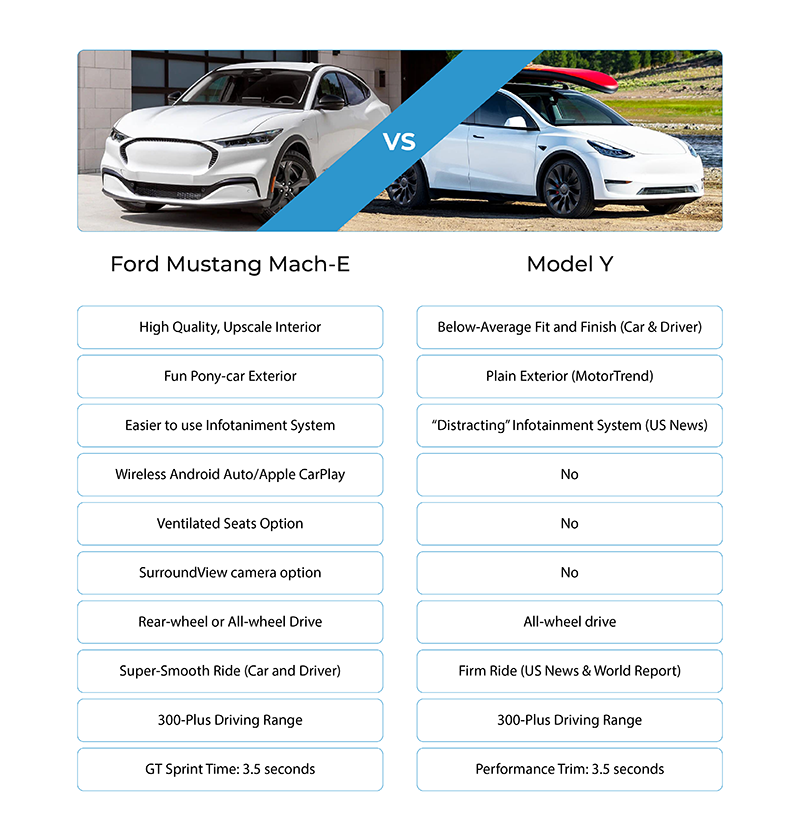
If speed is your metric, the Tesla Model Y leaves the Mustang Mach-E in its dust—literally. With a 0-60 mph time of just 4.8 seconds in its Long Range AWD guise, the Model Y is quicker than a Porsche Macan Turbo. The Mach-E, while no slouch at 5.2 seconds in its GT Performance trim, feels like it’s sprinting with a weighted blanket. But raw numbers only tell part of the story. The Model Y’s acceleration is linear, almost clinical—like a robot executing a perfectly timed jump. The Mach-E, on the other hand, delivers a more organic surge, its torque curve peaking with a visceral growl that belies its electric nature.
Handling is where the Mach-E claws back some ground. Ford’s SUV boasts a lower center of gravity thanks to its battery placement, and its adaptive suspension system (on higher trims) imbues it with a poise that the Model Y struggles to match. The Model Y’s steering feels numb, its body roll exaggerated—traits that betray its utilitarian underpinnings. The Mach-E, meanwhile, corners with the confidence of a pony car, its rear-wheel-drive heritage shining through in tight switchbacks. Yet, even here, Tesla’s ace in the hole is its regenerative braking system, which allows for one-pedal driving that feels like piloting a spaceship.
Range and Charging: The Marathon vs. The Sprint
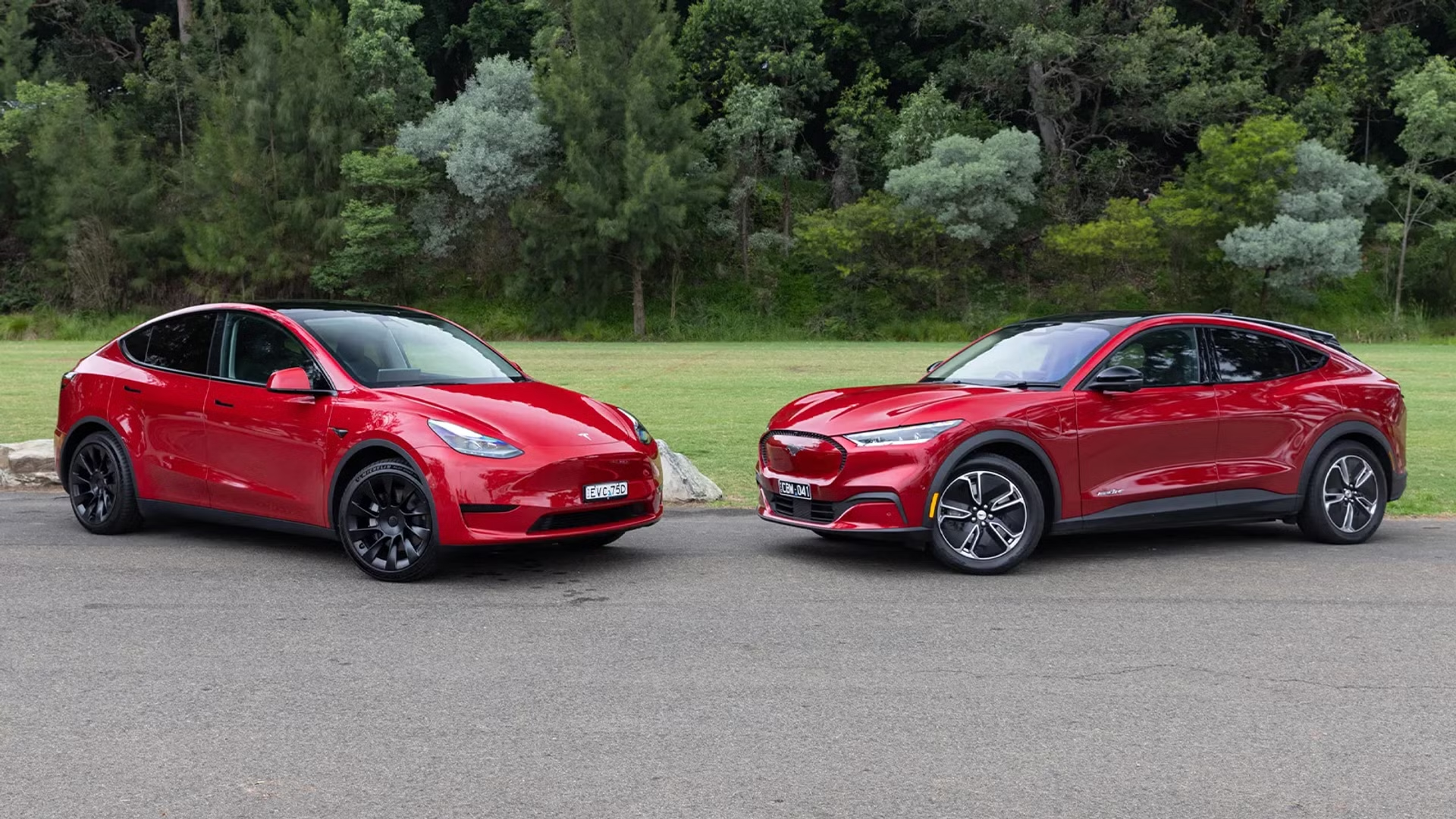
Range anxiety is the bogeyman of electric vehicles, and both the Model Y and Mach-E have wielded their respective battery arsenals to combat it. The Model Y’s Long Range variant delivers up to 330 miles on the EPA cycle, a figure that puts it in the upper echelon of EVs. The Mach-E’s extended-range model, meanwhile, tops out at 314 miles—a mere 16 miles shy, but enough to give Tesla fans a smug sense of superiority. Yet, range is only half the battle. Charging infrastructure is where the Mach-E flexes its corporate muscle.
Ford’s BlueOval charging network, in partnership with Electrify America, offers a vast and rapidly expanding grid of fast chargers. Tesla’s Supercharger network, while smaller in raw numbers, is unmatched in reliability and speed. A Model Y can add up to 200 miles of range in just 15 minutes at a Supercharger; the Mach-E’s peak charging rate of 150 kW pales in comparison. Here, Tesla’s first-mover advantage is undeniable. But Ford’s recent decision to open its charging network to non-Ford EVs (including the Model Y) could level the playing field—if it ever gains traction.
Interior: Minimalism vs. Materialism
Step inside the Model Y, and you’re greeted by a cavernous, almost monastic space. The dashboard is a single slab of glass, devoid of buttons, with a yoke-style steering wheel that polarizes drivers. The Mach-E, by contrast, embraces a more traditional layout, with physical toggles for climate control and a rotary gear selector that harks back to the Mustang’s glory days. Tesla’s interior feels like a spaceship designed by Jony Ive; the Mach-E’s feels like a lounge for gearheads.
Comfort is another battleground. The Model Y’s seats are supportive but firm, its ride quality unsettlingly stiff over rough pavement. The Mach-E, with its adaptive dampers and plush upholstery, cocoons occupants in a cloud of quiet luxury. The Model Y’s infotainment system is a marvel of integration, with games, streaming, and even a karaoke feature. The Mach-E’s SYNC 4 system is competent but clunky, a relic of Ford’s automotive past struggling to keep up with the future.
Practicality: Trunk Space and Towing Prowess
For families and adventurers, practicality is king. The Model Y offers 30 cubic feet of cargo space behind its rear seats, expandable to 76 cubic feet with the seats folded. The Mach-E counters with 29.7 cubic feet and 59.7 cubic feet, respectively—a difference that’s negligible in the grand scheme but noticeable when packing for a road trip. Both SUVs can tow up to 3,500 pounds, though real-world range drops precipitously when hauling heavy loads.
Where the Mach-E gains an edge is in its available third row—a rarity in the electric SUV segment. While cramped and best suited for children or occasional use, it’s a feature Tesla can’t match. The Model Y, meanwhile, offers a panoramic glass roof that floods the cabin with light, a small but significant luxury in an otherwise Spartan interior.
The Wildcard: Software and Over-the-Air Updates
This is where Tesla’s advantage becomes insurmountable. The Model Y is a rolling computer, capable of receiving over-the-air updates that add features, improve performance, and even enhance autopilot capabilities. The Mach-E, while not devoid of software, feels like a traditional car with a tech veneer. Ford’s BlueCruise hands-free driving system is impressive, but it’s a feature, not a lifestyle. Tesla’s ecosystem—from its mobile app to its gaming integrations—turns the Model Y into a digital playground. The Mach-E, by contrast, is a car first and a computer second.
Which SUV Truly Wins?
The answer, as with most things in life, depends on what you value most. If you’re a tech enthusiast, a road-tripper, or someone who craves the latest and greatest, the Tesla Model Y is the clear winner. It’s faster, more efficient, and endlessly customizable. But if you’re a traditionalist at heart, a driver who appreciates the tactile feedback of a physical gear shifter, or someone who needs a third row for the kids, the Mustang Mach-E offers a compelling alternative. It’s not just a car; it’s a statement—a bridge between the past and the future.
Ultimately, the Tesla Model Y and Ford Mustang Mach-E are both winners in their own right. One is the future, distilled into four wheels and a chassis. The other is the past, reimagined for a new era. The real question isn’t which SUV wins—it’s which one wins you.