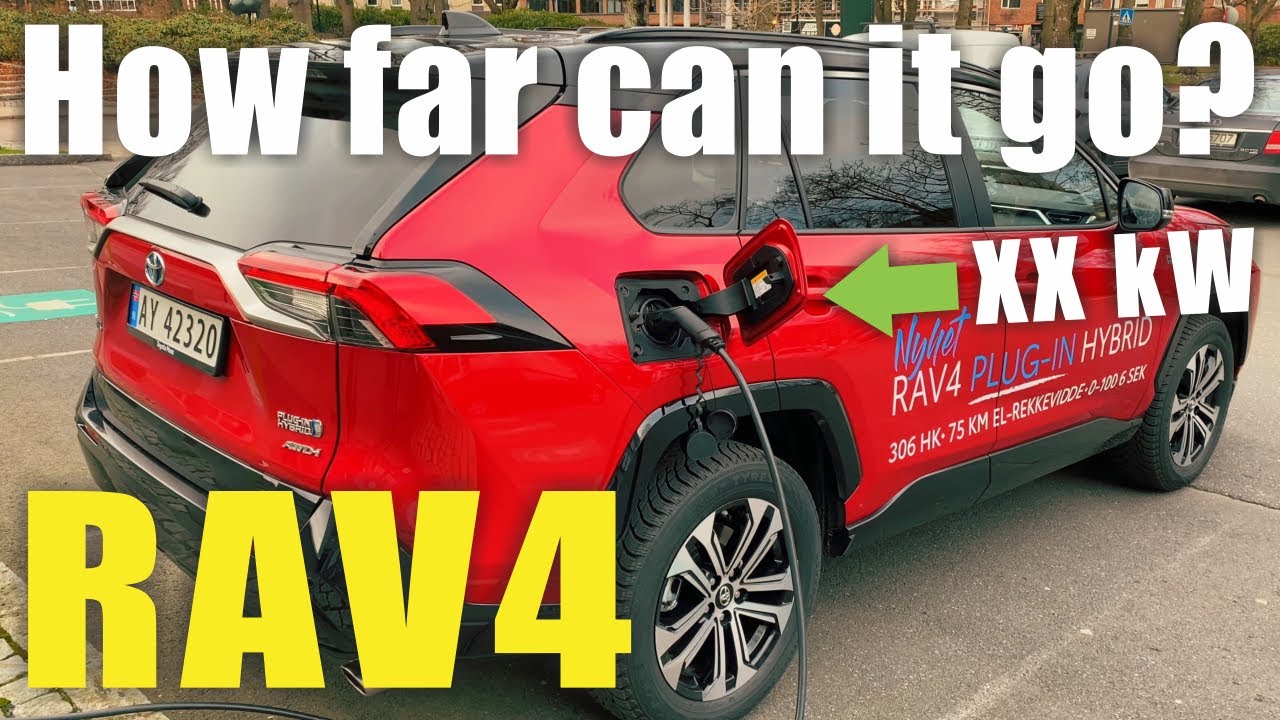
What happens when the “estimated” electric range meets the messy, everyday choreography of real roads—traffic lights, varying temperatures, highway gusts, and that one last errand you didn’t plan for? The Toyota RAV4 Prime, with its plug-in hybrid cleverness, invites exactly this kind of curiosity. Yet curiosity quickly turns into a small challenge: can you actually glide through a day on electrons alone, or will the battery’s enthusiasm fade faster than expected?
Today’s real-world electric range test isn’t about chasing a perfect number. It’s about stress-testing the experience—how the RAV4 Prime behaves when you stop treating range like a spreadsheet and start treating it like a living, breathing commute. Buckle in for a narrative walkthrough of conditions, driving styles, practical tactics, and the kinds of outcomes that feel far more honest than marketing promises.
Setting the Stage: What “Real-World” Really Means
Before any numbers appear, the environment has to be unmasked. Real-world electric range testing typically means running the vehicle under conditions that refuse to cooperate: inconsistent speeds, stop-and-go segments, hills that steal momentum, and weather that either coaxes or punishes efficiency. Even tire pressure, surface texture, and passenger load can tilt results.
In a PHEV like the RAV4 Prime, this matters even more. The car’s system blends electric drive with engine assistance, but your goal is to maximize distance before the gasoline engine becomes a frequent co-pilot. That makes your testing approach slightly different from a pure EV range test. You’re not merely measuring capacity—you’re observing when and why the vehicle decides it’s time to switch gears.

The Vehicle in Motion: EV Mode Behavior and Thresholds
The RAV4 Prime is designed to be intelligent, but intelligence has triggers. When you press into EV mode, the vehicle attempts to keep you in electric propulsion as long as conditions allow. However, the battery isn’t an endless reservoir of calm. It has boundaries, and those boundaries show up as changes in responsiveness, energy consumption, and the system’s willingness to maintain full electric operation.
Expect nuance. Gentle acceleration often yields long, serene EV stretches. Punchier throttle inputs can rapidly increase power draw, and the car may transition away from pure electric more quickly. In other words, your driving style becomes an invisible variable—like weather in a cooking recipe.
Route Design: City Thermodynamics vs Highway Aerodynamics
Any credible electric range test needs a route that reflects the way humans actually drive. A typical real-world scenario includes a combination of urban and suburban segments. City driving tends to be friendlier to EV range because the vehicle benefits from regenerative braking. Every stoplight becomes a chance to reclaim energy, turning deceleration into an ally rather than a tax.
Highway driving, meanwhile, is an aerodynamic gauntlet. Wind resistance rises with speed, and that means higher continuous power demands. Even if the RAV4 Prime is technologically sophisticated, physics is still the final judge. A highway portion can produce a noticeable step-down in how long EV propulsion lasts, especially under windy conditions or when speeds creep upward.
The most revealing tests mix these worlds—graceful city recovery paired with the steady grind of highway airflow. That contrast helps expose the car’s true balance between battery energy management and real transportation demands.
Temperature, Cabin Demands, and the Quiet Energy Thief
Temperature is a dramatic actor in range outcomes. Cold weather increases energy consumption for battery heating and can sap efficiency through thicker drivetrain lubrication and higher HVAC load. Heat also costs energy—though the mechanics differ. Either way, the cabin doesn’t want to be neglected. It wants comfort, and comfort has a price tag paid in kilowatt-hours.
Pay attention to how HVAC settings influence the experience. Fan speed, defrost usage, and the decision to prioritize seat heating can all alter consumption. A real-world test makes room for these realities. The car isn’t driving in a lab; it’s commuting through daily life where you might need defrost one moment and comfort cooling the next.

Charging Mindset: Starting Battery State and How It Shapes Results
Your battery isn’t a blank canvas. The starting charge level matters profoundly. Tests that begin with a full charge provide a more complete picture of usable EV distance. Still, the RAV4 Prime’s system may reserve some capacity for battery protection strategies. That means the distance you experience is practical range, not a raw mathematical maximum.
Additionally, the way you manage charging timing can influence results. Plugging in closer to departure can reduce the time the battery spends warming or cooling. In cold conditions, preconditioning practices can dramatically change the first stretch of driving—where consumption is often highest.
Energy Monitoring: Reading the Road Like a Translator
One of the most empowering parts of a range test is learning to interpret vehicle feedback. Energy screens, consumption estimates, and the “feel” of acceleration provide qualitative guidance. The goal is not obsession—it’s calibration. When the vehicle predicts range remaining, it’s attempting to forecast based on current patterns. If you drive differently than the forecast expects, the projection can swing.
So the challenge becomes an exercise in consistency. Smoothness extends EV operation. Abrupt maneuvers often shorten it. This is where the RAV4 Prime’s character emerges: it rewards intention. It also teaches humility. The road always has the final word.
Regenerative Braking: The Hidden Hero in Stop-and-Go Life
In city environments, regenerative braking can become a quiet superpower. When you anticipate stops and lift early, the vehicle captures kinetic energy. That captured energy then becomes additional electric propulsion later. It’s not magic, but it feels like it when you’re watching the efficiency trend improve.
To see the effect, think of your driving as choreography. If you brake late and hard, regeneration has less opportunity to work smoothly. If you coast with intention and brake progressively, regeneration can behave like a helpful assistant instead of a rushed accountant.
Hybrid Takeover: When the Gas Engine Joins the Conversation
Eventually, even the most disciplined EV effort may trigger engine assistance. The transition can happen due to battery state, power demand, or sustained speed. The most honest testing doesn’t treat engine engagement as a failure—it treats it as a meaningful datapoint.
In practice, the question becomes: how frequently does engine involvement occur, and how intrusive is it to your day? Some commuters may accept occasional engine assistance if the majority of miles are electric. Others may want near-pure EV behavior, especially for short local trips and school runs.
The RAV4 Prime offers flexibility, but its usefulness depends on driver expectations. Setting expectations correctly is part of mastering the range reality.
Practical Tactics to Extend Real-World EV Distance
Want to push your EV range closer to the optimistic end? Try a few disciplined moves. Use moderate acceleration. Maintain steady speeds on longer stretches. Plan routes with minimal stoplight density if you’re optimizing for highway efficiency, or maximize regenerative opportunity if you’re staying urban.
Consider tire condition and alignment. Efficiency is partly mechanical. Also, reduce unnecessary cargo when possible. Weight is an anchor, and anchors drag efficiency down.
Finally, treat energy consumption like an instrument panel story: small adjustments compound. One change might seem insignificant. But across 20, 30, or 40 miles, those little choices can become a noticeable shift.
The Challenge Question Revisited: Can You Make It Work?
So—back to the playful question. Can you drive a day using mostly electric power in the Toyota RAV4 Prime, without turning every errand into a mission? The answer depends on conditions, yes. But the broader truth is encouraging: with thoughtful driving, smart temperature management, and route awareness, the RAV4 Prime can deliver an electric commute experience that feels genuinely usable.
Yet the “challenge” remains real. If your route is fast, windy, cold, or heavy on HVAC, EV distance will shrink. If you accelerate like you’re late to a meeting, it will shrink faster. Range is not merely a number—it’s a relationship between vehicle systems and human behavior.
Wrap-Up: Turning Range Anxiety into Range Literacy
The most valuable outcome of an electric range test isn’t simply a final figure. It’s range literacy—knowing how the RAV4 Prime responds to your habits, your roads, and your weather. With that knowledge, the anxiety fades. Planning becomes effortless. And the car stops being a question mark and becomes a predictable partner.
In the end, the Toyota RAV4 Prime doesn’t ask you to be perfect. It asks you to pay attention. Follow the clues from the vehicle, respect the physics of speed and temperature, and you’ll discover how far the electric miles can truly stretch before the gasoline engine steps in.