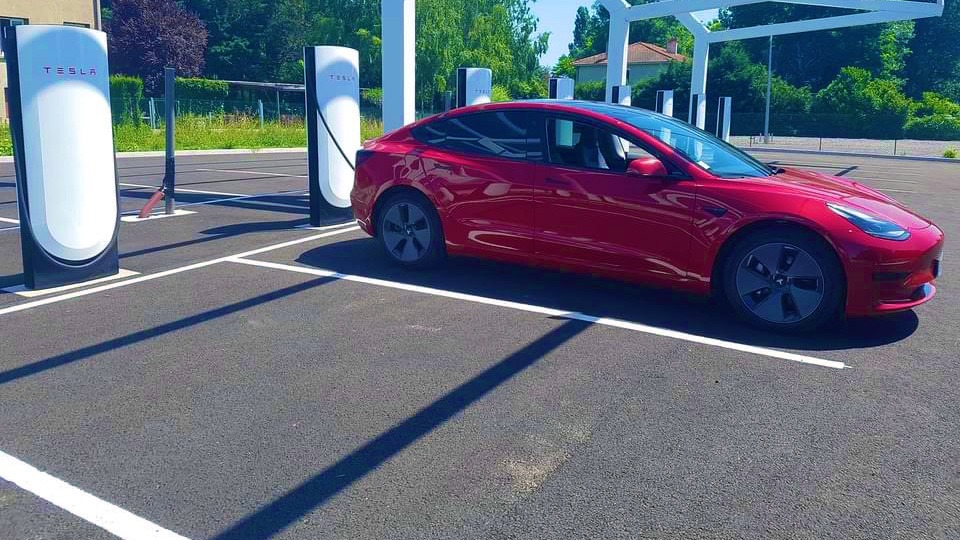
The Tesla Supercharger V4 has arrived, not with a whisper, but with a high-voltage hum that resonates through the electric vehicle ecosystem. For years, the promise of 350 kW charging has loomed like a distant horizon—tantalizing, yet just out of reach for most drivers. Now, with the first real-world installations emerging, the veil is lifting. What was once a speculative marvel is becoming a tangible reality. But why does this matter beyond the obvious? Beneath the surface of faster charging lies a deeper narrative about autonomy, infrastructure, and the evolving relationship between humans and machines.
Imagine pulling into a charging station not as a pause in your journey, but as a brief interlude—one where your vehicle replenishes energy at a rate that rivals the time it takes to refill a gas tank. This is the promise of the Tesla Supercharger V4. With a peak output of 350 kW, it doesn’t just charge; it transforms the act of refueling into a near-seamless extension of the driving experience. Yet, as with any technological leap, the fascination isn’t merely in the numbers. It’s in the unspoken implications: the way it reshapes travel patterns, redefines convenience, and challenges our perceptions of what’s possible.
The Birth of a New Charging Paradigm
The Supercharger V4 isn’t an incremental upgrade—it’s a paradigm shift. Traditional fast-charging stations, while revolutionary in their time, often left drivers tethered to the idea that charging must be a compromise. Long waits, even at high-power stations, were an accepted inconvenience. The V4 obliterates that notion. By delivering up to 350 kW, it can add up to 200 miles of range in just 15 minutes under ideal conditions. This isn’t just faster charging; it’s a redefinition of what “fast” means in the context of electric mobility.
What makes this possible is a combination of advanced power electronics, optimized thermal management, and Tesla’s proprietary architecture. The V4’s architecture is designed to minimize energy loss during transmission, ensuring that the bulk of the 350 kW reaches the battery rather than dissipating as heat. This efficiency isn’t just a technical achievement—it’s a psychological one. Drivers no longer need to mentally budget for charging stops; they can treat them as incidental, much like a quick coffee break during a road trip.

The implications extend beyond individual convenience. As charging times shrink, the psychological barrier to long-distance EV travel erodes. The fear of being stranded with a depleted battery—a concern that has long haunted prospective EV buyers—becomes less relevant. The V4 doesn’t just charge cars; it charges confidence in the electric future.
The Infrastructure Behind the Power Surge
Peering behind the curtain of the Supercharger V4 reveals a web of infrastructure that’s as intricate as it is innovative. To deliver 350 kW consistently, the charging network must be more than just a collection of high-power stalls. It requires a robust grid connection, advanced cooling systems, and a digital backbone capable of managing real-time power distribution.
Tesla’s approach to this challenge is rooted in its vertically integrated ecosystem. The company doesn’t just build chargers; it designs the entire ecosystem around them. This includes proprietary power management software that dynamically allocates energy based on demand, ensuring that even during peak usage, each vehicle receives optimal charging rates. The result is a network that feels almost alive—adapting, optimizing, and responding to the needs of its users in real time.
Yet, the infrastructure story isn’t just about technology. It’s about geography. The placement of V4 stations is strategic, targeting corridors where long-distance travel is most common. Highways, interstates, and popular tourist routes are prioritized, ensuring that the V4’s capabilities aren’t confined to urban centers. This isn’t accidental; it’s a calculated move to make electric vehicles as versatile as their internal combustion counterparts.
Consider the psychological shift this enables. Drivers no longer need to plan their routes around charging stations. Instead, they can focus on the journey itself, knowing that a high-power recharge is always within reach. This subtle change in mindset could be the catalyst that propels EVs into the mainstream consciousness.
The Human Element: Convenience Redefined
At its core, the Supercharger V4 is a study in human behavior. It addresses a fundamental truth: people don’t want to wait. Whether it’s at a gas station, a coffee shop, or a charging stall, the modern consumer values time above all else. The V4 caters to this instinct by turning a necessary task into a near-invisible one.
Imagine arriving at a V4 station after a few hours on the road. The car begins charging immediately, and within minutes, you’re back behind the wheel. There’s no need to linger, no need to calculate how much time to spare. The experience is fluid, almost imperceptible—a far cry from the days when charging an EV felt like a chore.
This convenience extends beyond the driver. Fleet operators, ride-sharing services, and commercial fleets stand to benefit immensely from the V4’s capabilities. For businesses that rely on vehicles, downtime is lost revenue. The V4 minimizes this downtime, allowing fleets to operate with unprecedented efficiency. It’s a silent revolution in logistics, one that could redefine entire industries.
Yet, the human element isn’t just about speed. It’s about trust. The V4’s reliability—its ability to consistently deliver high power without faltering—builds confidence in the technology. Drivers begin to see EVs not as experimental vehicles, but as dependable tools for everyday life. This trust is the foundation upon which the electric future is built.

The Broader Impact: Accelerating the Electric Transition
The Supercharger V4 isn’t just a product; it’s a statement. It signals Tesla’s commitment to pushing the boundaries of what’s possible in electric mobility. But its impact extends far beyond the company itself. It serves as a benchmark for the entire industry, challenging competitors to match or exceed its capabilities.
For other automakers, the V4 is both a benchmark and a wake-up call. If Tesla can deliver 350 kW charging today, what’s stopping others from following suit? The race to higher power outputs is on, and it’s a race that benefits everyone. As charging speeds increase, the appeal of electric vehicles grows, accelerating the transition away from fossil fuels.
This acceleration has ripple effects. Reduced dependence on gasoline translates to lower emissions, cleaner air, and a healthier planet. It also spurs innovation in battery technology, as manufacturers strive to keep pace with the charging infrastructure. The V4 isn’t just a charger; it’s a catalyst for change.
Yet, the broader impact isn’t limited to environmental or technological spheres. It’s also economic. The growth of high-power charging networks creates jobs, stimulates local economies, and fosters new business models. From maintenance technicians to software developers, the V4 ecosystem is a job creator in its own right.
The Future: What Lies Beyond 350 kW?
As impressive as the Supercharger V4 is, it’s merely a stepping stone. The relentless march of progress means that 350 kW will soon be the new normal, and the industry will set its sights on even higher power outputs. The next frontier? Megawatt-level charging, where vehicles can replenish their batteries in minutes rather than tens of minutes.
This isn’t science fiction. Companies like Tesla, along with startups and legacy automakers, are already exploring the possibilities. Imagine a future where an EV can charge from 10% to 80% in under five minutes. Such capabilities would blur the line between electric and internal combustion vehicles, making EVs the default choice for consumers.
The journey to this future will require collaboration across industries. Automakers, energy providers, and governments must work in tandem to build the infrastructure needed to support such high power levels. It’s a monumental task, but one that’s already underway.
For now, the Supercharger V4 stands as a testament to what’s possible when innovation meets ambition. It’s a reminder that the electric future isn’t a distant dream—it’s a reality that’s unfolding before our eyes. And as the technology evolves, so too will our relationship with mobility, transforming the way we move, the way we live, and the way we think about the world.
The Tesla Supercharger V4 is more than a technological marvel; it’s a harbinger of change. It challenges our assumptions, redefines convenience, and accelerates the transition to a cleaner, more efficient future. As the first 350 kW chargers come online, they don’t just power vehicles—they power a new era of mobility. And in that era, the road ahead looks brighter than ever.