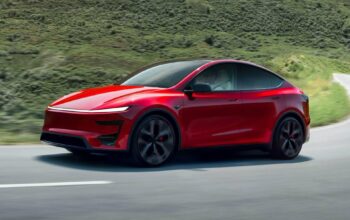
The Tesla Model Y Long Range has long been celebrated for its impressive EPA-estimated range, often touted as a benchmark for electric vehicle efficiency. Yet, as any discerning driver knows, real-world conditions rarely mirror the controlled environments of laboratory tests. The gap between EPA ratings and actual driving range is a subject of perennial fascination—and occasional frustration—for EV enthusiasts. Why does this discrepancy exist? And what does it reveal about the nature of electric mobility itself?
At first glance, the Model Y Long Range’s EPA range of 330 miles seems almost aspirational, a figure that promises freedom from the tyranny of charging stops. But the moment you step out of the showroom and onto the open road, the variables multiply. Temperature fluctuations, driving habits, payload weight, and even tire pressure conspire to reshape that pristine number. The question isn’t just about how far the car *can* go, but how far it *does* go under the messy, unpredictable conditions of everyday life. This tension between promise and reality is where the true story of the Model Y Long Range begins.
The Allure of the EPA Rating: A Benchmark Built on Illusion
The EPA’s range estimates are, by design, a standardized measure—a way to compare vehicles on a level playing field. They account for a mix of city and highway driving at a moderate 65°F, with no cargo, no passengers beyond the driver, and a battery preconditioned to optimal temperature. It’s a scenario as pristine as a showroom floor, devoid of the chaos that defines real-world driving. For the Model Y Long Range, this translates to 330 miles of theoretical travel, a figure that has cemented its reputation as a long-haul champion.
Yet, the EPA’s methodology is not without its critics. The test cycle, known as the FTP-75, was originally designed for internal combustion engines and later adapted for EVs. It assumes a fixed speed profile and neglects factors like aggressive acceleration, high-speed cruising, or the energy demands of auxiliary systems like climate control. In essence, the EPA rating is a theoretical maximum, not a practical guarantee. It’s the electric equivalent of a car manufacturer’s highway mileage claim—impressive on paper, but rarely achieved in practice. The Model Y Long Range’s EPA rating is no exception; it’s a starting point, not a destination.
Real-World Range: The Variables That Steal Miles
Step outside the controlled environment of the EPA test, and the Model Y Long Range’s range begins to wane. Temperature, for instance, is a silent range killer. Cold weather reduces battery efficiency by up to 30%, as chemical reactions slow and heating systems draw power. In subzero conditions, the Model Y’s range can plummet to 230 miles or less, a stark contrast to its summer performance. Conversely, extreme heat also takes a toll, though less dramatically, as the battery management system works to maintain optimal temperatures.
Driving style plays an equally pivotal role. The Model Y Long Range’s EPA rating assumes a gentle, steady pace—think a Sunday drive through the countryside. But real-world driving often involves stop-and-go traffic, rapid acceleration, and sustained highway speeds. Aggressive driving can slash range by 20-30%, turning a 330-mile promise into a 230-mile reality. Even something as mundane as tire pressure can make a difference; underinflated tires increase rolling resistance, forcing the motor to work harder and draining the battery faster.
Payload is another oft-overlooked factor. The EPA assumes a single occupant, but most drivers don’t travel solo. Adding passengers, luggage, or a roof rack increases weight, which in turn reduces range. A fully loaded Model Y Long Range might see its range drop by 10-15 miles, a seemingly small number until you’re 50 miles from the nearest charger. These variables don’t operate in isolation; they compound. A cold morning, a lead foot, and a trunk full of camping gear can collectively shave off a third of the car’s advertised range.
The Hidden Costs of Efficiency: Climate Control and Auxiliary Loads
EVs are often praised for their simplicity, but their auxiliary systems tell a different story. The Model Y Long Range’s range isn’t just sapped by propulsion; it’s also drained by the very conveniences that make electric driving appealing. Climate control, in particular, is a voracious consumer of energy. Heating in winter can reduce range by 15-25%, while air conditioning in summer might trim 10-20% off the total. Preconditioning the cabin while the car is still plugged in mitigates some of this loss, but not all.
Other auxiliary loads—like infotainment systems, seat heaters, or even the humble 12V battery—add up. The Model Y’s large touchscreen, while a marvel of modern design, is a constant power draw. Even the act of charging the phone via USB can chip away at the battery. These aren’t flaws; they’re the trade-offs of a vehicle that prioritizes comfort and connectivity. Yet, they underscore a fundamental truth about EVs: their efficiency is only as good as the systems that support it. The Model Y Long Range may boast a 330-mile EPA rating, but that number assumes minimal auxiliary usage—a condition few drivers can realistically meet.
Highway vs. City: The Range Paradox
Conventional wisdom suggests that EVs excel in city driving, where regenerative braking recaptures energy and stop-and-go traffic minimizes energy loss. The Model Y Long Range seems to defy this logic. On the highway, its range often exceeds expectations, thanks to its low drag coefficient and efficient motor. Yet, in stop-and-go traffic, the same car can see its range drop precipitously. Why? Because the EPA’s city cycle is designed for gentle acceleration and frequent braking, a scenario that aligns poorly with real-world urban congestion.
In practice, the Model Y Long Range’s highway range can approach 300 miles, while its city range might hover around 280 miles. The difference isn’t dramatic, but it’s enough to challenge the notion that EVs are inherently better suited for urban environments. The Model Y’s efficiency is a product of its aerodynamics and battery chemistry, not its driving environment. This nuance is often lost in the broader conversation about EV range, where city driving is frequently touted as the ideal scenario. The Model Y Long Range reminds us that efficiency is a multifaceted equation, one where the variables of speed, traffic, and terrain all play a role.
Charging Infrastructure: The Unseen Range Multiplier
Range anxiety isn’t just about how far the car can go; it’s about how far it can go between charges. The Model Y Long Range’s real-world utility is as much about its charging capabilities as its battery capacity. Tesla’s Supercharger network, with its widespread coverage and high-speed capabilities, transforms the car from a regional commuter into a long-distance traveler. A 30-minute Supercharger stop can add 170 miles of range, making a 600-mile road trip not just feasible, but almost mundane.
Yet, the charging experience isn’t without its frustrations. Not all Superchargers are created equal; some stalls may be occupied, others may be out of service, and a handful might not deliver the full 250 kW of power the Model Y Long Range can accept. The variability of charging infrastructure introduces a new layer of unpredictability. A driver accustomed to the Model Y’s 330-mile EPA rating might find themselves planning routes around charging stops, adjusting speeds to maximize efficiency, or even accepting longer travel times. The car’s range is only as good as the network that supports it—and in that network, the Model Y Long Range finds both its greatest strength and its most persistent challenge.
The Psychology of Range: Why the Discrepancy Fascinates Us
There’s something deeply human about the obsession with range. It’s not just about the numbers; it’s about the fear of being stranded, the desire for autonomy, and the thrill of pushing boundaries. The gap between EPA ratings and real-world range taps into a primal anxiety—one that internal combustion engines never fully resolved. Gas stations are ubiquitous; charging stations are not. The Model Y Long Range’s EPA rating offers a tantalizing promise of freedom, but the real world demands pragmatism.
This tension is what makes the Model Y Long Range so fascinating. It’s a car that embodies the contradictions of the electric revolution: a machine of extraordinary efficiency that’s still beholden to the same physical laws as every other vehicle. Its range is both a triumph of engineering and a reminder of the limits of technology. The EPA rating is a benchmark, but the real story is written in the miles between charges, in the choices drivers make, and in the infrastructure that shapes their journeys. The Model Y Long Range doesn’t just drive on roads; it drives on the hopes and fears of a world transitioning to electric mobility.
The Tesla Model Y Long Range’s real-world range may never match its EPA rating, but that’s not the point. The point is the journey—the way it challenges our assumptions, the way it forces us to confront the gap between promise and reality. In that gap, we find not just a measure of a car’s capabilities, but a reflection of our own relationship with technology, freedom, and the open road. The Model Y Long Range isn’t just a vehicle; it’s a mirror, and what it shows us is that the future of driving is as much about adaptation as it is about innovation.