On a sport sedan, the brakes are not merely hardware—they are the car’s way of speaking under pressure. A track day is a theater of speed where every lap rewrites the script, demanding shorter stopping distances, sharper modulation, and cooling that doesn’t blink. When the tires are singing and the steering is dialing in, the brake system becomes the quiet protagonist: absorbing heat, shedding it with disciplined urgency, and returning control with unwavering intent.
This is where brake & cooling tests earn their keep. Not as lab rituals, but as character studies. Each measurement reveals temperament. Each repeated stop is a test of endurance. And each cooling strategy—ducting, airflow management, heat cycling—determines whether your sedan remains a calm conductor or turns into a rattled percussion section.
The Track Day Truth: Braking Is a Heat Management Story
At the track, braking is less about peak power and more about thermal governance. You can have impressive friction materials on paper, yet find performance fading after a few laps. That fading is not a mystery; it’s a temperature conversation between pad compound, rotor metallurgy, and the way air reaches the braking surfaces.
Heat accumulates like a tide. The first braking event is eager and crisp, almost theatrical. Then the intervals shorten, and the rotor temperature climbs. As temperatures rise, pad coefficient of friction can shift—sometimes gradually, sometimes abruptly. Meanwhile, the rotor’s ability to store and redistribute heat becomes critical. The car feels it instantly: longer pedal travel, reduced bite, and a softer initial response that never fully recovers.
Brake & cooling testing aims to map that tide. It helps you identify the point where performance turns from confident to compromised. With the right data, you don’t guess—you anticipate. The sedan becomes predictable, and predictability is power.
Baseline Readiness: Pre-Test Mechanical Sanity Checks
Before any stop-from-speed drama, the foundation must be sound. A track-ready sedan starts with basics that can quietly sabotage endurance: caliper slide condition, piston seal health, pad bedding condition, rotor surface integrity, and correct fluid level.
Watch for subtle signs. Uneven pad transfer patterns can foreshadow rotor imbalance or caliper misalignment. Sticky caliper pins can turn cooling advantages into irrelevant trivia because the brake stays partially engaged. Even the brake fluid’s moisture content matters; as fluid absorbs water over time, it lowers boiling margin, leading to vapor lock and a spongier pedal.
Testing begins with a disciplined baseline. Measure cold brake pedal feel. Confirm tire pressures. Ensure wheel bearings and suspension don’t introduce vibration that forces the brakes to work harder. When the mechanical environment is controlled, the results become meaningful rather than coincidental.
Pad & Rotor Behavior Under Repeated Stops
Imagine the rotor as a flywheel and the pad as a percussion mallet. With each braking event, they trade energy. The rotor absorbs kinetic energy as heat, and the pad converts that energy into deceleration through friction. Under repeated stops, the system’s equilibrium becomes the real battleground.
During brake cooling tests, repeated braking runs are structured to simulate real track demands. Short runs reveal initial bite and modulation. Longer sequences expose heat soak behavior and the presence of pad glazing or rotor hot spots. The goal is to observe how quickly recovery occurs between braking zones—because on track, recovery time is not a theoretical concept; it is the gap before the next heavy braking.
Rotor thickness, vane design, and surface finish influence thermal distribution. Pads with aggressive compounds can offer dramatic bite but may require careful bedding to prevent uneven deposition. Bedding is not just a ritual; it is the process of creating a stable friction layer that behaves consistently under heat cycling.
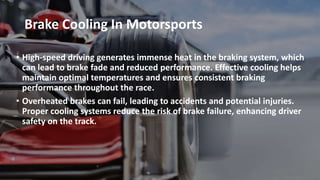
On test day, track drivers often describe the sensation with poetry: “The pedal feels like it’s remembering.” That “memory” is chemistry and structure working together—pad compound stability, rotor surface integrity, and the cooling flow that keeps them within a responsive temperature band.
Brake Fluid and Boiling Margin: The Pedal’s Safety Line
Brake fluid is the hydraulic courier of intent. As temperatures climb, fluid must resist boiling and vapor formation. Once vapor enters the system, compressibility increases, and the pedal becomes unpredictable. A track sedan can lose braking confidence not because friction is weak, but because hydraulics have turned into a thermal trampoline.
Brake cooling tests should therefore include thermal monitoring and fluid assessment. Fresh high-performance fluid with appropriate wet and dry boiling points strengthens boiling margin. But fluid performance is still only part of the system. Heat transfer from caliper to lines and the routing of hard lines can change how quickly temperatures rise.
In practice, the most informative metric is how the pedal behaves across repeated sessions. Does the pedal firm up after recovery? Does it drift longer into the travel range? Is there a delayed bite that appears after several laps? These are signatures of thermal stress and vapor risk.
Airflow Strategy: Ducts, Backplates, and Wheel-End Discipline
Cooling is not just about moving air—it’s about directing it where heat is born. The wheel-end is an aerodynamics puzzle. Rotors act like heaters; pads are the heat interface. If airflow bypasses the braking surfaces, you can have a powerful setup that still overheats.
Brake ducts are often the most visible solution, but effective cooling depends on placement, duct geometry, and sealing. Ducting should deliver airflow to the rotor hat or the inner rotor surface where heat concentrates, not merely to the caliper exterior. Backplate management helps ensure that air continues its path rather than spilling outward.
Track-day testing evaluates cooling efficacy with practical observations and thermal tools. A sedan may start with strong bite, then lose it as temperatures soar. Cooling improvements should flatten that decline, keeping response stable across laps.

When ducting works, the brake system stops feeling like a wildfire and starts acting like a camp stove—controlled, steady, and ready for the next sprint to the apex.
Heat Cycling and Material Stability Over a Full Session
Track days rarely consist of a single sprint. They are composed of repeated hot-and-cool cycles: a run, a pit lane, a restart, then another surge. This cycling matters because materials expand, friction layers evolve, and thermal gradients stress components.
During tests, observe consistency. Does the car repeatedly return to the same pedal effort after cooling? Are there changes in steering or vibration that indicate rotor warping or uneven thermal expansion? Rotor surface monitoring can reveal hot spots, while pad inspection can indicate glazing, uneven wear, or excessive transfer.
Heat cycling also affects noise and dust behavior. Some compounds generate significant particulates; others reduce dust but may demand temperature discipline. A track-ready sedan should be tuned for repeatable performance, not just peak excitement.
Performance Metrics That Actually Matter on Track
Numbers are valuable, but track relevance is everything. Brake tests should target metrics that reflect driving outcomes: stopping distance consistency, pedal travel evolution, and recovery time between braking events.
Using thermal probes or infrared measurement can help establish temperature trends across laps. Yet the most compelling indicator remains the driver’s sense of modulation. A brake system that provides consistent initial bite and stable progression makes the car easier to drive fast with confidence.
Consistency is the unique appeal of a properly tested track-ready sedan. It turns the car from a thrilling wildcard into a reliable instrument—one that lets you exploit traction rather than manage uncertainty.
Common Failure Modes: What Tests Reveal Before It’s Too Late
Brake cooling and track testing often uncover predictable issues. Caliper heat soak can lead to fade even when pads seem sufficient. Rotor hot spots can produce pulsing. Insufficient airflow can cause the brake system to drift beyond its optimal temperature band. Poor bedding or mismatched pad compound behavior can create a “false first lap”—excellent feel early, then a sudden drop in confidence.
Testing helps identify which problem you have, not just that you have one. It separates setup limitations from maintenance oversights and from cooling inadequacies. That distinction matters, because the fix for a hydraulic issue is different from the fix for thermal airflow failure.
Building a Track-Ready Loop: From Test to Tune
A cohesive track setup emerges from iterative refinement. Start with baseline checks. Evaluate brake response across controlled runs. Introduce cooling changes methodically—duct revisions, airflow sealing, or component swaps—then retest under similar conditions.
Each iteration should aim for a flatter performance curve. The best setups don’t merely survive heat; they manage it intelligently. Over time, the sedan’s braking becomes a repeatable ritual: brake hard, modulate smoothly, release with control, and return to speed without the lingering fear of fade.
In the end, that’s the essence of a track-day capable sport sedan. It doesn’t ask you to hope. It asks you to drive.
Outro: Brakes That Don’t Flinch
Brake & cooling tests are a form of trust-building between driver and machine. Heat is inevitable, but collapse is not. With disciplined testing, the sedan’s braking system becomes resilient—emotionally steady like a seasoned pilot, technically precise like a well-tuned instrument.
When the cooling strategy is right and the thermal behavior is mapped, your track day stops being a gamble. It becomes a sequence of confident decisions. And every lap feels less like a stress test and more like proof: that your sport sedan is ready for speed, ready for repetition, and ready to answer the next braking moment without flinching.