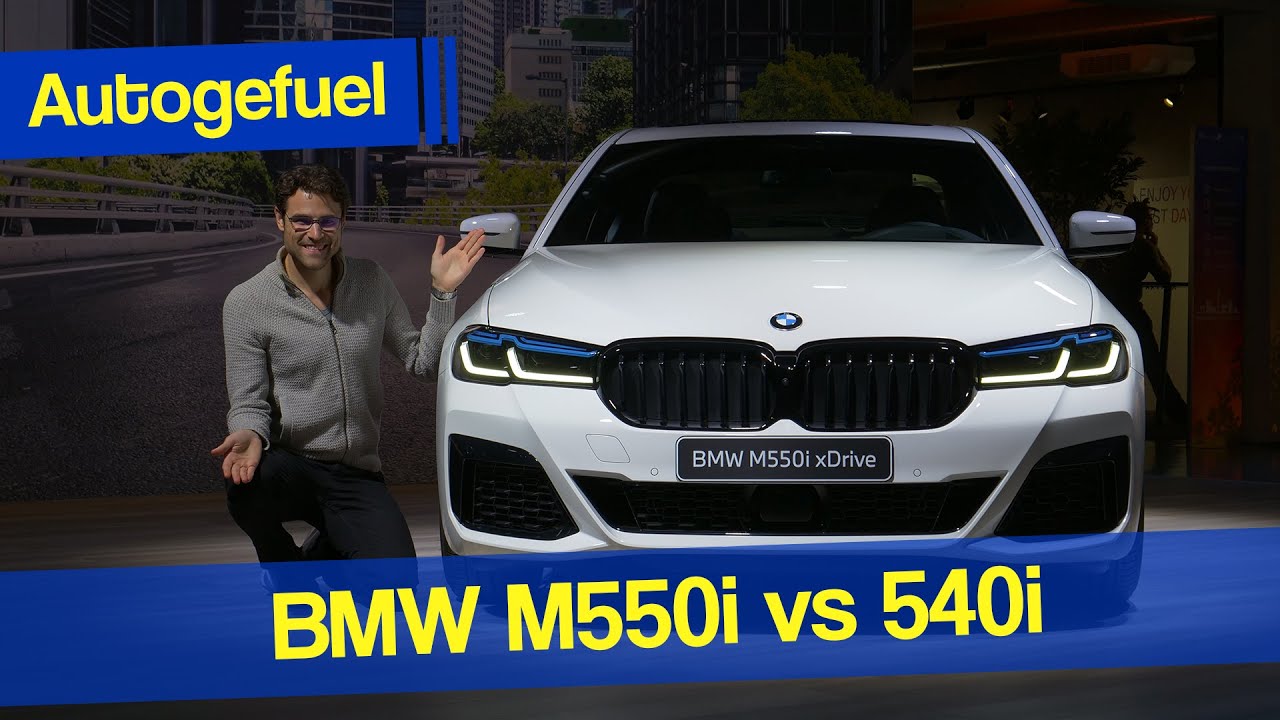
On paper, the BMW 540i xDrive and the BMW M550i look like members of the same electrified family—both sedans designed to feel composed at highway speeds and confident when roads begin to unspool into something more adventurous. Yet drivers often voice a curious refrain: “Why does the M550i feel more dramatic, even when I’m not chasing lap times?” It’s a question that sounds subjective, but it points to something practical—how each car parcels out power, traction, sound, and response over time. The fascination isn’t merely about faster numbers. It’s about the choreography of performance: how the car anticipates input, how it transmits torque, and how it turns momentum into emotion.
In this comparison, the question becomes less “Which is better?” and more “Which is more satisfying for the way you drive?” Because the 540i xDrive speaks in a language of balanced authority, while the M550i tends to lean into theatrical momentum—less about restrained confidence, more about a controlled crescendo. The gap between them can feel larger than spec sheets suggest, especially when you notice how the cars behave mid-corner, during passing maneuvers, and at the edges of everyday comfort.
Two Sedans, Two Philosophies of Speed
Both the 540i xDrive and the M550i are built to deliver a premium blend of comfort and thrust, but their temperaments differ. The 540i xDrive is often described as the “smooth operator.” It arrives with polished immediacy—pulling forward with minimal drama, then settling into a steady rhythm that feels almost predestined. Short bursts feel effortless, and longer acceleration runs can seem to stretch time, as if the car has all the traction in the world.
The M550i, meanwhile, tends to feel like performance with a pulse. Even before you measure acceleration, the car communicates intent. The throttle response can feel slightly more urgent. The way power arrives feels thicker, with a stronger sense of inevitability. It’s not just that it’s quicker; it’s that it sounds and feels like it wants to keep escalating.
This is the first common observation worth addressing: many people assume “more power” alone explains the M550i’s allure. The deeper truth is subtler. Vehicle dynamics are not simply horsepower and torque. They’re also packaging—the tuning of the transmission, the calibration of engine mapping, and the decisions made around driveline behavior under varying loads.
Power Delivery and the Art of Throttle Response
Acceleration isn’t a single event; it’s a sequence of sensations. The 540i xDrive typically offers a progressive surge—power that ramps in a controlled, nearly linear fashion. That can make it feel extraordinarily “civilized.” You can modulate it with a gentle pedal touch and still get satisfying forward motion. It’s the sort of response that makes everyday driving feel less like compromise and more like selection.
The M550i tends to compress that sequence. Torque arrives with a heavier presence, and the engine’s character often feels fuller at lower revs. The result is a more immediate shove that can make passing maneuvers feel like a switch being flipped. In practical terms, it means you can maintain a calmer speed in traffic and still have an assertive burst when the moment arrives.
But fascination isn’t only about immediacy; it’s about how the car remains coherent while accelerating hard. The 540i xDrive commonly shines in stability—where traction is delivered predictably and the chassis stays composed. The M550i often shines in momentum—where the car feels like it gathers speed with less effort from the driver, and the sensation of acceleration feels more continuous.
xDrive in Real Life: Traction, Torque Vectoring, and Confidence
Both cars carry xDrive, and that matters—especially if your local roads include uneven surfaces, damp pavement, or those deceptively slippery stretches where traction feels uncertain. The common observation is that both cars “feel planted.” Yet the deeper reason is how traction systems manage torque distribution and wheel slip across changing conditions.
When you accelerate, the driveline’s behavior is influenced by more than a simple split. The control strategy reacts to steering angle, throttle position, wheel speed changes, and transient dynamics. This is where the sedans can feel different despite being in the same AWD category.
The 540i xDrive often feels like it prioritizes composure. It tends to encourage an understated kind of confidence—steady acceleration, calm correction, and a smooth relationship between input and outcome. The M550i can feel similarly assured, but the sensation often arrives with more urgency and “pull,” particularly when you stand on the throttle. The chassis still stays composed, but the car feels more forceful in its willingness to accelerate immediately.
The fascination here is kinetic: xDrive doesn’t just prevent loss of traction. It makes performance feel available, not fragile. It turns potential speed into a usable experience.
Chassis Dynamics: Steering Feel and Cornering Poise
On a performance sedan, steering feel is more than feedback—it’s a communication channel. The 540i xDrive generally leans toward refined precision, with steering that can feel measured and predictable. You can place it on a line and expect it to hold with minimal fuss. That kind of balance is intoxicating for drivers who prefer speed without chaos.
The M550i typically feels more “eager,” which can be interpreted as more rotational energy. In the real world, that often manifests as a car that seems to want to change direction more assertively when you ask it to. The chassis can feel more active under load transitions, and the body control can feel more urgent—less like it’s simply managing physics and more like it’s playing with it.
Neither car is merely fast in a straight line. Both are engineered for high-speed stability and confident cornering, but the character differs: the 540i xDrive tends to reward smoothness, while the M550i rewards decisive inputs.
Braking and G-Force Credibility
Speed without braking confidence is a promise that never gets fulfilled. Both vehicles are designed to slow with authority, but the way they build braking confidence can feel distinct. The 540i xDrive often offers a reassuring, progressive pedal feel. It encourages trust because it doesn’t feel like it’s waiting to react—it reacts and continues to feel linear as you demand more.
The M550i tends to amplify the sense of deceleration. The effort can feel more forceful, and the transition from acceleration to braking can feel more dramatic. That drama can be exhilarating—especially when you’re accustomed to sedans that feel toned down in their stopping behavior.
In everyday driving, you feel it as “repeatable confidence.” You can slow from high speed without the pedal becoming vague or the car feeling overwhelmed. That’s part of why performance sedans become emotional vehicles rather than mere transportation appliances.
Ride Quality: Luxury Meets Performance Under Uneven Roads
Here’s where the comparison often surprises people. A more performance-oriented car doesn’t always mean a harsher ride, and a more balanced one doesn’t always mean more softness. The 540i xDrive frequently feels composed over pavement imperfections—absorbing irregularities with a sense of control that keeps cabin comfort intact. Small bumps feel filtered, and larger impacts are often handled with minimal disturbance to passengers.
The M550i usually retains that luxury focus while adding a layer of stiffness when the situation demands it. That’s the deeper fascination: it’s not simply “soft vs firm.” It’s about how the suspension calibrations balance comfort with body control. Under spirited driving, the M550i can feel more tightly governed, while in calm cruising it often returns to a comfortable demeanor.
Ultimately, ride quality is part of performance. A car that feels good at low speed stays more enjoyable when speed rises.
Sound, Smell, and the Emotional Architecture of Speed
Performance sedans have a sensory dimension that technicians can’t fully quantify. The 540i xDrive often delivers a cultured sound profile—pleasant, controlled, and rarely intrusive. It can make acceleration feel like an elegant statement.
The M550i often feels more evocative. The engine’s presence, the way it builds, and the tonal character can turn a normal drive into a personal event. Even if the objective numbers aren’t your obsession, the acoustics and vibration cues can shape your perception of responsiveness. This is why drivers sometimes feel more satisfied in the faster car even when they’re not using its maximum capability.
That sensory feedback is part of the car’s “emotional architecture.” It rewards engagement. It makes performance feel personal rather than mechanical.
Interior and Ergonomics: Who the Cars Are For
Both sedans are designed for long-distance comfort, but their identities can differ subtly in how the cockpit supports driver intent. The 540i xDrive tends to feel like a driver’s office—cleanly arranged, easy to inhabit, and friendly to commuting routines. The layout often encourages calm attention, and the car’s overall demeanor matches that lifestyle.
The M550i can feel more like a command center. It may invite a more assertive driving posture through its overall sense of urgency and readiness. When you step into it, the cabin can feel like it’s waiting for you to accelerate—waiting without impatience, but with enthusiasm.
Both are premium. The difference is the mood they set, and mood is a performance variable no spec sheet captures.
Real-World Scenarios: Passing, Merging, and Highway Tempo
In daily life, performance is measured in moments: merges at short sightlines, highway passing with limited gaps, and the need to change speed without drama. The 540i xDrive commonly excels in these scenes through smoothness. You can plan your maneuver and execute it with finesse, keeping the car stable and predictable.
The M550i can dominate these moments with immediacy. It often makes the choice to pass feel simpler, because the car seems ready to comply instantly. That’s where the fascination deepens—because quickness becomes not just speed, but certainty.
And then there’s highway cruising. The 540i xDrive tends to feel effortless, more about sustaining tempo than chasing it. The M550i can feel like it’s willing to raise tempo at any instant, turning a “relaxed drive” into a more dynamic one without requiring a change in your mindset.
So Which One Deserves Your Garage?
Choose the BMW 540i xDrive if you want a performance sedan that prizes balance—smooth power delivery, composed dynamics, and an elegance that never gets in the way. It’s for drivers who like speed but prefer it polished, structured, and repeatable.
Choose the M550i if you want velocity with a more theatrical personality. It’s for drivers who crave immediacy, want deeper emotional feedback from the drivetrain, and appreciate a car that feels eager even when you’re driving casually.
The common observation—“the M550i feels more exciting”—is real. The deeper reasons lie in how the car delivers torque, how the transmission and engine mapping coordinate under load, and how the chassis translates those forces into coherent motion. Fascination, in the end, is the sensation of capability becoming usable pleasure.
Conclusion: The Fascination Beyond Numbers
BMW’s performance sedans share the same fundamental aim: to fuse everyday usability with genuine thrill. Yet the 540i xDrive and the M550i approach that aim through different emotional pathways. The 540i xDrive feels like confident refinement, a car that rewards patience and precision. The M550i feels like a controlled crescendo, a vehicle that turns drive decisions into visible momentum.
Whichever you choose, the point isn’t only performance—it’s the way the car makes you feel while moving. In that sense, the comparison isn’t a contest of specs. It’s a study in fascination: how engineering choices become lived sensation, and how two similar sedans can make the road feel utterly different.