There’s a particular kind of automotive longing that only the smallest, sharpest hatches can summon. Not a dramatic, movie-montage kind of yearning. More like the quiet urge you feel when you spot a stunning car in a market you can’t access—an almost conspiratorial curiosity. The 2026 Mercedes-AMG A35 and A45 sit right in that zone. They’re not on American roads. They’re not in American showrooms. And yet, the moment they come into focus, the imagination starts doing overtime.
Why do these cars get under our skin so easily? People often point to horsepower figures, performance credibility, or the familiar AMG swagger. Those are real reasons. But there’s a deeper fascination happening—something about shape, precision, and the romance of engineered compact aggression. The A35 and A45 are compelling not just because they’re fast. They’re compelling because they feel intentional.
Compact Chaos, AMG Style
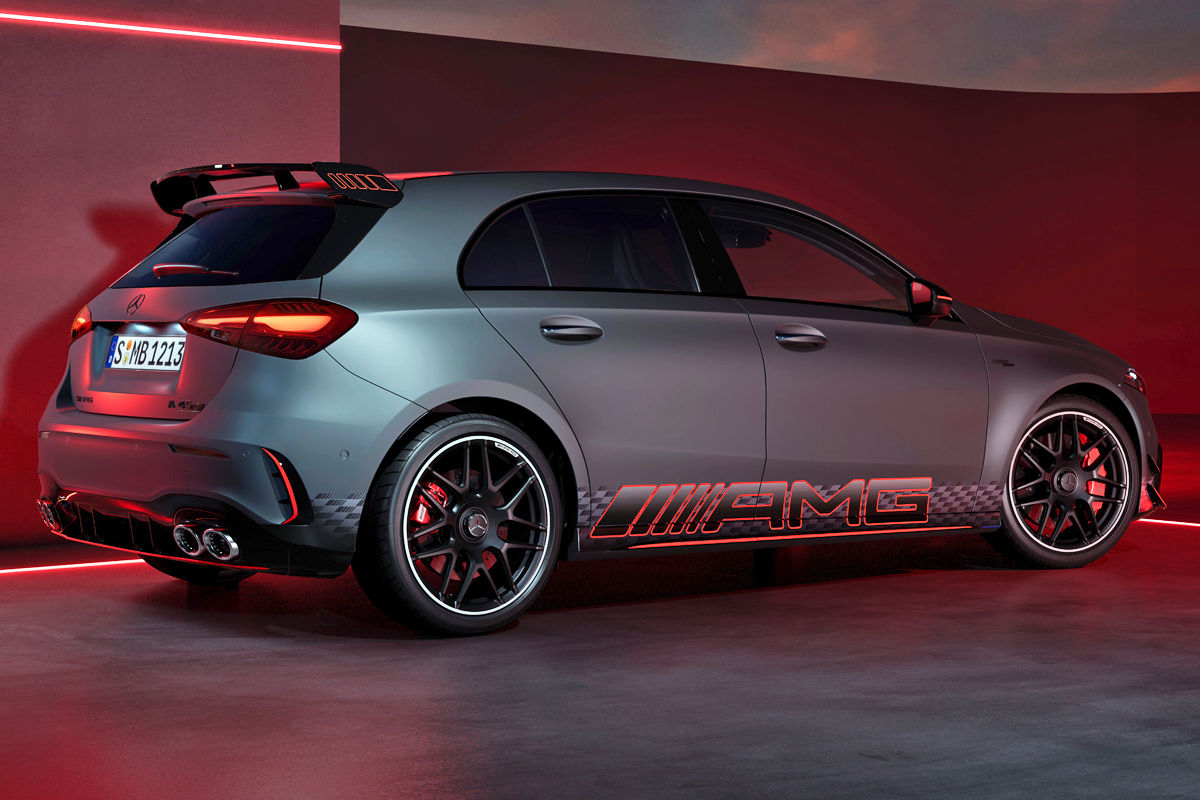
The first thing you notice about the A35 and A45 formula is how neatly it packages adrenaline. They’re hot hatches, yes—but not the kind that rely on brute force alone. These cars are built like pressure vessels: compact dimensions, disciplined chassis dynamics, and a drivetrain attitude that doesn’t ask permission before it delivers.
The A35 often gets viewed as the “more attainable” AMG option. That label is understandable, but it can underplay the real story. The A35 isn’t a watered-down AMG. It’s a sharply calibrated entry point into the AMG worldview. It carries the visual and mechanical intent—those subtle cues that signal you’re looking at something more than a badge and a spoiler.
Then the A45 arrives like an argument you can’t ignore. It’s the headline act. It’s the car that turns everyday parking lots into stage sets. Its performance character is famously emphatic, with an eagerness that borders on mischievous. It doesn’t just accelerate; it surges. It invites you to drive differently—more sharply, more attentively, more joyfully.

Not In The US: The Sting Behind The Absence
When enthusiasts say, “It’s not in the US, but we can dream,” they aren’t merely expressing impatience. They’re reacting to a gap in the market. America has a strange relationship with compact performance cars. We’re familiar with the concept of a hot hatch, but the landscape has been reshaped by SUVs, pickups, and a broader preference for higher seating positions and bigger cabins.
So the question becomes: why does the A35/A45 story not fit neatly here? The answer is rarely one single factor. It’s more like a tangled skein of regulations, corporate strategy, and brand positioning. Emissions standards, crash-test considerations, fuel economy targets—those details matter. Even more influential is whether a model will sell in meaningful numbers, not just attract attention.
Sometimes, a car can be adored yet still be deemed economically inconvenient. That’s the paradox that makes enthusiasts feel slightly haunted by the idea of a car they can’t buy. You’re not dreaming because the car is unknown. You’re dreaming because the car is known—and that makes the absence feel sharper.
The Fascination Is More Than Horsepower
Sure, power figures are a siren song. People love spec sheets. They love dyno bragging rights. But the A35/A45 fascination is also sensory. These cars tend to feel coherent: throttle responses that match your inputs, steering weight that communicates more than it moves, and chassis behavior that seems to keep its cool even when you’re not.
Hot hatches often offer performance, but the A35 and A45 cultivate a particular kind of mechanical confidence. The appeal is in the way they blend practicality with a performance edge that doesn’t feel performative. It feels like a tool—yet an exquisitely stylish one.
There’s also the aesthetic psychology. Compact cars can look surprisingly purposeful. They don’t need massive proportions to feel dramatic. In fact, their restraint makes the aggression more legible. The lines, the stance, and the aerodynamic cues create a visual rhythm that says: this is built to move.
A35 Vs A45: Two Flavors Of AMG Urgency
Choosing between the A35 and the A45 is like choosing between two musical moods. One is intense and focused. The other is intense and theatrical. Both are energizing, but the temperament differs.
The A35 is often the “daily-driver with claws” concept. It’s the car you can live with—commute in, park in tight spaces, and still feel the AMG mood whenever the road opens up. It’s a kind of controlled volatility. It’s the choice for someone who wants performance without making every outing feel like a test session.
The A45 leans further into the extreme end of the spectrum. It’s the option for drivers who want their compact car to act like a small weapon. The response character tends to feel sharper, more insistent. It’s not just about going fast; it’s about how aggressively the car seems to encourage you to drive with conviction.
And that’s where the deeper fascination lives. Many performance cars deliver straight-line speed. The A35/A45 duo delivers something rarer: a sense of collaboration between machine and driver. The car doesn’t just tolerate enthusiasm. It responds to it.
Where Would These Cars Fit? American Reality, Imagined
Imagine the parking lots of American cities reshaped by these hatches. Think about the first time someone notices the stance. Not the oversized, commuter-friendly look—something sleeker, lower, more precise. These cars would create a different kind of curb appeal. They’d also offer an alternative to the SUV-dominated performance narrative.
There’s a growing segment of drivers who want nimble handling, efficient compact packaging, and performance that doesn’t require a second mortgage. The A35/A45 could become poster cars for that desire. They’d appeal to those who find joy in corner entry, in braking discipline, in the satisfying click of downshifts. Enthusiasts don’t always want maximum size. Often, they want maximum meaning per square foot.
Of course, market realities would still shape pricing, availability, and service networks. But the dream isn’t irrational. It’s fueled by a genuine overlap between what these cars are and what many drivers quietly crave.
Why 2026 Specifically Feels Like A Fresh Opportunity
Every new model year carries the possibility of refinement—software tweaks, calibration improvements, styling updates, and the subtle “we listened” changes that enthusiasts love more than flashy headlines. The 2026 era carries that vibe: modernization without losing the aggressive core identity.
For a car like the A35, evolution is often about sharpening the daily usability while keeping the AMG aura intact. For the A45, it’s usually about making performance more tractable—less drama, more repeatability. In other words: faster is great, but usable speed is addictive.
The Real Reason We Keep Dreaming
There’s a habit enthusiasts have: chasing the feeling, not just the machine. The A35 and A45 represent a particular emotional recipe—compact aggression, refined engineering, and that distinctly European blend of practical form and performance intent. The reason they become daydream material is that they feel both reachable and forbidden.
They’re close enough to be exciting—visible in markets that exist—yet far enough from American roads to become legend-adjacent. That tension is fertile. It turns a car into a narrative object. People don’t merely want to buy it. They want to be part of the imagined reality where it’s sitting in their garage, ready to turn errands into little adventures.
And maybe that’s the most honest answer. The fascination isn’t only about what these cars do. It’s about what they represent: a different automotive philosophy, one that favors precision over bulk and excitement over compromise.
Final Thoughts: A Hype That Feels Like Hope
The 2026 Mercedes-AMG A35 and A45 may not be heading to the US in any immediate, guaranteed way. But that doesn’t drain their allure. If anything, the absence adds spice. We don’t just admire them—we project onto them. We imagine the sound, the acceleration, the steering feel, the daily practicality paired with a performance heartbeat.
In a world where many choices are oversized and homogenized, the A35/A45 dream feels refreshing. It’s compact, sharp, and unapologetically engineered. And somewhere between the specs and the longing, the real attraction becomes clear: it’s the belief that performance can be precise, stylish, and intimately fun—without needing to shout its presence.