Every generation has its unofficial yardstick—the car that turns a weekend drive into a small, satisfying argument. For American sports-car fans, that argument often curdles into a familiar refrain: “The Corvette is the grown-up, and the Mustang is the romantic.” It’s an easy story to tell. It fits on bumper stickers. Yet the moment you place a 2026 Corvette Stingray beside a Ford Mustang GT, the narrative becomes more textured than people expect. Short sprints invite one conclusion. City traffic invites another. Long highway stretches, the kind where fatigue quietly edits your opinions, reveal what you really came for: a duel of intent.
The fascination isn’t only about speed. It’s about what each car means. One suggests engineering as philosophy—precision, restraint, and relentless repeatability. The other suggests attitude as engineering—muscle, melody, and a certain unapologetic swagger. The common observation is that these two models compete for attention in the same consumer mindshare. The deeper truth is that they compete for a more intimate prize: identity.
Two Legends, Two Different Kinds of Confidence
Stand back and the contrast reads instantly. The Corvette Stingray carries itself like a scalpel—sharp edges, a low stance, and an aeronautical sense of purpose. It seems to ask for less interpretation. It wants to be driven with commitment.
The Mustang GT is confidence with a heartbeat. Its presence is broader, more rooted, more conversational. It doesn’t hide its inspiration. It feels like it was designed to be seen at a light, not merely clocked on a track.
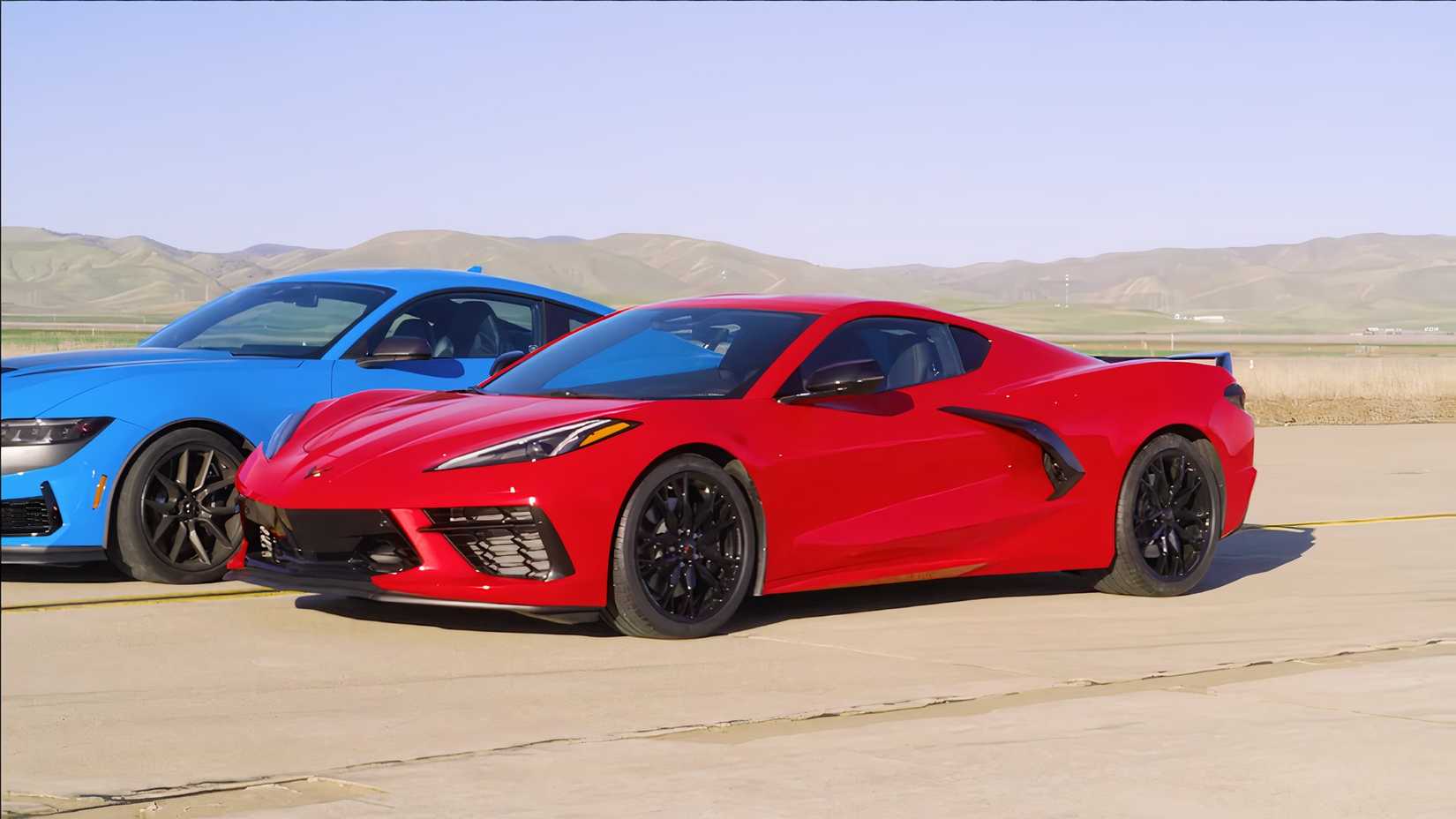
Here’s the common assumption: people pick the Corvette for numbers and the Mustang for vibes. But the truth is messier. The Corvette’s confidence can be emotional too—because it’s the emotion of control. The Mustang’s confidence can be technical, too—because it’s the satisfaction of raw, accessible performance.
Power Delivery: The Art of How It Reaches You
Performance isn’t just the peak. It’s the path. A car can be quick on paper and feel oddly reluctant in reality. Others can be strong everywhere, but strangely forgettable. The 2026 Stingray and the Mustang GT take divergent routes through the same landscape.
The Stingray’s personality tends to be linear in intention, aiming to deliver thrust with composure. When the engine wakes up, it often arrives with a measured authority—one that encourages smooth inputs and rewards patience. It’s the kind of power delivery that makes you feel like the car is listening.
The Mustang GT’s power delivery, by comparison, is typically more theatrical. The throttle response can feel immediate, almost insistent. It builds urgency, not just acceleration. Even when you drive gently, you can sense the muscle behind the curtain.
This is where fascination deepens. Enthusiasts aren’t only chasing faster times. They’re chasing a sensation of rightness—the moment the drivetrain, the transmission, and your right foot form a single agreement.
Handling and Chassis Feel: Precision vs Persuasion
Let’s address the observation that always comes up: “Corvette handles better.” In many cases, it’s true. But the real question isn’t whether it handles better. It’s how it communicates.
The Stingray’s chassis tuning often emphasizes stability under stress. The steering can feel crisp, and the suspension can work like a disciplined metronome—absorbing irregularities while keeping the car’s attitude coherent. You can drive harder without feeling like you’re negotiating with physics.
The Mustang GT typically offers a different kind of persuasion. It may not always match the Corvette’s composure at the absolute limit, but it can feel engaging in a more human way. Weight transfer can communicate clearly. Grip changes can feel readable. The chassis may invite you to participate, rather than simply execute.
There’s a reason drivers keep returning to that difference. Precision can be intoxicating. So can legible unpredictability—what some call “character,” though it’s really the sensation of feedback.
Braking, Heat, and the Discipline of Repetition
A sprint is one thing. Repetition is another. When you push performance, friction generates heat. Heat reveals weaknesses. A strong braking system isn’t only about stopping power; it’s about endurance and consistency.
The Corvette Stingray’s braking approach often targets repeated confidence. Pedal feel tends to be firm, and deceleration can remain predictable across multiple hard applications. That predictability matters because it changes your driving psychology. Instead of second-guessing, you can plan.
The Mustang GT can also deliver strong braking performance, but the experience can be more variable depending on configuration and driving style. When it’s dialed in, it’s impressive. When conditions change, the car can remind you that it’s still a muscle machine with its own priorities.
And that’s the fascination: some cars aim to be dependable instruments. Others aim to be bold storytellers. Both can be satisfying, but they satisfy different hungers.
Interior Atmosphere: Cockpit Philosophy
Inside, the duel becomes personal. The Stingray’s cabin often feels designed for focus—driver-centric layout, purposeful materials, and controls that encourage quick decisions. It’s a space meant to reduce distraction. The mood is almost cockpit-like, like the car expects you to be serious.
The Mustang GT’s interior has a different temperament. It can feel more expressive and more flexible—embracing the everyday as much as the spirited drives. It’s often the sort of cabin where you can commute, then switch into “drive mode” without feeling like you’ve climbed into a lab.
Common thought says these are luxury differences. Yet the deeper reason people obsess over interiors is emotional ergonomics. The cabin isn’t merely where you sit—it’s where your decisions become instinct.
Technology and Driver Aids: Assistance or Alibi?
Modern performance cars come loaded with systems: traction management, stability control, selectable driving modes, and predictive sensor networks. Critics sometimes frame these features as an alibi for lower mechanical involvement.
But in the real world, technology can be a translator. It takes raw intent—your throttle, your steering, your braking—and converts it into usable performance. The Stingray may lean toward precision orchestration. The Mustang may lean toward adaptability and ease, letting you choose how much intervention you want.
When both cars are configured well, driver aids don’t erase skill. They refine it. The result is not less passion, but more usable passion.
Sound and Sensation: The Non-Negotiable Ingredient
Cars are machines, yes. But American sports cars are also soundtracks. The Mustang’s appeal is frequently tied to its musicality—an engine note that feels iconic even when you’re not trying to impress anyone. It’s less about laboratory accuracy and more about presence.
The Corvette’s sound tends to feel more engineered—often sharper, more deliberate, sometimes with a mechanical bass line that arrives like punctuation at the end of a sentence. It’s the sound of intention, not improvisation.
This is why comparisons never settle. A person can like one car for its lap times and another car for its night drives. Neither preference is irrational. It’s simply tuned to different aspects of desire.
Who Wins the Duel? It Depends on What You Want to Be
If your goal is a car that rewards precision, repeatable confidence, and composed aggression, the 2026 Corvette Stingray fits that profile like a glove that actually measures your hand. It’s a machine for drivers who want their performance to feel inevitable.
If your goal is a car that delivers immediate character, everyday usability, and a visceral connection to horsepower culture, the Mustang GT makes a compelling case. It’s a machine for drivers who want performance to feel personal and loud—sometimes figuratively, sometimes literally.
The deeper reason the rivalry persists is that both cars offer an escape hatch from modern sameness. One escapes into technical clarity. The other escapes into expressive tradition. Each feels like rebellion against the idea that sports cars must all become the same.
Final Takeaway: The Fascination Is the Contrast
The 2026 Corvette Stingray vs Ford Mustang GT American sports-car duel isn’t just about which one is faster. It’s about how each car narrates speed—through chassis discipline, through power delivery, through sound, through the way a cabin shapes your mood.
So when the next conversation starts—“Corvette wins” or “Mustang wins”—listen for what people are really saying. They’re not only choosing performance. They’re choosing a feeling they want to live with: control or character, precision or persuasion. And in that choice, the rivalry stays alive.
At the end of the day, the most satisfying outcome is the one that keeps you curious. Drive both. Feel both. Let the differences sharpen your own preferences. The duel won’t end. It will simply evolve—into the next twist of American passion.