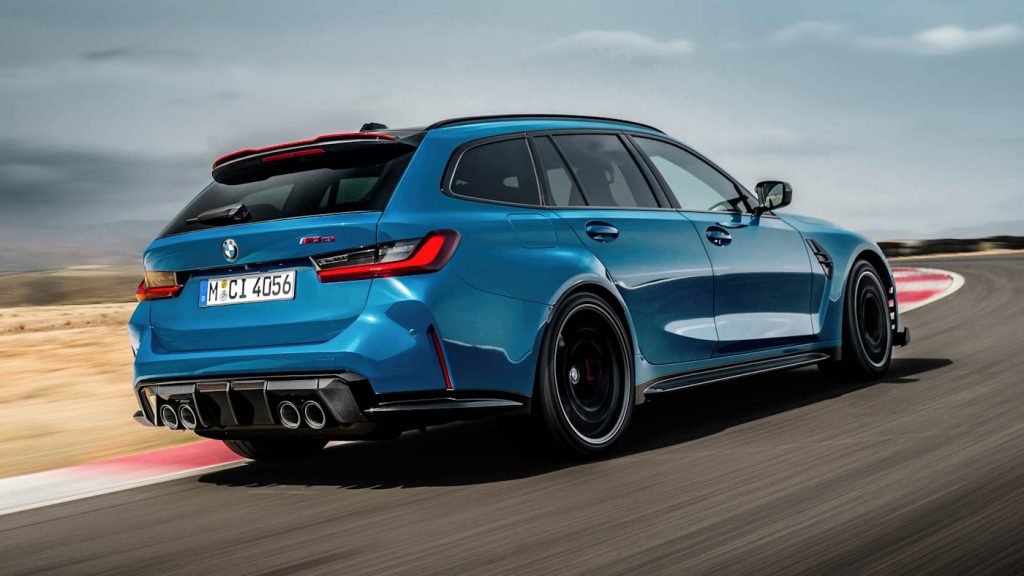
The automotive world is abuzz with whispers of a 2026 BMW M3 Touring making its way to the United States—a prospect that has enthusiasts clutching their pearls in disbelief. For years, American drivers have been forced to gaze longingly across the Atlantic, where the M3 Touring has been a staple of BMW’s performance lineup. But why has this wagon, with its blend of practicality and raw power, remained a European exclusive? The answer lies not just in market demands, but in the deeper currents of automotive culture, engineering philosophy, and the very identity of the M3 itself.
The M3 has always been more than just a car; it’s a statement. Born in the crucible of motorsport, the M3 lineage has evolved from a homologation special into a symbol of driving purity. The Touring variant, with its extended roofline and elongated cargo hold, adds a layer of versatility that seems almost antithetical to the M3’s purist roots. Yet, it’s this very contradiction that makes the wagon so compelling—a fusion of track-ready aggression and daily-driver pragmatism.
The M3 Touring: A European Enigma
For over a decade, the M3 Touring has been a fixture in Europe, where its blend of performance and practicality aligns perfectly with the demands of enthusiasts who also need to haul skis, golf clubs, or a week’s worth of groceries. The wagon’s elongated silhouette doesn’t just hint at extra cargo space; it embodies a philosophy of adaptability, a rejection of the one-dimensional sports sedan in favor of a machine that can dominate both the autobahn and the supermarket parking lot.
Yet, in the United States, the M3 Touring has remained conspicuously absent. The reasons are manifold. Market segmentation plays a role—American buyers have historically favored SUVs and crossovers, relegating wagons to the realm of the utilitarian. The M3, with its performance pedigree, has always been positioned as a premium sports sedan, and introducing a wagon variant risks diluting its exclusivity. There’s also the matter of brand perception; BMW’s M division has cultivated an image of razor-sharp focus, and a wagon might seem like a departure from the M3’s core identity.
But these are surface-level explanations. The deeper truth lies in the cultural divide between Europe and America. In Europe, the wagon is a symbol of efficiency and versatility, a car that can adapt to the demands of both work and play. In America, the sedan has long been the default choice for enthusiasts, with wagons relegated to the realm of the practical or the obscure. The M3 Touring challenges this status quo, forcing a reconsideration of what an M car can—and should—be.
The Engineering Marvel Beneath the Sheet Metal
If the M3 Touring does arrive in the U.S., it won’t be a mere badge-engineered afterthought. The wagon variant is a testament to BMW’s engineering prowess, where every component is optimized for both performance and utility. The extended roofline isn’t just a styling flourish; it’s a carefully considered design choice that improves aerodynamics while maximizing interior space. The rear seats, though not as cavernous as those in a traditional wagon, offer surprising comfort for a performance car, while the extended cargo area provides enough room for everything from a set of golf clubs to a weekend’s worth of luggage.

The powertrain is where the M3 Touring truly shines. Rumors suggest that the 2026 model will retain the twin-turbocharged inline-six engine found in its sedan counterpart, but with subtle tuning to accommodate the wagon’s altered weight distribution. The result? A car that delivers the same spine-tingling acceleration and razor-sharp handling as the sedan, but with an added layer of versatility. The adaptive suspension, a hallmark of M division engineering, ensures that the wagon remains composed even when laden with cargo, while the rear-wheel-drive bias (or optional xDrive all-wheel drive) keeps the driving experience engaging and dynamic.
But perhaps the most intriguing aspect of the M3 Touring’s engineering is its ability to balance performance with practicality. The wagon’s extended wheelbase and revised suspension geometry contribute to a more planted ride, reducing body roll and improving high-speed stability. Meanwhile, the clever packaging of the drivetrain and exhaust system ensures that the wagon retains the M3’s signature growl, a symphony of mechanical excellence that’s as much a part of the M3 experience as its acceleration.
The Cultural Shift: Why Now?
The question isn’t just whether the M3 Touring will come to America—it’s why now? The automotive landscape is undergoing a seismic shift, with a growing chorus of enthusiasts demanding cars that can do more than just sit in a garage on weekends. The rise of the “shooter” wagon—a term coined to describe performance-oriented wagons that blend the thrill of a sports car with the utility of a family hauler—has paved the way for the M3 Touring’s potential arrival.
Brands like Audi with its RS6 Avant and Mercedes with its E63 S Wagon have already proven that there’s a market for high-performance wagons in the U.S. These cars cater to a niche but passionate segment of buyers who refuse to compromise between performance and practicality. The M3 Touring, with its storied lineage and engineering pedigree, would slot perfectly into this ecosystem, offering a more accessible entry point into the world of performance wagons.
There’s also the matter of BMW’s own evolving strategy. The company has been steadily expanding its M lineup in the U.S., with models like the M2 Competition and M8 Competition finding eager buyers. The M3 Touring would represent a natural evolution of this strategy, appealing to a broader audience while reinforcing BMW’s commitment to driving pleasure. Moreover, the growing popularity of electric vehicles has forced automakers to rethink their approach to performance, and the M3 Touring’s internal combustion engine could serve as a bridge between tradition and innovation.
The Driving Experience: A Symphony of Power and Precision
To drive an M3 Touring is to experience the best of both worlds. The moment you slide behind the wheel, the cabin envelops you in a cocoon of premium materials and driver-focused ergonomics. The steering wheel, wrapped in perforated leather and adorned with M-specific stitching, sits at the perfect angle, while the digital cockpit displays a wealth of information with surgical precision. The engine burbles to life with a deep, resonant growl, a sound that’s as much a part of the M3 experience as the car’s acceleration.

On the road, the M3 Touring is a revelation. The extended wheelbase and revised suspension geometry lend the car a sense of stability and composure that’s rare in performance sedans. The steering, direct and communicative, transmits every nuance of the road surface, while the adaptive suspension soaks up imperfections with ease. The twin-turbocharged inline-six engine delivers a surge of power that’s both linear and explosive, propelling the car from 0-60 mph in a blur of speed and sound. The eight-speed automatic transmission shifts with the precision of a Swiss watch, ensuring that every gear change is seamless and effortless.
But it’s on a twisty backroad where the M3 Touring truly comes alive. The car’s rear-wheel-drive bias (or optional xDrive) allows for controlled drifts and power slides, while the limited-slip differential ensures that power is distributed evenly to the rear wheels. The brakes, massive and fade-resistant, haul the car down from triple-digit speeds with ease, while the adaptive dampers keep the car planted through corners. The result is a driving experience that’s as engaging as it is exhilarating—a car that rewards skill and punishes complacency.
The Future: A New Era for the M3?
The arrival of the 2026 BMW M3 Touring in the U.S. would mark a turning point in the car’s storied history. It would signal a shift in the automotive landscape, one where performance and practicality are no longer mutually exclusive. It would challenge the status quo, forcing enthusiasts to reconsider what an M car can—and should—be. And it would reaffirm BMW’s commitment to driving pleasure, proving that the M3’s legacy is far from over.
Of course, there are challenges ahead. The M3 Touring would need to carve out its own identity in a market that’s still skeptical of wagons. It would need to prove that it’s more than just a sedan with a stretched roof. And it would need to deliver on the promise of performance, practicality, and prestige that has defined the M3 for generations. But if there’s one thing the M3 has always done, it’s defied expectations. From its humble beginnings as a homologation special to its current status as a benchmark for performance sedans, the M3 has never been content to play by the rules.
The 2026 M3 Touring could be the next chapter in this remarkable story—a chapter that redefines what it means to be an M car. And if that happens, American enthusiasts will finally get the chance to experience the magic of the M3 Touring for themselves. The road ahead is long, and the challenges are many. But if the past is any indication, the M3 Touring will rise to the occasion, proving once again that greatness isn’t just about power—it’s about passion, precision, and the relentless pursuit of perfection.