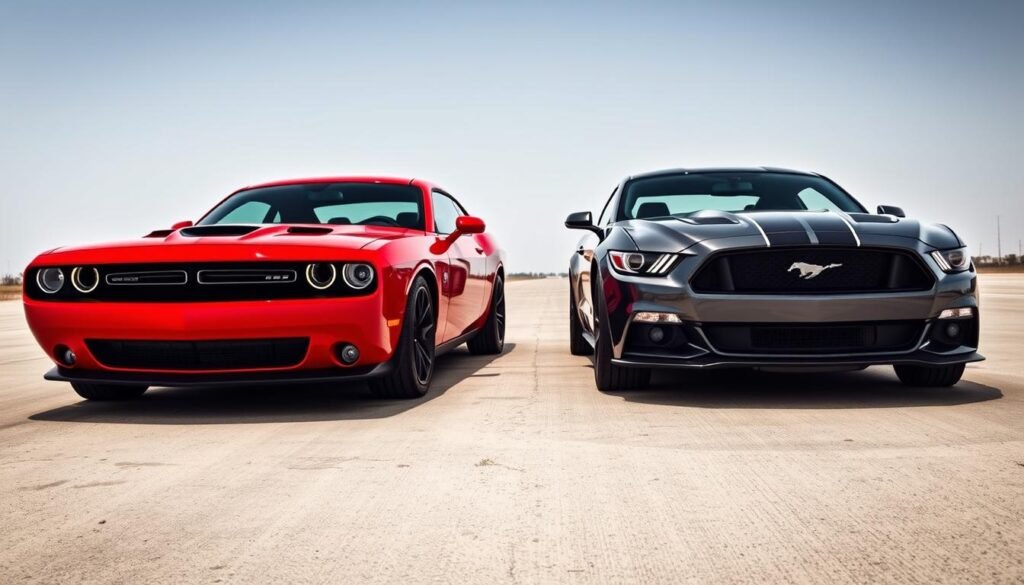
The Ford Mustang GT and Dodge Challenger R/T are titans of the American muscle car universe—two legends locked in an eternal duel for supremacy. One is a sleek, modern-day thoroughbred, its lines whispering of precision engineering and track-bred agility. The other is a brute-force relic of a bygone era, its aggressive stance and raw power evoking the golden age of V8 dominance. When these two V8-powered titans collide, the result isn’t just a comparison—it’s a visceral, unapologetic celebration of American automotive passion. Buckle up. This isn’t just a race. It’s a war.

The Heart of the Beast: Powertrain Showdown
At the core of this rivalry lies the engine—a thunderous, fire-breathing V8 that defines what it means to be a muscle car. The Ford Mustang GT wields a 5.0L Coyote V8, a masterpiece of modern engineering. With 486 horsepower and 414 lb-ft of torque, it’s not just fast; it’s surgically precise. The Coyote’s dual overhead cams, high-flow heads, and advanced fuel injection system deliver power with surgical efficiency, making it a track-ready predator disguised as a pony car.
Across the battlefield, the Dodge Challenger R/T counters with its legendary 5.7L HEMI V8. A name synonymous with raw, unfiltered power, the HEMI churns out 375 horsepower and 410 lb-ft of torque. But here’s the twist: the HEMI isn’t just about numbers. It’s about character. The deep, guttural growl of its exhaust, the way it shudders under acceleration, the sheer audacity of its presence—it’s a rolling symphony of mechanical defiance. The Coyote may be more refined, but the HEMI is the kind of engine that makes neighbors call the cops.
For those craving even more brutality, the Challenger offers the 6.4L HEMI V8 in the Scat Pack trim, pumping out 485 horsepower and 475 lb-ft of torque. It’s a monster that laughs in the face of speed limits and common sense. Meanwhile, the Mustang GT can be pushed further with the optional 5.2L supercharged V8 in the Shelby GT350, delivering 526 horsepower and a scream that could wake the dead. This isn’t just a comparison of engines—it’s a clash between precision and primal force.
Handling the Beast: Chassis and Dynamics
Power is nothing without control, and here’s where the Mustang GT flexes its modern muscles. Built on Ford’s rear-wheel-drive S550 platform, the GT boasts an independent rear suspension, adaptive dampers, and a finely tuned chassis that clings to the tarmac like a race car. The steering is razor-sharp, the body control is surgical, and the way it dances through corners is nothing short of balletic. It’s a car that rewards skill, a machine that whispers to the driver: *You are in control.*
The Challenger R/T, on the other hand, is a rolling anachronism—a time capsule of 1970s muscle car philosophy. Its body-on-frame construction and solid rear axle hark back to an era when handling was an afterthought. But don’t mistake its vintage roots for weakness. The Challenger’s sheer size and weight (over 4,000 lbs) make it a lumbering beast in tight corners, but its long hood and short deck give it a commanding presence on the straight and narrow. It’s not a car for slaloms—it’s a car for straight-line terror.
For those seeking a middle ground, the Challenger Scat Pack and Mustang GT with the Performance Package offer a compromise. Stiffer springs, upgraded brakes, and larger wheels help tame the beast, but the fundamental differences remain. The Mustang is a scalpel; the Challenger is a sledgehammer. Choose your weapon wisely.

Design Philosophy: Beauty or Brutality?
The Mustang GT is a study in modern elegance. Its sculpted body, LED lighting, and aggressive grille are a nod to its pony car heritage, but the lines are sharp, the proportions are balanced, and the overall aesthetic is undeniably contemporary. It’s a car that looks fast even when it’s parked—a testament to Ford’s ability to blend performance with style.
The Challenger R/T, in contrast, is a rolling declaration of war. Its long hood, wide stance, and menacing grille are a throwback to the muscle cars of yesteryear, a deliberate rejection of subtlety. The Challenger doesn’t just exist in the world—it demands attention. The retro-inspired interior, with its retro-styled gauges and bold accents, reinforces the theme: this is a car that doesn’t care about trends. It’s here to dominate.
One is a modern masterpiece; the other is a vintage icon. The Mustang GT appeals to those who appreciate finesse, while the Challenger R/T speaks to those who crave unapologetic aggression. The choice isn’t just about performance—it’s about identity.
Interior: Luxury or Legacy?
Step inside the Mustang GT, and you’re greeted by a cabin that blends modern comfort with sporty functionality. The seats are supportive, the materials are high-quality, and the infotainment system is intuitive. It’s a space designed for long drives and spirited runs alike, with a focus on driver engagement. The digital instrument cluster and available 12-inch touchscreen are nods to the future, but the overall feel is distinctly human.
The Challenger R/T’s interior is a different beast entirely. The retro styling is charming, the materials are solid, and the overall ambiance is one of unbridled nostalgia. But it’s also a space that feels dated in places—the cheap plastics, the awkward button placement, the lack of modern amenities. It’s a cabin that prioritizes character over comfort, a rolling museum piece that refuses to evolve.
For those who value cutting-edge tech and refined interiors, the Mustang GT is the clear winner. But for those who crave the raw, unfiltered charm of a bygone era, the Challenger R/T offers a unique kind of magic.
Price and Value: Bang for Your Buck
Price is where the two titans diverge most starkly. The base Mustang GT starts around $38,000, a price that includes modern amenities, impressive performance, and a level of refinement that’s hard to match. Even the Shelby GT350, with its supercharged V8, starts under $60,000—a steal for the performance on offer.
The Challenger R/T, meanwhile, starts at around $36,000, but that’s just the beginning. The Scat Pack pushes the price to $45,000, and the Hellcat—with its supercharged 6.2L V8—starts at a whopping $70,000. For the money, you’re getting raw power and vintage charm, but you’re also sacrificing modern refinements and fuel efficiency.
If value is your priority, the Mustang GT is the smarter choice. But if you’re willing to pay a premium for a rolling piece of automotive history, the Challenger R/T is a compelling alternative.
The Verdict: Which One Wins the War?
So, which one emerges victorious in this V8 showdown? The answer, as with all things in life, depends on what you value most.
If you crave modern performance, razor-sharp handling, and a refined interior, the Ford Mustang GT is your steed. It’s a car that rewards skill, a machine that blends the best of the past and present into a cohesive whole. It’s fast, it’s fun, and it’s built for the future.
But if you’re drawn to the raw, unfiltered power of a bygone era, if you want a car that turns heads and makes jaws drop, the Dodge Challenger R/T is your champion. It’s a brute-force relic of a time when power was king and subtlety was for cowards. It’s not the fastest, not the most agile, but it’s the most unforgettable.
In the end, this isn’t just a comparison between two cars. It’s a clash between two philosophies of performance. The Mustang GT represents the future of muscle cars—refined, precise, and relentless. The Challenger R/T embodies the spirit of the past—unapologetic, brutal, and timeless.
So, which side are you on? The scalpel or the sledgehammer? The precision or the primal force? The choice is yours. Just remember: in this war, there are no losers—only legends.