The automotive world has long been enchanted by the idea of an electric wagon—a vehicle that marries the practicality of a station wagon with the silent, instant torque of an electric powertrain. Yet, for years, this dream remained just out of reach, overshadowed by the dominance of SUVs and sedans in the EV space. But whispers in the industry, coupled with a recent surge in concept reveals, suggest that the 2026 Audi A6 e-tron Avant might just be the electric wagon we’ve been waiting for. This isn’t merely another EV announcement; it’s a potential paradigm shift, one that could redefine what we expect from electric luxury and, perhaps, from the very concept of the family car itself.
Why does the idea of an electric wagon hold such allure? It’s not just about the practicality—though the A6 Avant’s spacious interior and adaptable cargo area are undeniable draws. There’s something deeper at play here, a cultural and emotional resonance that transcends mere utility. The wagon, after all, is a symbol of versatility, of journeys both mundane and extraordinary. It’s the car that can ferry your children to soccer practice on a rainy Tuesday and then whisk you away to a mountain retreat come Friday. In an era where electric vehicles are often criticized for their perceived limitations—range anxiety, charging infrastructure, the “boring” perception of EVs—an electric wagon promises to shatter those stereotypes. It’s a vehicle that says, “I can do it all, and I can do it better.”
The Return of the Avant: Why Wagons Never Really Left
To understand the significance of the A6 e-tron Avant, we must first acknowledge the wagon’s storied past. The Audi Avant, in particular, has long been a benchmark for station wagon excellence, blending German engineering precision with a sense of understated elegance. Yet, as the automotive landscape shifted toward SUVs in the 2010s, wagons seemed to fade into the background. But they never truly disappeared. Enthusiasts clung to them, and automakers like Audi quietly refined their offerings, knowing that the right moment would come to reintroduce them to the mainstream.
The 2026 A6 e-tron Avant represents that moment. It’s not just an electric version of a familiar body style; it’s a reinvention. The Avant name itself carries weight—it’s a nod to tradition, but the e-tron suffix signals a leap into the future. This is a car that understands the past while hurtling toward the future, a rare balance in an industry often divided between nostalgia and innovation. The wagon’s elongated roofline, its sweeping lines, and its expansive glasshouse aren’t just aesthetic choices; they’re a statement. They say, “We see you. We know what you need.”
Design: Where Form Meets Function in Electric Elegance
The A6 e-tron Avant’s design is a masterclass in blending the old with the new. At first glance, it retains the familiar Avant silhouette—a long hood, a gently sloping roofline, and a generous rear overhang. But look closer, and the electric underpinnings reveal themselves. The closed-off grille, a signature of modern EVs, is replaced by a sleek, aerodynamic panel that channels airflow with precision. The headlights, sharp and angular, are a far cry from the bulbous LED units of yesteryear, their design language echoing Audi’s latest design philosophy.
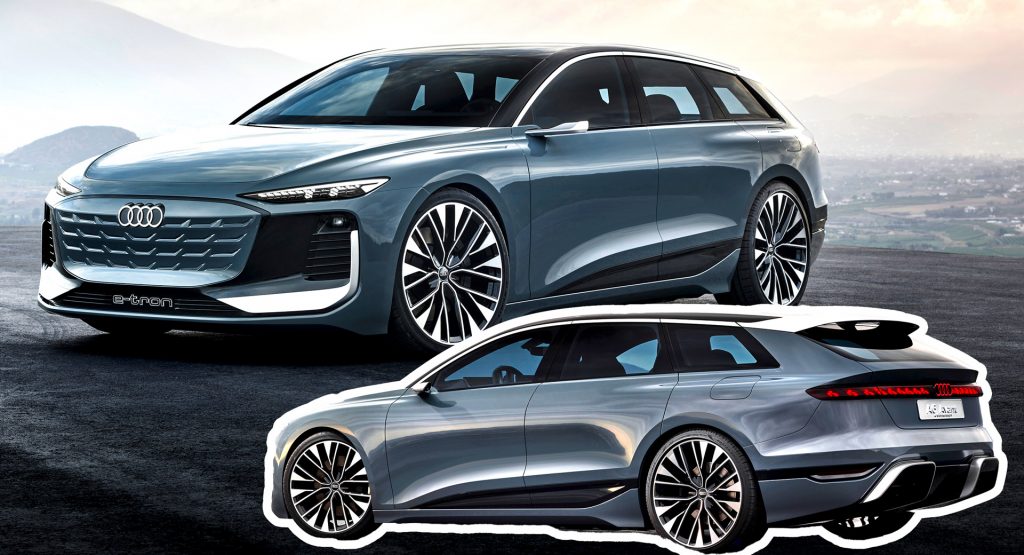
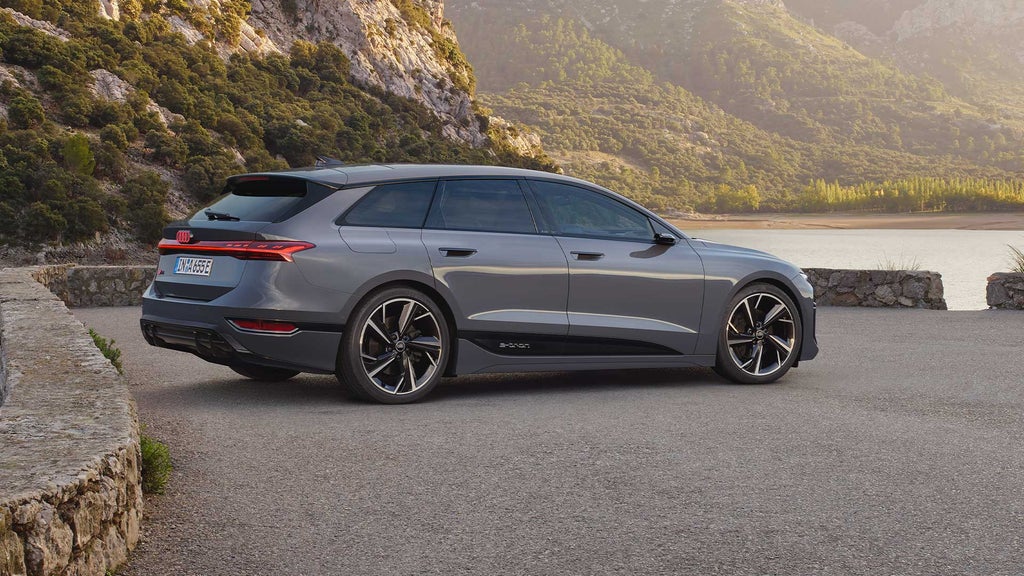
The rear of the car is where the Avant’s character truly shines. The liftgate is expansive, offering unparalleled cargo space—enough to swallow a week’s worth of groceries, a stroller, or even a set of golf clubs without breaking a sweat. The taillights, thin and horizontal, wrap around the corners like a futuristic halo, their design both functional and mesmerizing. It’s a car that doesn’t just sit in a parking lot; it commands attention, even when it’s stationary.
But the real magic lies in the details. The flush door handles, the aerodynamic wheel covers, and the subtle blue accents scattered throughout the exterior all hint at the electric revolution under the skin. This isn’t a car that’s been retrofitted for electricity; it’s been designed from the ground up with it in mind. Every line, every curve, every surface has been optimized not just for aesthetics, but for efficiency, range, and performance.
Performance: The Silent Symphony of Electric Power
Under the hood—or, more accurately, beneath the floor—lies the heart of the A6 e-tron Avant: its electric powertrain. While exact specifications remain under wraps, industry insiders suggest a dual-motor setup, with all-wheel drive as standard. This isn’t just about straight-line speed, though the instant torque delivery of an electric motor ensures that the A6 e-tron Avant will be quicker off the line than most of its combustion-engined rivals. It’s about the way the car feels, the way it communicates with the driver.
Imagine pulling away from a traffic light. In a traditional car, there’s a moment of hesitation, a pause as the engine spools up. In the A6 e-tron Avant, there’s none of that. The car lunges forward with a seamless surge of power, the kind that makes you grin despite yourself. The steering, too, is a revelation. Electric power steering is often criticized for feeling artificial, but Audi’s engineers have struck a balance—firm enough to provide feedback, yet light enough to make the car feel nimble.
The suspension, too, has been reimagined for the electric age. Air suspension is likely standard, allowing the A6 e-tron Avant to adapt to different driving conditions with ease. On the highway, it glides over imperfections with the composure of a luxury sedan. On a twisty backroad, it tightens its gait, leaning into corners with the precision of a sports car. It’s a car that refuses to be pigeonholed, a vehicle that can be both a comfortable cruiser and a spirited driver’s companion.
Range, Charging, and the Practicality of Electric Living
Of course, no discussion of an electric vehicle would be complete without addressing range and charging. The A6 e-tron Avant is expected to leverage Audi’s latest battery technology, with a capacity rumored to be in the neighborhood of 100 kWh. That’s enough to deliver a real-world range of around 300 miles on a full charge, putting it in the same league as the Tesla Model S Long Range or the Lucid Air. But range is only part of the equation. What truly sets the A6 e-tron Avant apart is its charging capability.
Audi’s Ultra-fast Charging Network, in partnership with Electrify America, promises to replenish 80% of the battery in just 15 minutes at compatible stations. That’s the kind of speed that makes long-distance travel feasible, the kind of convenience that erases the last vestiges of range anxiety. And with the A6 e-tron Avant’s spacious interior, you can easily make that charging stop part of the journey—grab a coffee, stretch your legs, and by the time you’re back in the car, you’ll be ready to roll again.
But it’s not just about the numbers. It’s about the lifestyle. The A6 e-tron Avant is a car designed for people who value their time. It’s for the parent who needs to ferry kids to school and soccer practice without the hassle of gas station detours. It’s for the road warrior who spends more time on the highway than in the garage. It’s for anyone who’s ever looked at an SUV and thought, “I don’t need all that space, but I do need something that feels alive on the road.”
The Cultural Shift: Why the World is Ready for an Electric Wagon
So why now? Why has the time finally come for the electric wagon? The answer lies in a confluence of factors, both practical and cultural. On the practical side, the EV market has matured. Battery technology has advanced to the point where range is no longer a limiting factor for most drivers. Charging infrastructure, while still uneven, is expanding at a breakneck pace. And automakers, including Audi, have finally begun to embrace body styles beyond the SUV.
But there’s a deeper, more intangible reason for the wagon’s resurgence. In an era of climate crisis and social upheaval, the wagon represents something hopeful—a return to versatility, to adaptability. It’s a rejection of the one-size-fits-all approach that has dominated the automotive industry for the past decade. The wagon is a car for people who value flexibility, who see their vehicle as an extension of their lifestyle rather than a status symbol.
There’s also the matter of aesthetics. In a world where so many cars look the same—boxy, anonymous SUVs dominating the landscape—the A6 e-tron Avant stands out. Its design is a love letter to the past, but its underpinnings are firmly rooted in the future. It’s a car that doesn’t just blend in; it turns heads. And in an age where individuality is increasingly rare, that’s a powerful draw.
Conclusion: The Avant-garde of Electric Mobility
The 2026 Audi A6 e-tron Avant isn’t just another electric car. It’s a statement. It’s a challenge to the status quo. It’s a reminder that the future doesn’t have to be uniform, that innovation can coexist with tradition, and that luxury doesn’t have to come at the expense of practicality. This is a car that understands the needs of modern drivers—not just their desire for speed and technology, but their need for space, versatility, and a connection to the road.
As the automotive world hurtles toward an electric future, the A6 e-tron Avant stands as a beacon of what’s possible. It’s proof that the wagon isn’t dead; it’s evolving. It’s proof that electric vehicles can be more than just utilitarian appliances—they can be objects of desire, of aspiration. And most importantly, it’s proof that the best cars aren’t just about where they’re going, but how they make you feel along the way.
So, if you’ve ever looked at an electric SUV and thought, “I miss the wagon,” your wait may soon be over. The 2026 Audi A6 e-tron Avant isn’t just coming. It’s arriving with the promise of a new era—one where the road ahead is as open and inviting as the cargo space behind you.