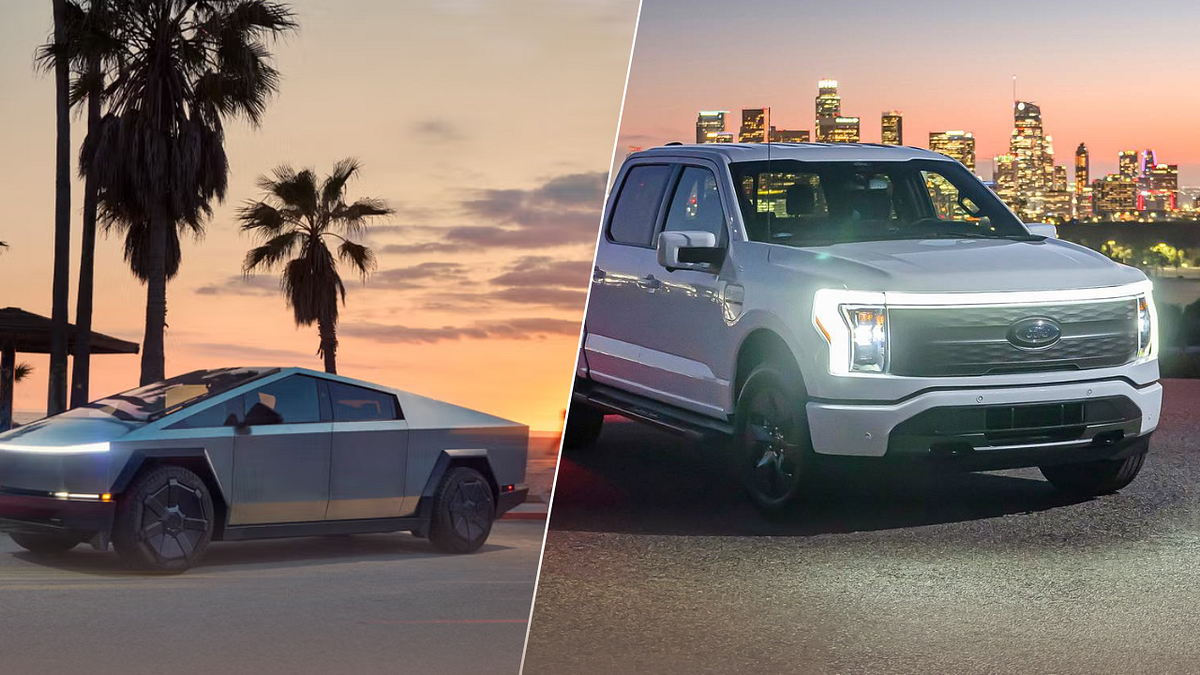
The electric truck revolution is here, and two titans stand at the forefront: the Ford F-150 Lightning and the Tesla Cybertruck. These aren’t just vehicles; they’re statements—bold declarations that the future of hauling, towing, and everyday utility has arrived in a form that’s as futuristic as it is functional. But beyond the gleaming exteriors and the promise of zero emissions, what truly sets these trucks apart? Why does the clash between the Cybertruck’s angular, sci-fi aesthetic and the Lightning’s rugged, familiar silhouette feel like more than just a battle of specs? The answer lies in the way these trucks embody the tension between innovation and tradition, between the audacity of disruption and the comfort of the known.
This face-off isn’t just about horsepower or battery range. It’s about identity. The F-150 Lightning whispers of heritage, a lineage of blue-collar toughness that’s woven into America’s automotive DNA. The Cybertruck, on the other hand, screams rebellion—a middle finger to convention, wrapped in stainless steel and unapologetic angularity. Yet both trucks share a common obsession: redefining what a truck can be in an era where sustainability and capability must coexist. So, buckle up. We’re diving deep into the heart of this electric tug-of-war, where every amp, every pound of torque, and every cubic inch of cargo space tells a story about where we’re headed—and where we’ve come from.
The Design Philosophy: Familiarity vs. Futurism
The Ford F-150 Lightning is a masterclass in evolutionary design. It takes the iconic F-150 silhouette—the bold grille, the muscular fenders, the unmistakable presence—and electrifies it without erasing its soul. The Lightning retains the truck’s rugged charm, a visual handshake that reassures even the most skeptical traditionalists. Its front fascia, while updated with a closed grille for aerodynamics, still nods to the F-150’s legacy, a subtle reminder that Ford isn’t just chasing the future; it’s inviting it into the family.
Enter the Tesla Cybertruck. Where the Lightning whispers, the Cybertruck bellows. Its geometric, origami-like design is a deliberate departure from the organic curves of conventional trucks. The sharp, beveled edges aren’t just for show; they’re a statement of intent. Tesla’s design language here is one of defiance, a rejection of the soft, rounded aesthetics that have dominated automotive design for decades. The Cybertruck’s exoskeleton construction, made from ultra-hard 30X cold-rolled stainless steel, isn’t just about durability—it’s about permanence. This truck looks like it was hewn from a single slab of the future, untouched by the passage of time.
The contrast is striking. The Lightning feels like a trusted ally, a vehicle that’s been refined over generations to handle the demands of work and family. The Cybertruck, by contrast, feels like a scout from another world, a vehicle that’s here to challenge our perceptions of what a truck should look like. Yet beneath the surface, both trucks share a common goal: to prove that electric trucks can be more than just eco-friendly alternatives—they can be icons.
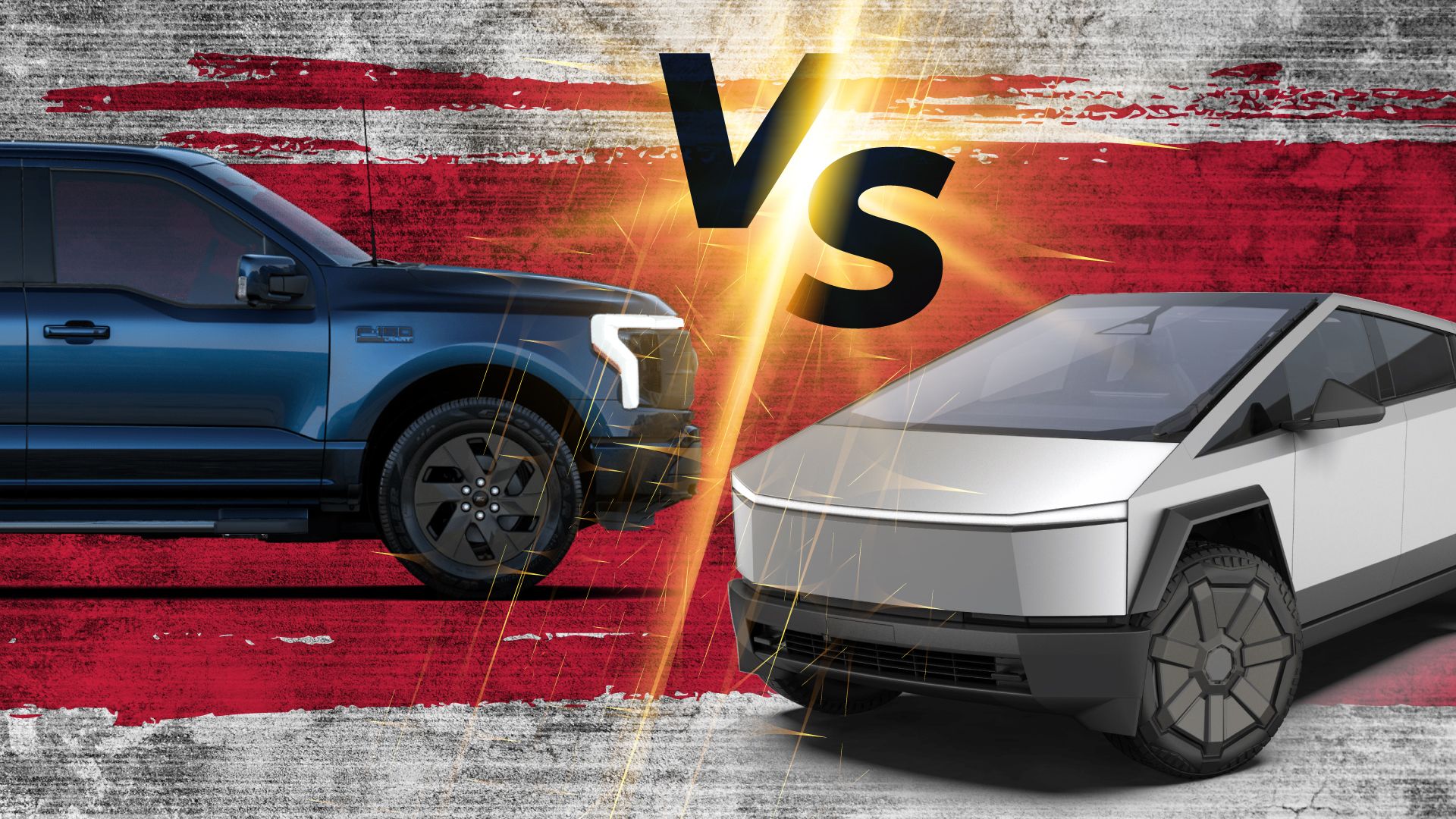
Performance and Power: Raw Might Meets Silent Dominance
When it comes to sheer performance, the F-150 Lightning and Cybertruck are in a league of their own. The Lightning’s dual-motor all-wheel-drive system delivers up to 580 horsepower and 775 lb-ft of torque, catapulting it from 0 to 60 mph in a scant 3.5 seconds. But it’s not just about speed. The Lightning’s power is about control—its adaptive suspension and advanced traction control make it a beast in both urban sprawl and off-road terrain. Ford’s Pro Power Onboard feature turns the truck into a mobile generator, capable of powering your home during an outage or running power tools at a job site. It’s a truck that doesn’t just move; it empowers.
The Cybertruck, meanwhile, is a different kind of beast. With its tri-motor configuration, it boasts up to 800 horsepower and a mind-bending 1,000 lb-ft of torque. The acceleration is brutal—0 to 60 mph in as little as 2.6 seconds—but the real magic lies in its handling. The Cybertruck’s low center of gravity, thanks to its battery placement, makes it feel planted, almost glued to the road. Its adaptive air suspension can raise or lower the ride height on the fly, adapting to everything from highway cruising to off-road obstacles. And let’s not forget the towing capacity: up to 14,000 pounds for the Cybertruck, outmuscling the Lightning’s 10,000-pound rating. It’s a truck that doesn’t just pull; it commands.
Yet the most fascinating aspect of their performance isn’t the numbers—it’s the silence. Both trucks accelerate with a whisper, a stark contrast to the growling V8s of their gasoline-powered predecessors. This silence isn’t just a feature; it’s a revolution. It’s the sound of progress, a reminder that power doesn’t have to come at the expense of the environment. But it’s also a challenge to our perceptions. Can a truck truly be a truck without the roar of an engine? The Lightning and Cybertruck answer with a resounding yes.
Range and Charging: The Long Haul vs. The Quick Pit Stop
Range anxiety is the bogeyman of electric vehicles, but both the F-150 Lightning and Cybertruck are here to bury that myth. The Lightning offers up to 320 miles of EPA-estimated range on a full charge, with the extended-range battery pushing that to 380 miles. Ford’s BlueCruise hands-free driving system adds another layer of convenience, allowing for effortless highway cruising on compatible roads. Charging is a breeze, too. The Lightning can juice up to 80% in about 41 minutes on a 150-kW fast charger, making it a practical choice for long road trips.
The Cybertruck, however, takes range to another level. With up to 500 miles of EPA-estimated range in its tri-motor configuration, it’s one of the longest-range electric trucks on the market. Tesla’s Supercharger network is a game-changer, offering some of the fastest charging speeds in the industry. A Cybertruck can add up to 240 miles of range in just 15 minutes at a V3 Supercharger. But it’s not just about speed; it’s about accessibility. Tesla’s charging infrastructure is vast, reliable, and, most importantly, easy to use. The Cybertruck’s range and charging capabilities make it a compelling choice for those who demand both performance and practicality.
The real story here isn’t just about numbers—it’s about mindset. The Lightning’s range is impressive, but it’s rooted in the idea of continuity. It’s a truck that’s designed to fit seamlessly into your existing lifestyle. The Cybertruck’s range, on the other hand, feels like a dare. It’s a truck that’s built for the future, a vehicle that’s ready to take on the unknown. Both approaches have their merits, but they cater to different kinds of drivers. One is a bridge to the future; the other is a leap.
Interior and Technology: From Workhorse to Living Room
Step inside the F-150 Lightning, and you’re greeted by a cabin that’s both familiar and futuristic. The dashboard is dominated by a massive 15.5-inch touchscreen, but it’s not just a slab of glass—it’s a portal to a world of connectivity. Ford’s SYNC 4 system integrates seamlessly with your smartphone, offering features like wireless Apple CarPlay and Android Auto, as well as advanced navigation and entertainment options. The Lightning’s interior is a blend of comfort and functionality, with ample storage space, premium materials, and a focus on ergonomics. It’s a truck that’s as at home on a construction site as it is on a family road trip.
The Cybertruck’s interior is a different beast entirely. It’s minimalist to the point of austerity, with a single 17-inch touchscreen dominating the center console. The seats are supportive, the materials are high-quality, and the overall design is uncluttered. But it’s not just about looks—it’s about experience. The Cybertruck’s interior is designed to be intuitive, with controls that respond to touch and voice commands. The lack of physical buttons is jarring at first, but it quickly becomes liberating. It’s a cabin that feels like it was designed for the 21st century, a space that’s as much about the future as the truck itself.
Yet the most striking difference between the two interiors isn’t the technology—it’s the philosophy. The Lightning’s cabin feels like a natural evolution, a space that’s been refined over decades to meet the needs of real-world drivers. The Cybertruck’s cabin, by contrast, feels like a blank canvas, a space that’s waiting to be filled with the driver’s personality. Both approaches have their strengths, but they cater to different kinds of people. One is a truck for the everyman; the other is a truck for the visionary.
Pricing and Value: The Bottom Line
Price is where the F-150 Lightning and Cybertruck diverge most sharply. The Lightning starts at around $55,974, with the extended-range model pushing that to $74,474. It’s a premium, but it’s a premium that comes with a pedigree. The Lightning isn’t just a truck; it’s a statement of intent. It’s a vehicle that’s designed to appeal to both traditional truck buyers and early adopters of electric technology. Ford’s pricing reflects that duality—it’s expensive, but it’s also a safe bet.
The Cybertruck, on the other hand, starts at $60,990 for the rear-wheel-drive model, with the dual-motor and tri-motor versions pushing the price to $99,990. It’s a significant investment, but it’s also a statement. The Cybertruck isn’t just a truck; it’s a piece of art, a vehicle that’s designed to turn heads and spark conversations. It’s a truck for those who want to be part of the future, not just observers of it.
The value proposition here is complex. The Lightning offers a balance of performance, practicality, and heritage. It’s a truck that’s designed to appeal to a broad audience, from contractors to families. The Cybertruck, meanwhile, is a niche vehicle, a truck that’s designed for those who want to stand out. It’s a vehicle that’s as much about identity as it is about capability. Both trucks offer incredible value, but they cater to different kinds of buyers. One is a truck for the masses; the other is a truck for the few.
The electric truck wars are more than just a battle of specs and features. They’re a clash of ideologies, a confrontation between the past and the future. The Ford F-150 Lightning is a bridge—a vehicle that’s designed to ease us into the electric era without asking us to abandon the traditions we hold dear. The Tesla Cybertruck, on the other hand, is a leap—a vehicle that’s designed to challenge our perceptions of what a truck can be.
Yet for all their differences, these trucks share a common goal: to prove that electric vehicles can be more than just eco-friendly alternatives. They can be icons. They can be legends. They can be the trucks of tomorrow, today. The choice between them isn’t just about power or range or price—it’s about what kind of future you want to drive. Do you want a truck that whispers of tradition, or one that bellows of revolution? The answer, ultimately, is up to you. But one thing is certain: the electric truck era has arrived, and it’s here to stay.