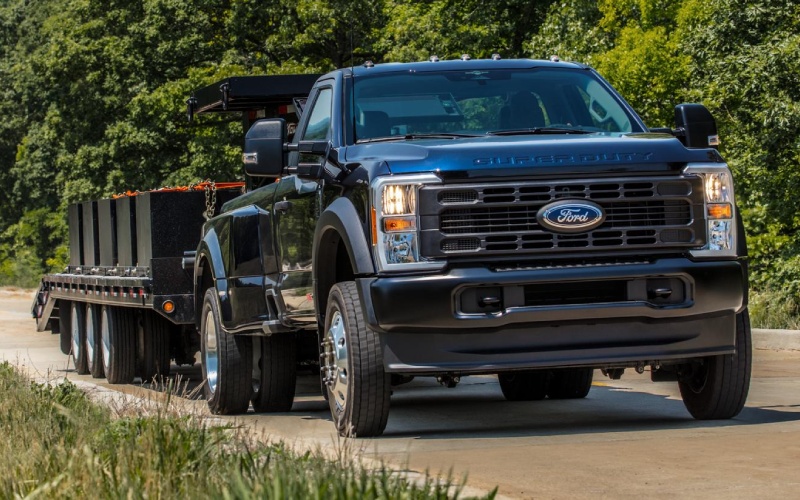
The 2026 Ford Super Duty lineup is here, and with it comes a question that’s been echoing through truck lots and online forums for years: Which model reigns supreme for towing—the F-350 or the F-450? At first glance, the answer seems obvious. The F-450 is bigger, burlier, and built for heavier loads. But the deeper you dig, the more nuanced the story becomes. It’s not just about raw numbers; it’s about how these trucks are engineered to handle the demands of real-world towing, from fifth-wheel setups to long-haul payloads. And while the F-350 might seem like the underdog, its capabilities are anything but modest. So, let’s cut through the noise and explore what truly sets these titans apart—and which one deserves a spot in your driveway.
The Powerhouse Showdown: Engine and Powertrain Breakdown
At the heart of every Super Duty’s towing prowess lies its engine, and the 2026 lineup doesn’t disappoint. Both the F-350 and F-450 are available with Ford’s legendary 7.3L Godzilla V8 or the turbocharged 6.7L Power Stroke diesel, but the F-450 takes the crown when it comes to sheer grunt. The diesel option in the F-450 cranks out a staggering 475 horsepower and 1,050 lb-ft of torque, while the F-350’s diesel maxes out at 450 horsepower and 935 lb-ft. That extra torque isn’t just a number—it’s the difference between a smooth, controlled pull and a white-knuckle struggle up a mountain pass.
But here’s where things get interesting. The F-350’s high-output diesel option, available in certain trims, bridges the gap with 480 horsepower and 1,050 lb-ft of torque. For drivers who need F-450-level power without the bulk, this is a game-changer. Meanwhile, the F-450’s standard turbocharged diesel is paired with a 10-speed TorqShift automatic transmission, optimized for heavy-duty towing with features like adaptive shift logic that adjusts gears based on load and terrain. The F-350 offers the same transmission, but its shorter wheelbase and lighter frame mean it can feel more nimble in urban settings—yet still haul enough to make a semi-truck jealous.
Frame and Chassis: The Backbone of Towing Stability
Towing isn’t just about horsepower; it’s about stability. The F-450’s heavy-duty fully boxed frame is a marvel of engineering, designed to flex less under extreme loads and resist torsional stress. This rigidity is crucial when hauling 30,000+ pounds in a fifth-wheel configuration, where even slight frame flex can lead to trailer sway or uneven weight distribution. The F-350’s frame is no slouch—it’s built with high-strength steel and a fully boxed design in higher trims—but it’s ultimately tuned for a balance between towing capacity and everyday drivability.
One often-overlooked advantage of the F-450’s chassis is its dual rear-wheel (DRW) setup, which spreads the load across six wheels instead of four. This not only increases payload capacity but also improves stability when towing near the truck’s maximum limits. The F-350 can be spec’d with a DRW configuration too, but its single-rear-wheel (SRW) models are surprisingly capable for drivers who prioritize fuel efficiency and ease of parking. For those who tow frequently, though, the DRW option on either model is a non-negotiable upgrade.
Towing Capacity: Where Numbers Tell Only Half the Story
When comparing the F-350 and F-450, the towing numbers are the first thing everyone cites. The F-450’s maximum conventional towing capacity reaches 37,000 pounds, while the F-350 tops out at 32,500 pounds. For fifth-wheel towing, the F-450 can handle up to 37,000 pounds, compared to the F-350’s 27,500 pounds. But these figures only tell part of the story. The real question is: How does each truck feel when it’s working?
The F-450’s longer wheelbase and heavier frame mean it tracks straighter under load, especially in crosswinds or when navigating tight turns. The F-350, with its shorter wheelbase, can feel more responsive in city driving, but it requires more driver input to maintain stability at higher weights. Additionally, the F-450’s integrated trailer brake controller and advanced towing tech like Pro Trailer Backup Assist make it easier to manage large trailers, while the F-350 relies more on driver skill in tight spots. For weekend warriors hauling a camper or a boat, the F-350 is plenty. But for commercial haulers or those pushing the limits, the F-450’s composure is unmatched.
Payload and GCWR: The Unsung Heroes of Heavy Hauling
Towing capacity gets all the glory, but payload capacity and gross combined weight rating (GCWR) are the silent workhorses of heavy-duty towing. The F-450’s GCWR can exceed 70,000 pounds, allowing it to tow massive loads while carrying additional gear, tools, or even a second vehicle in the bed. The F-350’s GCWR maxes out around 60,000 pounds, which is still impressive but falls short for the most demanding applications.
Payload is where the F-450 truly flexes its muscles. With a maximum payload of 7,850 pounds, it can handle everything from construction equipment to livestock trailers without breaking a sweat. The F-350’s payload peaks at 7,640 pounds, but its lighter frame means it can feel more nimble when unloaded. For drivers who need to carry heavy cargo in addition to towing, the F-450’s payload advantage is a game-changer. It’s the difference between a truck that can do it all and one that’s constantly pushing its limits.
Technology and Comfort: Towing Without the Torture
Modern towing isn’t just about brute force; it’s about smart technology that makes hauling easier and safer. Both the F-350 and F-450 come equipped with Ford’s Pro Trailer Backup Assist, which lets drivers steer trailers with a knob instead of wrestling with the wheel. But the F-450 takes it further with onboard scales that monitor payload in real time, preventing overloading before it becomes a problem.
The cab of the F-450 is also more insulated against noise and vibration, thanks to its heavier-duty sound-deadening materials and advanced suspension tuning. This makes long hauls less fatiguing, whether you’re driving cross-country or navigating a construction site. The F-350’s interior is no slouch—it offers the same high-tech infotainment and comfort features—but it’s tuned more for versatility than outright luxury. For drivers who spend hours behind the wheel, the F-450’s refined ride is a compelling reason to choose it over its lighter sibling.
Real-World Applications: Which Truck Fits Your Life?
The F-450 isn’t just for commercial use—it’s also the ultimate choice for full-time RVers, horse trainers, and contractors who need maximum capacity without compromise. Its ability to handle heavy fifth-wheel trailers and large gooseneck loads makes it the go-to for those who live and work on the road. The F-350, meanwhile, is the jack-of-all-trades that excels in both towing and daily driving. It’s ideal for weekend warriors, DIY enthusiasts, and drivers who need a truck that can do it all—from hauling a trailer to running errands in town.
Consider the F-350 if you prioritize fuel efficiency, maneuverability, and a lower price point. It’s the smarter choice for drivers who tow occasionally but still want a truck that feels like a daily driver. Opt for the F-450 if you’re towing near the limits of what’s possible, need the extra payload, or simply want the peace of mind that comes with a truck built for the most demanding jobs. The F-450’s capabilities aren’t just impressive—they’re a testament to what happens when engineering meets real-world necessity.
The 2026 Ford Super Duty lineup offers two exceptional trucks, each tailored to different needs. The F-350 is the versatile powerhouse that can handle most towing tasks with ease, while the F-450 is the unstoppable titan built for those who refuse to compromise. Whether you’re a weekend adventurer or a professional hauler, the right choice comes down to how you plan to use your truck—and how much you’re willing to push it. One thing’s for sure: with either model, you’re getting a machine that’s ready for anything.