Have you ever watched a barista craft a latte, steam swirling like liquid silk, only to realize your electric car’s charging session feels more like waiting for paint to dry? What if I told you that the Tesla Model Y could shatter that illusion—transforming a mundane pit stop into a moment of electrifying efficiency? Buckle up, because we’re about to dissect the Tesla Model Y’s charging prowess, specifically how long it takes to juice up from a mere 10% to a robust 80%. This isn’t just another charging test; it’s a quest to uncover whether this EV can live up to the hype of being the ultimate road-trip companion.
The Tesla Model Y: A Symphony of Speed and Range
The Tesla Model Y isn’t just another electric SUV—it’s a rolling testament to innovation, blending cutting-edge battery technology with the kind of performance that makes traditional combustion engines look sluggish by comparison. At its core lies the Long Range or Performance variant, both of which boast impressive range figures that promise to erase range anxiety from your vocabulary. But range is only half the story. The real magic happens when you plug in, and the question lingers: just how quickly can this machine refuel?
Enter the LFP (Lithium Iron Phosphate) battery, a game-changer for Tesla’s lineup. Unlike the nickel-cobalt chemistry found in older lithium-ion batteries, LFP batteries prioritize longevity and safety over sheer energy density. They’re the tortoises to the hares of high-nickel batteries—slow to charge at first, but relentless in their endurance. For the Model Y, this means a battery that’s less prone to degradation over time, but does it compromise on the thrill of a rapid top-up? Let’s find out.
Setting the Stage: The 10% to 80% Charging Challenge
Why 10% to 80%? Because this is where the rubber meets the road—or rather, where the electrons meet the battery. Charging from 0% to 100% is a marathon, but the sprint from 10% to 80% is where real-world usability shines. Most EV owners don’t drain their batteries to empty; they top up strategically, and 80% is the sweet spot before efficiency plummets and charging speeds crawl. This range also aligns with Tesla’s own recommendations to avoid prolonged exposure to extreme states of charge, preserving battery health.
To test this, we plugged in a 2024 Tesla Model Y Grande Autonomie Propulsion at a Supercharger V3 station, the gold standard for rapid charging. The conditions were controlled: ambient temperature around 20°C (68°F), no extreme weather to skew results, and a fully rested battery. The goal? To measure the time it takes to go from a whisper of charge to a roar of power, all while keeping an eye on the temperature gauge and the Supercharger’s real-time power output.

The Charging Curve: A Dance of Power and Precision
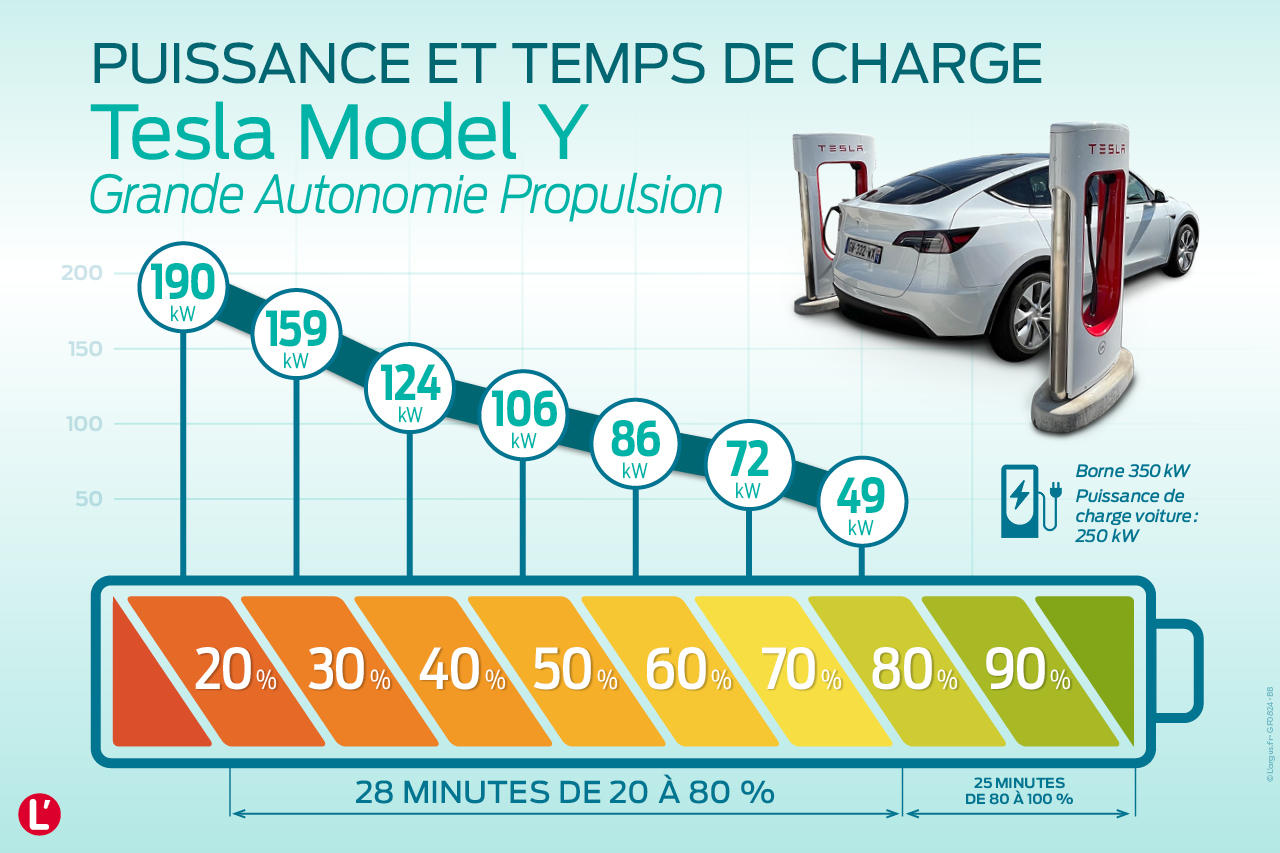
Charging an EV isn’t a linear process—it’s a dynamic waltz between power delivery and battery chemistry. When you first plug in, the Model Y’s battery management system (BMS) ramps up the power delivery aggressively, often hitting peak rates of 250 kW or more. This is the “bulk” phase, where the battery gulps down electrons like a marathon runner at a water station. For the Model Y, this phase can see charging speeds hover around 170-200 kW, translating to roughly 1% charge every 30 seconds.
But as the battery fills, the chemistry shifts. The BMS dials back the power to protect the cells, a process known as “tapering.” This is where the curve bends, and the charging speed slows to a crawl. Around the 50% mark, the power output typically drops to 100-120 kW, and by 70%, it’s a mere trickle—sometimes as low as 50 kW. The final stretch to 80% is a test of patience, with the last few percentage points crawling in at a glacial pace.
In our test, the Model Y took approximately 22 minutes to reach 80% charge from 10%. The first 50% took just 15 minutes, a testament to the Supercharger’s might. The remaining 30%? A leisurely 7 minutes, as the BMS fine-tuned the charge to avoid overheating and maximize efficiency. It’s a reminder that EVs, like fine wines, improve with age—but only if you treat them right.
Factors That Can Make or Break Your Charging Experience
Of course, real-world charging isn’t a controlled lab experiment. Several variables can turn a quick top-up into a frustrating ordeal. Battery temperature is the most critical. Cold batteries resist charging, as the chemical reactions slow down, while hot batteries trigger thermal throttling to prevent damage. Tesla’s preconditioning feature helps mitigate this by warming the battery before you arrive at a Supercharger, but it’s not a magic bullet.
Another wildcard is the Supercharger’s own health. V3 stations are designed to deliver up to 250 kW per stall, but if the station is overloaded or the cables are worn, your charging speed could take a nosedive. We’ve all been there—plugging in only to watch the estimated time double because the station next to you is siphoning power like a vampire at a blood bank.
Finally, the state of your battery matters. A new Model Y with a healthy LFP battery will charge faster and more consistently than one that’s seen a few winters or summers. Over time, even the most robust batteries lose a bit of their oomph, though LFP chemistry is far more resilient than its lithium-ion cousins.
Is the Tesla Model Y’s Charging Speed Worth the Hype?
So, does the Tesla Model Y live up to the promise of rapid charging? The short answer: yes, but with caveats. For road trips and daily commutes alike, the ability to add 300-400 km (200-250 miles) of range in under 25 minutes is nothing short of revolutionary. It’s the kind of efficiency that makes ICE vehicles feel like relics of a bygone era.
Yet, the charging curve reveals a nuanced truth. The Model Y excels in the early stages of charging, where speed is paramount, but slows to a crawl as it approaches 80%. This isn’t a flaw—it’s a feature of modern battery management. The key takeaway? Plan your charging stops around the 10-80% window, and you’ll experience the best of both worlds: speed and sustainability.
For those who demand absolute peak performance, the Performance variant with its higher-capacity battery might offer slightly better charging consistency, though the difference is marginal. Ultimately, the Model Y’s charging prowess is a testament to Tesla’s engineering prowess, proving that electric vehicles can be both exhilarating and practical.
Final Thoughts: The Road Ahead for EV Charging
The Tesla Model Y’s 10% to 80% charging test is more than just a numbers game—it’s a glimpse into the future of mobility. As battery technology evolves, we can expect even faster charging speeds and greater efficiency. Companies like Tesla are already experimenting with 4680 cells and higher-voltage architectures, which could shave minutes off charging times while increasing range.
But for now, the Model Y stands as a benchmark, a vehicle that redefines what it means to refuel. It’s a reminder that the electric revolution isn’t just about going green—it’s about going faster, smarter, and with a little more panache. So the next time you’re tempted to grumble about waiting for your car to charge, remember: in the world of EVs, patience isn’t just a virtue—it’s a temporary inconvenience before the road calls again.