The Tesla Model S Plaid isn’t just a car—it’s a kinetic manifesto, a rolling provocation that dares physics to slow it down. When the rubber meets the asphalt, the Plaid doesn’t just accelerate; it vanishes into a shimmer of electrons and torque, leaving behind a vacuum of astonishment where a sedan once stood. This is not mere transportation; it’s a transcendence of motion, a symphony of electrons conducting a 1,020-horsepower crescendo that catapults the driver from stillness to warp speed in the blink of an eye. To understand the Plaid’s 0–60 mph and quarter-mile dominance is to peer into the heart of electric fury—a place where combustion engines gasp in existential dread and internal combustion’s legacy flickers like a dying ember.
Imagine, if you will, a silent predator coiled in the shadows of a suburban garage. It doesn’t roar. It doesn’t snarl. It hums—a deep, resonant thrum that vibrates through the floorboards like the pulse of a sleeping giant. Then, with the subtlety of a lightning strike, it awakens. The Plaid doesn’t build power; it detonates it. Three electric motors, each a maestro of torque vectoring, conspire in perfect harmony to unleash a force that feels less like driving and more like being launched by an unseen hand. This is the essence of the Plaid: a paradox of serenity and savagery, a machine that whispers before it screams.
The Engine of Tomorrow: Three Motors, One Unholy Purpose
At the heart of the Plaid’s ferocity lies a tri-motor powertrain, a technological triptych that transforms the Model S from a luxury cruiser into a dragstrip demon. Two motors power the rear axle, their combined might channeled through a sophisticated gear reduction system that turns each rotation of the rotor into a tidal wave of acceleration. The third motor, nestled up front, doesn’t just balance weight—it weaponizes it, enabling torque vectoring that can send power to any wheel, at any moment, with the precision of a surgeon’s scalpel.
This isn’t just all-wheel drive. It’s all-wheel domination. The Plaid doesn’t just grip the road; it reshapes it. When the driver mashes the accelerator, the car doesn’t just move forward—it compresses the asphalt beneath it, as if the very ground is recoiling from the onslaught. The torque curve is a vertical cliff, rising from zero to its peak instantaneously, leaving turbocharged engines choking on their own lag. There is no turbo spool, no gearbox hunt—just an unbroken surge of electricity that feels less like acceleration and more like teleportation.

0–60 mph: The Vanishing Point of Reality
To say the Plaid achieves 0–60 mph in 1.99 seconds is to understate the experience. This is not a number; it’s a rupture in the fabric of time. The world outside the cabin blurs into streaks of color and light as the car crosses the threshold from stillness to supersonic in less than two heartbeats. The driver is not merely pressed into the seat; they are suspended, weightless, as if the laws of gravity have momentarily suspended their judgment.
What makes this feat even more remarkable is the absence of drama. There is no gearshift, no clutch engagement, no mechanical crescendo—just a seamless, relentless push that feels like being catapulted by an invisible force. The Plaid doesn’t accelerate; it erases distance. The dashboard remains eerily calm, the digital readouts flickering with clinical precision as the speedometer needle races toward triple digits. By the time the driver registers the velocity, they are already halfway down the road.
This is the magic of electric torque: instant, linear, and relentless. It doesn’t build—it obliterates. And in doing so, it redefines what it means to be fast. The Plaid doesn’t just beat the clock; it dismantles it, leaving competitors like the Bugatti Chiron and Rimac Nevera scrambling to justify their existence in a world where electrons outperform explosions.
Quarter-Mile: The Dragstrip as a Canvas of Shock and Awe
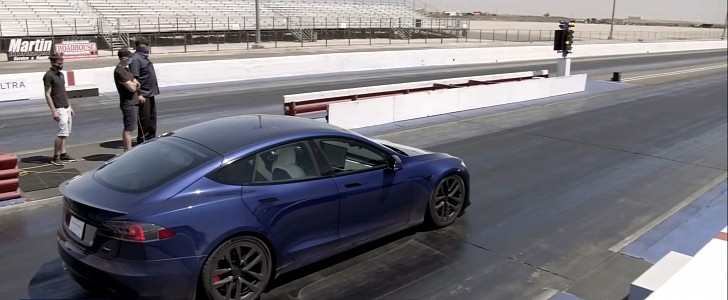
If the 0–60 sprint is a lightning bolt, the quarter-mile is a supernova. Here, the Plaid doesn’t just dominate—it obliterates records. With a trap speed of over 200 mph and a elapsed time of 9.23 seconds, the Plaid doesn’t just cross the line; it leaves it in the dust, a smoldering crater of shattered expectations. This is where the car’s aerodynamics, battery thermal management, and torque vectoring converge in a ballet of mechanical perfection.
The Plaid’s dragstrip persona is one of eerie composure. The driver may feel the g-forces pressing them into the seat, but the car itself remains poised, its body slicing through the air like a blade. The massive 21-inch wheels, wrapped in Michelin Pilot Sport 4S tires, cling to the pavement with the tenacity of a limpet, their sticky rubber deforming under the strain of 1,020 horsepower. The battery, cooled by a sophisticated liquid system, delivers every volt without hesitation, even under the punishing heat of repeated runs.
Watch closely as the Plaid launches. The front end dips slightly under braking regeneration, then rockets upward as the rear motors unleash their fury. The car doesn’t just accelerate—it levitates, its body tilting forward as if pulled by an unseen tether. The sound is not a roar, but a deep, resonant hum, a basso profundo that vibrates through the chassis and into the soul. By the time the driver reaches the 60-foot mark, they are already traveling faster than most supercars reach at the quarter-mile finish line.
The Human Factor: What It Feels Like to Ride the Lightning
To drive the Plaid is to experience a paradox of control and surrender. The steering is precise, the suspension tuned for both comfort and cornering, yet the car’s raw power demands respect. The first time the accelerator is pressed, there is a moment of hesitation—a fleeting doubt that this much force can be tamed. Then, the Plaid responds, not with hesitation, but with alacrity, as if it has been waiting for this moment all along.
The g-forces are not just felt; they are absorbed. The Plaid’s cabin becomes a cocoon of controlled chaos, where the driver is both pilot and passenger in a machine that defies conventional wisdom. The lack of engine noise is disconcerting at first, but soon it becomes a symphony—a high-pitched whine that crescendos into a harmonic shriek as the car hurtles toward its top speed. The wind noise increases, but the cabin remains eerily quiet, a sanctuary of speed where the only soundtrack is the hum of electrons and the rush of air.
This is where the Plaid’s true genius lies: it doesn’t just impress with numbers. It captivates with sensation. It turns the act of driving into an act of transcendence, a moment where technology and artistry merge into something greater than the sum of its parts.
The Legacy of the Plaid: A New Benchmark for Speed
The Tesla Model S Plaid isn’t just a fast car—it’s a cultural reset. It has redefined what it means to be fast, not by chasing the ghosts of internal combustion, but by forging a new path entirely. In a world where speed is often measured in decibels and drama, the Plaid proves that silence can be just as devastating as thunder.
It has set benchmarks that will echo through the automotive world for decades. The 0–60 mph time of 1.99 seconds isn’t just a record; it’s a challenge. The quarter-mile time of 9.23 seconds isn’t just a statistic; it’s a statement. The Plaid doesn’t just beat the competition—it renders it obsolete, a relic of a bygone era where speed was measured in cylinders and carburetors.
Yet, for all its raw power, the Plaid remains a car of contradictions. It is at once a dragstrip monster and a daily driver, a technological marvel and a study in minimalist elegance. It doesn’t just accelerate—it evolves. It doesn’t just dominate—it inspires. And in doing so, it invites us to reconsider not just what a car can do, but what it means to be alive in a world where the impossible is now routine.
The Tesla Model S Plaid is more than a machine. It is a declaration. A challenge. A spark. And like all great revolutions, it leaves the world forever changed.