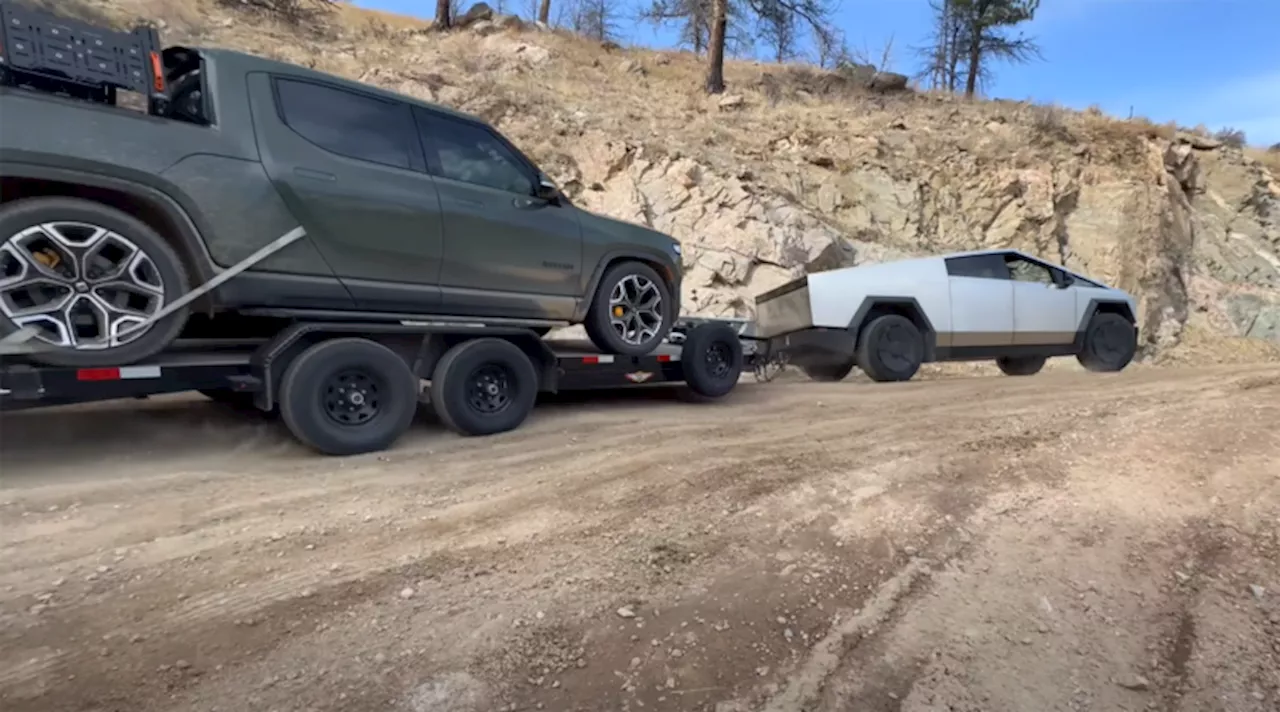
The Tesla Cybertruck, with its angular, stainless-steel exoskeleton and futuristic silhouette, has long been a lightning rod for debate. Is it a revolutionary leap in automotive design or an overambitious gamble? When Tesla announced that the Cybertruck could tow up to 11,000 pounds, the world took notice. But numbers on paper rarely tell the full story. What happens when this cyberpunk-inspired behemoth is put to the test with a 5,000-pound load in the real world? The answer isn’t just about raw capability—it’s about redefining what an electric truck can be in the crucible of practicality.
The Cybertruck’s towing prowess is more than a spec sheet footnote; it’s a statement. In a landscape dominated by traditional pickup trucks, where towing is often synonymous with brute force and mechanical complexity, Tesla has flipped the script. Instead of relying on a thrumming V8 or a torque-laden diesel, the Cybertruck harnesses the silent, relentless torque of its electric powertrain. This isn’t just towing—it’s a technological ballet, where electrons replace exhaust fumes, and efficiency trumps tradition.
The Silent Titan: How Electric Torque Transforms Towing
Imagine a beast that doesn’t roar but hums—a machine that doesn’t shudder under load but glides with eerie composure. The Cybertruck’s electric motors deliver instant torque, a characteristic that renders traditional towing anxieties obsolete. There’s no lag, no hesitation, no need to rev an engine to life. Instead, the truck responds with the precision of a Swiss chronometer, accelerating smoothly even when burdened with 5,000 pounds of cargo.
This silent dominance is more than a novelty; it’s a paradigm shift. In a world where internal combustion engines have long dictated the rhythm of towing, the Cybertruck introduces a new cadence—one where the absence of noise doesn’t equate to a lack of power. The torque curve of an electric motor is flat, meaning the Cybertruck doesn’t lose steam as it climbs hills or fights against wind resistance. It’s a relentless force, unburdened by the mechanical constraints of pistons and gears.
Yet, this transformation isn’t without its challenges. The weight of the battery pack, while essential for range, also means the Cybertruck carries a lower center of gravity. Towing amplifies this effect, creating a dynamic where stability becomes paramount. Tesla’s engineers have addressed this with adaptive suspension and a reinforced chassis, ensuring that the truck remains planted even when hauling a small boat or a trailer full of construction materials.
The Range Dilemma: When Towing Meets Reality
Here’s where the rubber meets the road—or rather, where the electrons meet the asphalt. Tesla’s official range estimates for the Cybertruck are impressive, but real-world towing introduces a harsh truth: efficiency plummets when the truck is under load. Towing 5,000 pounds isn’t just about strength; it’s about endurance. The Cybertruck’s range drops precipitously, not because of mechanical failure, but because physics demands it.
Consider this: an unladen Cybertruck might achieve 300 miles on a full charge, but with a 5,000-pound trailer in tow, that figure could dwindle to 150 miles or less. The energy required to move such a mass is colossal, and the truck’s aerodynamics, while sleek, aren’t optimized for the chaotic airflow created by a trailer. This is where the Cybertruck’s Achilles’ heel becomes apparent—not in its ability to tow, but in its ability to do so without frequent pit stops.
Yet, this isn’t a failure; it’s a trade-off. Traditional trucks suffer from the same issue, but their owners have grown accustomed to the ritual of refueling every few hundred miles. The Cybertruck, in contrast, forces a reevaluation. Is it better to spend hours at a gas station or to plan a route around charging stops? For those who embrace the electric future, the answer is clear. The Cybertruck’s towing range may be diminished, but its overall efficiency—measured in cost per mile—often surpasses that of its fossil-fueled counterparts.
The Cybertruck’s Aesthetic: Form Follows Function (and Vice Versa)
The Cybertruck’s design is polarizing, a jagged silhouette that looks like it was hewn from a block of stainless steel by a futurist sculptor. But this isn’t mere artistry; it’s engineering. The angular panels aren’t just for show—they’re a deliberate choice to minimize drag and maximize structural integrity. When towing, every degree of aerodynamic efficiency counts, and the Cybertruck’s wedge shape slices through the air with surprising grace.
Yet, the truck’s design also introduces practical challenges. The lack of a traditional grille means there’s no place to mount a conventional radiator, forcing Tesla to rely on liquid cooling for the battery and motors. The sharp edges, while visually striking, can also create turbulence behind the truck, further impacting efficiency. It’s a reminder that even the most radical designs must contend with the immutable laws of physics.
But perhaps the most intriguing aspect of the Cybertruck’s aesthetic is its psychological impact. Towing a trailer with a vehicle that looks like it belongs in a sci-fi film isn’t just practical—it’s a statement. It says, “I’m not bound by convention.” In a world where trucks are often associated with rugged individualism, the Cybertruck redefines that narrative. It’s not just a tool; it’s a manifesto.
The Human Factor: What It’s Like to Tow with the Cybertruck
Driving the Cybertruck while towing is an experience that defies expectations. The truck’s massive size and weight make it feel like a mobile fortress, yet the steering remains surprisingly light. The regenerative braking system, a hallmark of Tesla’s electric vehicles, provides a level of control that’s almost surgical. There’s a sense of confidence here, a feeling that the truck is in complete command of the situation.
Yet, the human element can’t be ignored. The Cybertrug’s lack of a traditional truck bed means that towing is its primary purpose, not an afterthought. This focus is both a strength and a limitation. For those who need a truck for work, the Cybertruck’s utilitarian design might feel lacking. But for those who see it as a statement piece—a rolling testament to innovation—the trade-offs are worth it.
There’s also the matter of charging infrastructure. Towing a 5,000-pound load requires careful planning, especially when it comes to finding compatible charging stations. Not all Superchargers are rated for heavy loads, and the truck’s weight can put additional strain on the charging equipment. It’s a reminder that while the Cybertruck is a marvel of engineering, the world around it isn’t always ready to accommodate its ambitions.
The Verdict: A Revolution in Towing, or Just a Bold Experiment?
The Tesla Cybertruck’s towing range test with a 5,000-pound load reveals a vehicle that is as flawed as it is fascinating. It’s a machine that excels in areas where traditional trucks struggle—efficiency, torque, and sheer technological audacity—but falters in others, like range and charging convenience. It’s not the perfect truck, but it might be the most interesting one.
For those who crave innovation, the Cybertruck is a glimpse into the future. It’s a truck that doesn’t just tow; it redefines what towing can be. It’s silent where others roar, efficient where others guzzle, and bold where others play it safe. It’s a vehicle that demands you reconsider everything you thought you knew about trucks.
And perhaps that’s its greatest appeal. The Cybertruck isn’t just a machine; it’s a challenge. It challenges the status quo, the conventions, and the very idea of what a truck should be. In a world that often prioritizes familiarity over progress, the Cybertruck stands as a defiant beacon of change.
So, is it the ultimate towing machine? Not yet. But it’s the closest thing we’ve seen to a truck that could one day render the gas-guzzling behemoths of the past obsolete. And in that sense, it’s already a success.