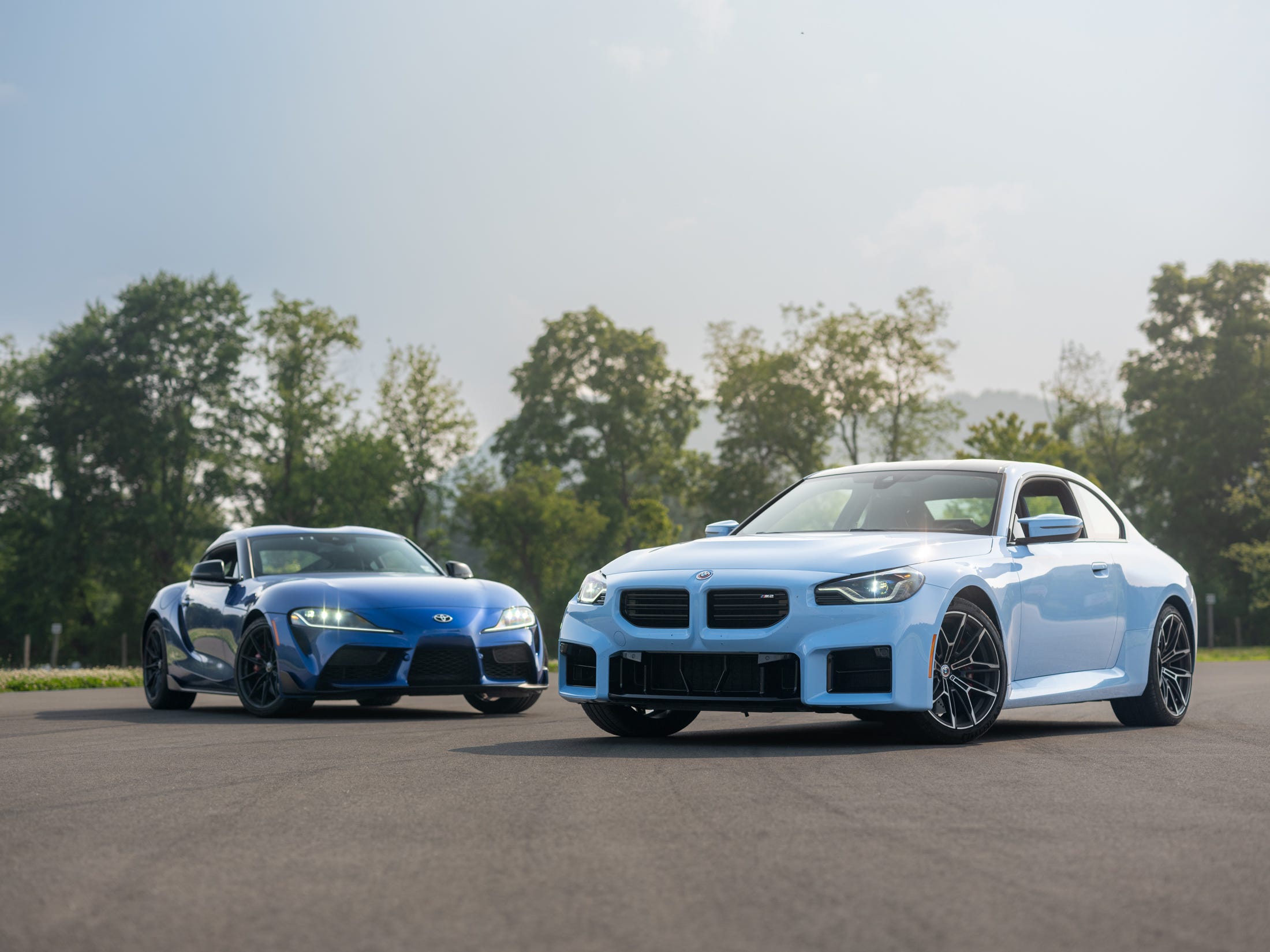
The BMW M2 and the Toyota GR Supra may look like two variations on a familiar theme: modern sports coupes, sculpted for the road, engineered for the kind of grin that arrives a second after the throttle blips. Yet beneath their sleek silhouettes lies a fundamentally different philosophy. The M2 is an exercise in compact authority—sharper, tighter, and steeped in the traditions of a brand that believes a driver’s seat should feel like the control tower. The Supra, by contrast, is a long-breathed performer with a more global rhythm—its straight-six character delivered with a sense of momentum that feels almost effortless, even when it’s anything but.
This duel isn’t only about lap times or peak numbers. It’s about how each car interprets the same request: “Make me feel fast.” One answers with precision and immediacy. The other answers with propulsion and flow. Put them side by side, and the contrast becomes the story.
First Impressions: Presence, Proportions, and the Sound of Intent
Stand before the M2 and the first sensation is density. The proportions feel purposeful, as if the car has been condensed around the drivetrain like a carefully engineered secret. Panel gaps look deliberate, and the stance suggests an eagerness to turn-in rather than simply to travel forward.
The Supra’s presence is different—less coiled and more aerodynamic, its shape wearing speed like an accessory. Even when stationary, the Supra seems to be waiting for motion to unlock its full personality. The cockpit, too, carries a slightly more cinematic posture: a view of the road that feels designed for sustained acceleration and sweeping lines.

Sound plays a role here as well. The M2 tends to project an aggressive clarity—mechanical and eager. The Supra leans into a smoother, more orchestral delivery. Neither is “better” in the abstract, but they each cast a different spell on the driver.
Engine Character: Turbo Response Versus Straight-Six Poetry
Under the hood, the essence of each car emerges. The Supra’s straight-six isn’t merely an engine—it’s a personality. The airflow through its turbo setup builds with a sense of intent, and the delivery often feels linear enough to encourage repeat throttle applications without the sensation of an on/off switch.
The M2’s straight-six, in typical BMW fashion, is engineered for driver involvement. Its power arrives with crispness, and the torque curve often feels calibrated to reward precise pedal modulation. The result is a driving experience that can feel almost telepathic: inputs travel from your foot to the rear tires with minimal delay.
In a straight-line contest, this matters. If you’re the kind of driver who likes to “measure” launches—feathering, correcting, and repeating—both cars will oblige. But if you prefer a more visceral shove, the M2’s immediacy can feel like a compact surge. If you prefer a relentless pull that builds into a horizon-stretching sprint, the Supra’s character can feel more expansive.
Transmission and Gearbox Temperament
Both coupes are built around a modern duality: everyday usability with the ability to go feral. Still, the way each transmission communicates is part of the personality.
The M2 often emphasizes a close ratio mindset. It invites frequent gear changes, rewarding decisive shifts and punishing indecision. The Supra, while also quick to respond, can feel more about maintaining momentum—less about constant interruption, more about keeping the engine in its favored band.
That difference becomes obvious in traffic and canyon driving alike. In stop-and-go conditions, the M2 may feel more “engaged,” as if it’s constantly nudging you to drive. The Supra can feel smoother at lower speeds, offering a more relaxed composure while still being ready to pounce.
Steering Feel and Chassis Coherency: Who’s More Focused?
Chassis coherency is the art of making the car feel like one continuous thought. The M2 typically wins this category in terms of steering feedback and front-end clarity. Its front axle tends to communicate grip with a tangible honesty. Turn-in feels direct, and the car often rotates with a confident willingness, especially when driven with commitment.
The Supra can feel similarly eager, but the way it reaches its limit may feel different—more about maintaining a stable trajectory and using rear traction rather than relying solely on steering bite. In fast sweepers, the Supra’s composure can read as composed and planted. The M2’s composed is also real, but it often arrives as sharpness: a sense of the nose being sculpted into the corner.
Both cars can be playful, but their play styles differ. The M2 can encourage quick corrections, while the Supra encourages a more flowing rhythm—less “flick and recover,” more “commit and accelerate.”
Braking and Heat Management: Confidence Under Repetition
When the driving becomes harder—repeated stops, sustained track pace—brakes are the ultimate honesty test. The M2 generally inspires a feeling of robust deceleration with a pedal that communicates clearly. Fade resistance tends to be strong enough that repeated braking doesn’t immediately turn the experience into guesswork.
The Supra, too, can deliver serious stopping power. Yet the overall sensation may lean slightly more toward endurance and traction management rather than raw, immediate bite. Either way, the point is psychological as much as mechanical: a car that brakes with consistency keeps the driver bold. A car that starts to fade forces a retreat into caution.
Consider this duel like a relationship. Both cars want trust, but they earn it in different ways.
Suspension and Ride Quality: How Comfort Becomes a Performance Tool
Ride quality is often treated as a separate topic, but it’s directly tied to performance. A car that absorbs imperfections without losing composure can maintain better tire contact, which becomes traction—sometimes measured, sometimes felt.
The M2 tends to feel more tightly sprung, ready to respond to steering and throttle inputs with minimal delay. That can mean a firmer, more immediate connection over rough surfaces. On the road, it can feel taut and purposeful, like the suspension is always prepared to become a racecar at the flip of a switch.
The Supra’s suspension character is frequently described as more balanced for everyday use, while still supporting spirited driving. It can feel calmer over broken pavement, and that calmness can make it easier to sustain focus on longer drives—exactly the kind of scenario where “sports coupe” becomes “touring weapon.”
Interior Ergonomics and Driver Psychology
The driver’s seat is where performance becomes personal. The M2’s cockpit often emphasizes immediacy—controls within a quick reach, a layout that feels built for active participation. The materials and instrumentation typically reinforce a sense of sporting intent.
The Supra’s interior leans into a more driver-focused minimalism, where visibility and layout create a clean mental runway. It’s designed to help you stay oriented at speed, keeping the experience less cluttered and more intuitive.
In long drives, the difference becomes emotional. The M2 can feel like a sports instrument—something to play. The Supra can feel like a stage—something to perform on. Neither feeling is inherently superior. The preference is personal, and the right answer depends on how you want your car to treat you.
Traction, Stability, and Limit Behavior: The Art of Staying Fast
The way a car approaches its limit is where enthusiast debates become religion. The M2 often reveals itself as a car that likes to rotate. Its grip management can feel precise, especially when traction control is calibrated to allow controlled slip without surrendering overall stability.
The Supra’s limit behavior can feel more rotationally smooth, often encouraging the driver to trust rear traction and throttle modulation rather than constant steering corrections. On a track, that can mean fewer abrupt transitions—yet still plenty of drama when you ask for it.
Both cars are capable of spirited driving well beyond the casual threshold. The question is not whether they can go fast. The question is whether they keep you feeling like you’re winning, even when the conditions become complicated—wet patches, changing temperatures, or uneven surfaces.
Daily Usability: Where the Duel Changes Stakes
Not every contest happens on a racetrack. Most of real life is parking lots, errands, and the slow creep of time through urban streets. Here, the M2’s compact nature can be a benefit, and its agility often makes it feel easy to maneuver despite its performance pedigree.
The Supra offers its own kind of practicality. It may not be a minivan—sports coupes rarely are—but its usability can feel more relaxed, especially in highway cruising. The difference is subtle: one car makes you want to hustle everywhere; the other makes you want to arrive in a more composed state.
Comfort becomes part of the performance equation. A car that you enjoy driving daily will create more opportunities to improve your own skill, turning everyday miles into training laps.
Value and Ownership Considerations: What Each Car Asks of You
Every performance purchase is a bargain between desire and responsibility. The M2 can feel like a focused investment in handling and driver engagement. Its maintenance and tire wear patterns—typical for a sports-oriented machine—should be treated as expected costs rather than surprises.
The Supra can feel like an investment in broad appeal: a globally recognized identity, a powerful straight-six experience, and a balance that can suit both spirited weekends and long drives. Ownership costs will also follow the reality of performance driving, but the Supra’s broader comfort profile can reduce the day-to-day “wear” on both body and mind.
In the ownership phase, the “winner” depends on your lifestyle. Are you seeking a compact weapon for quick sessions and sharp roads? Or are you seeking a long-breath performer with effortless momentum?
Conclusion: Two Legends, One Road, Different Kinds of Fast
BMW M2 versus Toyota GR Supra is not a simple ranking; it’s a comparison of emotional engineering. The M2 tends to feel like a scalpel—precise, responsive, and eager to translate your intent into movement. The Supra feels more like a thrust—smooth, expansive, and devoted to building speed with relentless confidence.
Choose the M2 if you want sharp steering communion, immediate throttle satisfaction, and a chassis that invites rapid decision-making. Choose the Supra if you want a straight-six experience that pulls with momentum, a more relaxed rhythm for longer drives, and a performance character that feels like momentum you can sculpt rather than a surge you must manage.
Either way, the duel delivers. Because in the end, these cars share something vital: the ability to make ordinary roads feel like they’re been re-machined for the driver’s enjoyment. Fast is not just an outcome—it’s a feeling. And both the M2 and the Supra know exactly how to deliver it.