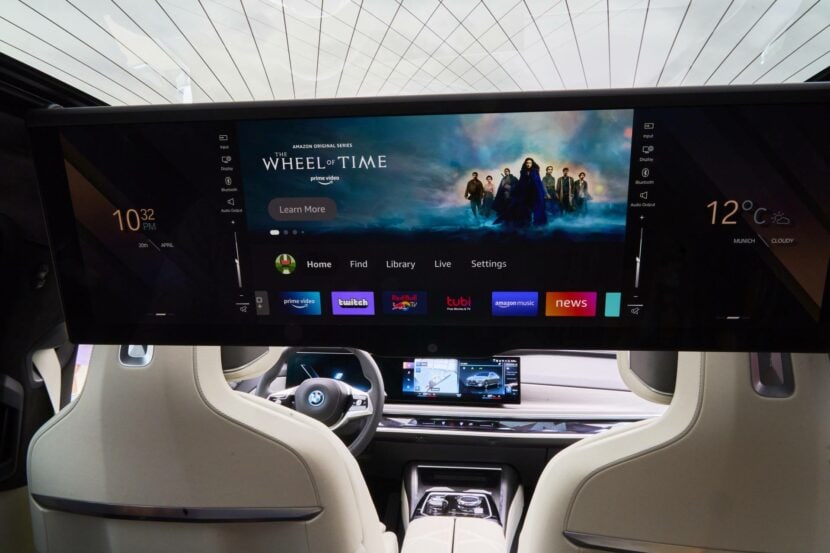
The moment the BMW 7 Series rear door closes, the cabin seems to exhale. Conversation lowers itself into a softer register. Light becomes more deliberate. Space feels less like a measurement and more like an arrangement—engineered, tuned, and quietly confident. Many people notice the obvious comforts first: plush seating, the hush of good insulation, the intuitive controls. But there’s a second layer that tends to reveal itself later, often when the car becomes less a vehicle and more a private venue. That’s where the Theater Screen enters the story, turning a back seat into an event space.
This test focuses on rear-seat luxury and the Theater Screen experience—why it feels persuasive at first glance, and why it lingers long after the drive ends. A common observation is that “it’s just a screen.” Yet that phrase misses what the 7 Series is actually doing: it orchestrates attention, reframes comfort, and makes time feel curated for the passengers behind the wheel.
Rear Seat First Impressions: Comfort That Feels Personal
Get behind the wheel and you’re aware of performance. Set yourself into the 7 Series rear seat and you’re aware of control. The surfaces are tactile in a way that’s hard to fake: supple, consistent, and free from the cheap “look but don’t touch” syndrome. The seat contours cradle without turning into a wrestling match, and the support is timed to the body rather than the other way around.
What stands out during the first minutes is the sense of easy inhabitance. Adjustments are rarely dramatic; instead, they feel incremental, like a tuning process. A small shift changes posture. A minor angle tweak changes breathing. That subtlety matters because rear-seat luxury isn’t only about softness—it’s about how the cabin collaborates with the passenger’s anatomy over time.
The 7 Series also treats sound like a design material. Wind noise is muted. Road texture is filtered. Even when the car is moving briskly, the cabin maintains an air of composure. It’s not silence; it’s a well-tempered acoustic stage. The result is a space where a short trip feels longer in the best way, and a longer ride feels less like endurance and more like a private retreat.
Microclimate and Mood: The Cabin as a Subtle Environment
Rear-seat luxury becomes most convincing when the car starts managing mood without announcing itself. Climate control in the 7 Series doesn’t just cool or warm; it smooths temperature gradients. A mild draft doesn’t suddenly hit the neck. Humidity doesn’t spike into discomfort. Instead, the cabin maintains a stable, almost spa-like equilibrium.
Lighting plays along. Ambient illumination creates a gentle chiaroscuro—bright enough to read, subdued enough to relax. It’s the kind of design that makes a passenger instinctively slow down. Short sentences turn into longer ones. Phones are picked up less frantically. Even the posture relaxes, as if the cabin’s ambience is persuading the body to stop bracing for the outside world.
Controls and Usability: Luxury That Doesn’t Require a Tutorial
A theater concept can fail if the interface is fussy. Here, the 7 Series aims for immediate confidence. Rear passengers can navigate entertainment and cabin functions with a clarity that doesn’t demand repeated learning. The controls feel logically arranged, and the system responds quickly enough to avoid breaking the illusion of effortless leisure.
The deeper trick is that good usability reduces cognitive overhead. When the interface is smooth, passengers don’t spend energy negotiating menus; they spend energy enjoying the moment. In practice, that means the Theater Screen becomes something you return to naturally, not something you “activate” like a contrived gadget.

Theater Screen Unveils Itself: From Feature to Atmosphere
When the Theater Screen is in play, it shifts the cabin’s identity. The rear seat stops being a comfortable place to wait and becomes a place to watch. The sense of immersion isn’t only about size—though the screen is undeniably commanding. It’s also about placement, angle, and the way the screen integrates into the cabin’s visual field.
A common observation is that “people will like it, but it’s excessive.” That view is understandable, especially in a world where dashboards are already crowded with technology. Yet the 7 Series makes a stronger case by turning excess into choreography. The screen is not a random attachment; it’s framed like a centerpiece, calibrated to be visible without dominating the entire cabin.
As content begins—sports, films, or a curated playlist—the cabin starts to behave differently. Passengers shift from passive viewing to engaged attention. The air feels fractionally more ceremonial. Even non-viewers find themselves glancing over, drawn by the movement of action on screen. The Theater Screen doesn’t just entertain; it gathers presence.
Image Quality and Viewing Comfort: Watching Without Fatigue
Luxury entertainment fails when it causes fatigue. Brightness that’s too aggressive creates glare. Colors that aren’t tuned can feel either washed out or artificially saturated. The 7 Series Theater Screen aims for a balanced presentation, keeping contrast readable and color convincing.
What feels important during a test drive is consistency: the screen remains legible across changing cabin lighting conditions, and the viewing experience stays stable as the car turns and the environment changes. The rear passenger shouldn’t feel like they’re compensating—tilting, squinting, or adjusting. Instead, the cabin provides a stable visual workflow.
There’s also a psychological element. When a screen looks “right,” the brain accepts it as trustworthy. It stops questioning whether the experience will degrade. That trust is what turns a novelty into a habit.
Sound and Cinematic Believability: Immersion Beyond Pixels
A theater is never just a display. It’s also audio, timing, and atmosphere. The rear cabin’s sound environment helps make the Theater Screen feel more convincing. The car’s acoustic discipline keeps external noise from intruding at the edges of the movie or broadcast.
Good audio doesn’t merely play loudly. It separates detail without making it harsh. Dialogue stays intelligible. Impact scenes don’t flatten into indistinct noise. Even when volume increases, the sound remains coherent rather than chaotic.
This matters because immersion is a chain. Break one link—sound muddiness, a distracting echo, inconsistent clarity—and the magic dissolves quickly. The 7 Series aims to keep the chain intact, so the Theater Screen feels less like a gadget and more like a legitimate viewing room.
Real-World Scenarios: Why People Become Fascinated
It’s easy to test entertainment on a calm afternoon. It’s more revealing on real days: traffic, errands, and the in-between moments when passengers expect to be bored. In those situations, the Theater Screen creates a reason to settle in rather than check out.
Imagine a commuter trip that turns into a mini event. A family ride where someone wants a game highlight reel. A business journey where downtime is converted into entertainment without sacrificing comfort. The rear seat becomes a sanctuary for attention—briefly shielding passengers from the churn of time outside the glass.
That’s the deeper reason for fascination. The screen is a permission slip. It allows passengers to treat the car like an extension of their living space. The 7 Series doesn’t just offer luxury; it offers agency over how time feels.
Rear Luxury as a Whole Package: The Screen’s Role in the Design Philosophy
The Theater Screen doesn’t function in isolation. Rear-seat luxury is built from many quieter decisions: insulation, seat comfort, ambient lighting, usability, and a sense of visual calm. When these elements align, the screen becomes more believable because the cabin around it is already working like a well-tuned instrument.
The observation that “it’s just a screen” tends to ignore how luxury is assembled. The 7 Series assembles comfort into a system, and the Theater Screen is one part of that system. It’s not there to impress; it’s there to elevate the passenger experience at a fundamental level.
Small Details That Seal the Impression
Even when the screen is off, the rear seat retains its persuasive calm. The cabin feels intentionally composed, with no sense of cluttering distraction. That’s important—because the best luxury never forces you to look at it. It waits for you to relax enough to notice.
As the drive continues, the passengers become less fussy. Movements become slower. Conversations become more comfortable. The car stops being something you endure and becomes something you enjoy. That transition is the real success criterion for rear-seat luxury, and the Theater Screen accelerates that transition with cinematic flair.
Conclusion: A Rear Seat That Turns Travel Into Theater
The BMW 7 Series Rear Seat Luxury & Theater Screen test reveals more than a high-end display. It shows how a premium cabin can reshape attention, comfort, and mood. The fascination people feel isn’t only about spectacle—it’s about what spectacle enables. It enables passengers to disappear into a chosen experience while the car quietly manages the rest.
In a world full of gadgets, the Theater Screen earns its place by behaving like an atmosphere rather than an interruption. It complements a cabin built for relaxation, and it transforms waiting into watching, and travel into something closer to a private show. The 7 Series doesn’t merely bring rear-seat luxury closer to the passenger—it brings the passenger closer to the feeling of being at home, with the road rolling by like a soft, cinematic backdrop.