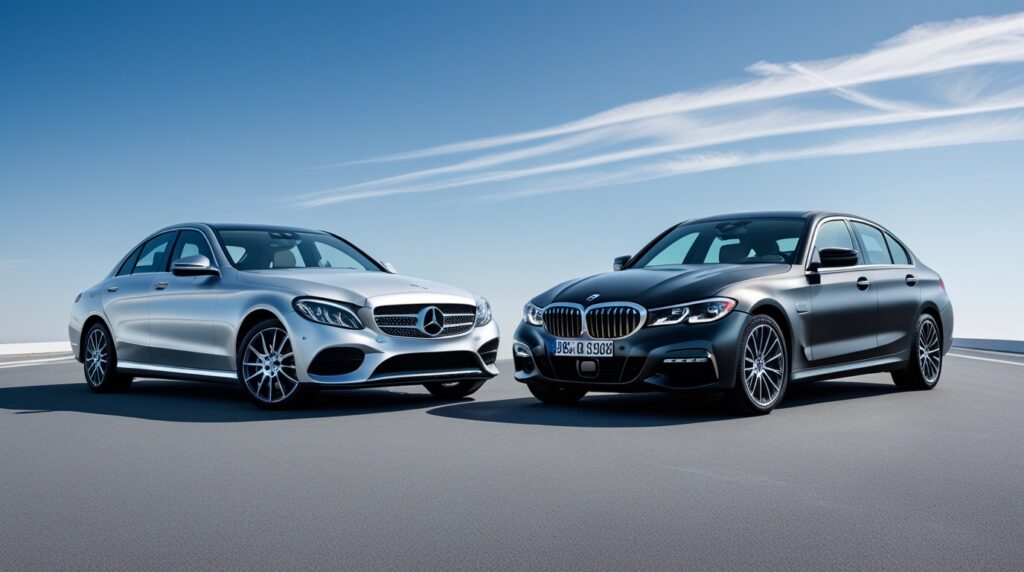
The first time you catch yourself comparing the BMW 3 Series and the Mercedes C-Class, something subtle happens. It isn’t simply about horsepower or infotainment menus—it’s about the kind of day you want to have once you’re behind the wheel. One car whispers with a tuned, almost mischievous confidence. The other speaks in a smoother cadence, promising comfort with a hint of gravitas. This entry-luxury duel is less a face-off than a philosophical divergence. And if you listen closely, the differences start to feel personal.
Consider the moment you press the engine start button. The cabin’s atmosphere changes. The steering feels like a decision, not a feature. The road becomes a stage, and both sedans arrive dressed for the spotlight—yet they play to different audiences. What happens next is where curiosity turns into conviction.
Two Temperaments, One Class of Aspirations
Entry luxury is not a monolith; it’s a spectrum of expectations. Some drivers want involvement—feedback, poise, and a sense that the car is responding to their intentions in real time. Others crave composure—silence, softness, and the feeling that the ride is engineered to absorb the world rather than highlight it.
The BMW 3 Series typically leans toward the former. It aims for a driving experience that feels sculpted, with controls that don’t merely work but communicate. The Mercedes C-Class, by contrast, often offers a more enveloping experience. Its charm is in how easily you settle in, how quickly the cabin becomes a cocoon, and how effortlessly daily life seems to glide by.
Neither is “better” in the absolute sense. Instead, each makes a different promise. BMW’s promise is agency—control that feels earned. Mercedes’ promise is serenity—comfort that feels instinctive.
Design Language: The Look That Leads the Mind
Design is a prelude. Before speed enters the equation, styling tells you what kind of ownership story you’re stepping into. The BMW 3 Series often presents itself like a confident sketch: crisp character lines, an athletic stance, and details that suggest motion even when parked. It has a certain angular sincerity, the kind that makes you glance twice.
The Mercedes C-Class tends to arrive with a more fluid elegance. Its surface treatments feel carefully composed, with a design cadence that emphasizes refinement over aggressiveness. In motion, that refinement reads as effortless. It’s not trying to dominate the street; it’s trying to curate it.

When you choose between them, you’re also choosing how you want the world to perceive you. BMW leans toward driver-forward charisma. Mercedes leans toward understated luxury.
Interior Atmosphere: How the Cabin Changes the Day
Step inside either vehicle and you’ll feel the difference in priorities immediately. The BMW 3 Series interior frequently targets a “driver-in-the-loop” sensation. Controls tend to feel intuitively placed, and the layout often encourages you to engage. Even when you’re not actively driving in an enthusiastic way, the cabin nudges you toward attentiveness.
The Mercedes C-Class interior aims for calm. Materials and surfaces can feel more indulgent to the touch, and the overall environment often reads as more spacious—less like a cockpit and more like a tailored lounge. There’s usually a soothing logic to the way functions are organized. It’s comfort dressed up as usability.
This is where perspective shifts. You begin to notice how you behave in each environment. Do you like to reach for controls quickly, or do you prefer your day to unfold with minimal friction? Both cars can do either. Yet their interiors nudge you toward different habits.
Infotainment and Technology: Convenience vs Confidence
Modern cars don’t just transport; they think alongside you. The question is how they do it. The BMW 3 Series experience often feels like a digital extension of driving—menus are there when you need them, and the system typically supports a more responsive, driver-centered workflow.
Meanwhile, the Mercedes C-Class infotainment approach often feels polished and fluid, emphasizing ease and visual clarity. It tends to prioritize a clean, contemporary user experience—one that doesn’t demand your full attention to be effective.
At first glance, this can seem like a matter of taste. But after a week of real use, taste becomes something else: confidence. Which interface makes you feel in command? Which makes you feel looked after? The answer can be surprisingly revealing.
Ride Quality and Handling: The Road’s Interpretation
Ride quality is where your daily route gets translated into emotion. The BMW 3 Series often provides a more dynamic feel—tight steering response, a controlled composure through corners, and an unmistakable sense of involvement. Even at legal speeds, it can make you feel that the chassis is awake.
The Mercedes C-Class typically focuses on smoothing out the rough edges. It aims for a more relaxed ride character, especially over uneven surfaces. The suspension works to filter harshness and maintain stability without broadcasting every pavement imperfection.
What’s fascinating is that both approaches can feel sporty—just in different ways. BMW can feel sporty because it communicates. Mercedes can feel sporty because it stays poised. One offers feedback; the other offers composure. The choice becomes less about speed and more about how you want the road to “speak.”
Performance and Powertrains: What Your Foot Actually Feels
Performance in this segment is rarely only about peak numbers. It’s about how quickly power arrives and how naturally it integrates with the rest of the car’s personality. The BMW 3 Series often delivers a more immediate, anticipatory response—acceleration that feels connected to throttle inputs. It invites you to drive with intention.
The Mercedes C-Class typically emphasizes smoothness and refinement. Acceleration may feel less “urgent” and more composed, as if the car is making progress with quiet authority. If you like the sensation of momentum without drama, Mercedes often hits the mark.
Then comes the question that separates daydreaming from ownership: do you want your car to feel like it’s eager to play, or like it’s eager to protect your comfort while it goes? BMW tends to feel engaged. Mercedes tends to feel composed.
Safety, Driver Assistance, and Peace of Mind
Entry luxury also means responsibility—systems designed to reduce uncertainty. Both vehicles typically include modern driver assistance features, designed to help with lane support, collision warning, and adaptive cruise behaviors.
Yet the real difference is how these systems are tuned to the driver’s expectations. Some cars feel intrusive; others feel like gentle guidance. The best safety tech feels almost invisible—present when needed, unobtrusive when not.
Imagine driving in rain at dusk, where visibility is imperfect and fatigue creeps in. In that moment, peace of mind becomes a luxury. The car that best supports your attention without stealing it earns trust.
Practicality and Ownership: Where the Numbers Meet Reality
Ownership isn’t just a test drive. It’s the long-term rituals: commuting, grocery runs, weekend errands, and the occasional detour. Trunk space, rear-seat comfort, visibility, and ergonomics matter more than people expect.
Both the BMW 3 Series and the Mercedes C-Class are designed to be everyday capable. But they may feel different in how they prioritize access and comfort. One might feel more driver-focused in sightlines and controls. The other might feel more lounge-like for passengers.
Even small items—how easy it is to stow a bag, how supportive the seats feel after an hour, how straightforward the climate controls are—can tilt the decision. The duel isn’t only on paper; it’s in the mundane moments that become memories.

The Verdict That Isn’t a Verdict
If the BMW 3 Series is the choice of a driver who wants engagement, the Mercedes C-Class is the choice of a driver who wants relaxation—without sacrificing sophistication. Both provide entry luxury in the truest sense: you’re not just upgrading from a standard sedan; you’re upgrading how your life feels on the move.
Here’s the shift in perspective: don’t ask which car is objectively “better.” Ask which car will make you more yourself. Do you want to feel connected to the road, steering through corners with a sense of encouragement? Or do you want the world softened around you, where comfort leads and performance follows?
In the BMW 3 Series vs Mercedes C-Class duel, the answer isn’t universal. It’s experiential. And once you notice how each car makes you think—how it shapes your habits behind the wheel—the decision becomes less like choosing a vehicle and more like choosing a rhythm.
Final Thoughts: Choose the Promise You’ll Keep
Entry luxury is a promise. BMW promises involvement, clarity, and a driving experience that feels like a dialogue. Mercedes promises refinement, ease, and a cabin that treats your time as valuable.
When your commute ends and the day finally quiets down, you’ll remember not just where you went, but how it felt to go there. That’s the real luxury. That’s the reason this duel remains compelling—because it invites you to look past specifications and toward identity.
Pick the car whose promise you want to live with. The road will handle the rest.