Ready for a road trip where the scenery changes faster than your playlist—yet your charge percentage stays remarkably calm? Picture this: you’re cruising past postcard towns, the horizon is doing its best impression of infinity, and then—right as the route turns scenic—the navigation clock announces the next charging stop. That’s the moment the real test begins. Not battery range alone. Not just “top speed.” It’s navigation clarity, charging velocity, and the subtle choreography between them.
Here’s a playful question to set the stakes: what if your next EV road trip isn’t limited by the miles between chargers, but by the time it takes to reach them, verify availability, and return to the fast lane of your itinerary? That’s the potential challenge—an invisible bottleneck. When it hits, the trip can feel like it’s being throttled by confusion rather than physics.
Let’s make that bottleneck disappear. Below is a comprehensive, road-trip-first view of the best 2025 EVs—with an emphasis on navigation reliability and charging speed, the two pillars that keep long drives fluid and fun.
Why navigation is a road-trip superpower (and not just a map)
Navigation in an EV isn’t merely directional. It’s predictive orchestration. The strongest systems model your remaining charge, estimate energy usage, and adjust routing based on elevation changes, traffic conditions, and temperature. Short sentences can be surprisingly accurate here: the best nav doesn’t just show options—it anticipates them.
On a road trip, look for three traits. First, charging-aware routing that treats chargers as part of the journey, not an afterthought. Second, real-time station intelligence, such as stall availability, power output variability, and whether a connector type matches your vehicle. Third, rerouting responsiveness: if a charger goes offline or you miss a turn, the system should recalibrate without making you feel like you’ve entered a labyrinth.
Even the most efficient EV can suffer if the software keeps suggesting “theoretically reachable” chargers that are actually inconvenient. That mismatch is where trips stall—sometimes literally, when you arrive and the station behaves like a ghost town.

Charging speed: the difference between “quick top-up” and “time tax”
Charging speed isn’t a single number. It’s an experience curve shaped by battery temperature, state of charge, connector compatibility, and the charger’s ability to deliver sustained power.
In practical road-trip terms, the sweet spot is often early in the charging window: when the battery is cool enough to accept higher current, and when the EV’s thermal management is doing its job with disciplined enthusiasm. Many EVs begin strong, then taper as the battery fills. That taper isn’t failure—it’s chemistry. But the vehicle that tapers later (or more gently) tends to feel dramatically faster at the pump.
When evaluating 2025 EVs for long drives, consider how each car handles “arrive low, charge effectively” behavior. A well-designed charging strategy can cut the length of each stop while also reducing the frustration of watching your estimated time to full charge drift upward like a balloon.
Also pay attention to charge session consistency. Two cars with similar peak kilowatts can feel different if one car’s system negotiates power more steadily. Road trips are full of tiny decisions—your charging plan shouldn’t become a gamble at every stop.
Best 2025 EV picks for road trips (navigation + charging velocity)
Let’s turn the concept into a practical checklist. The “best” 2025 EV for road trips tends to share a profile: confident driver-assist navigation, fast charging competence, and an energy estimate that remains believable even when you’re detouring for snacks or views.
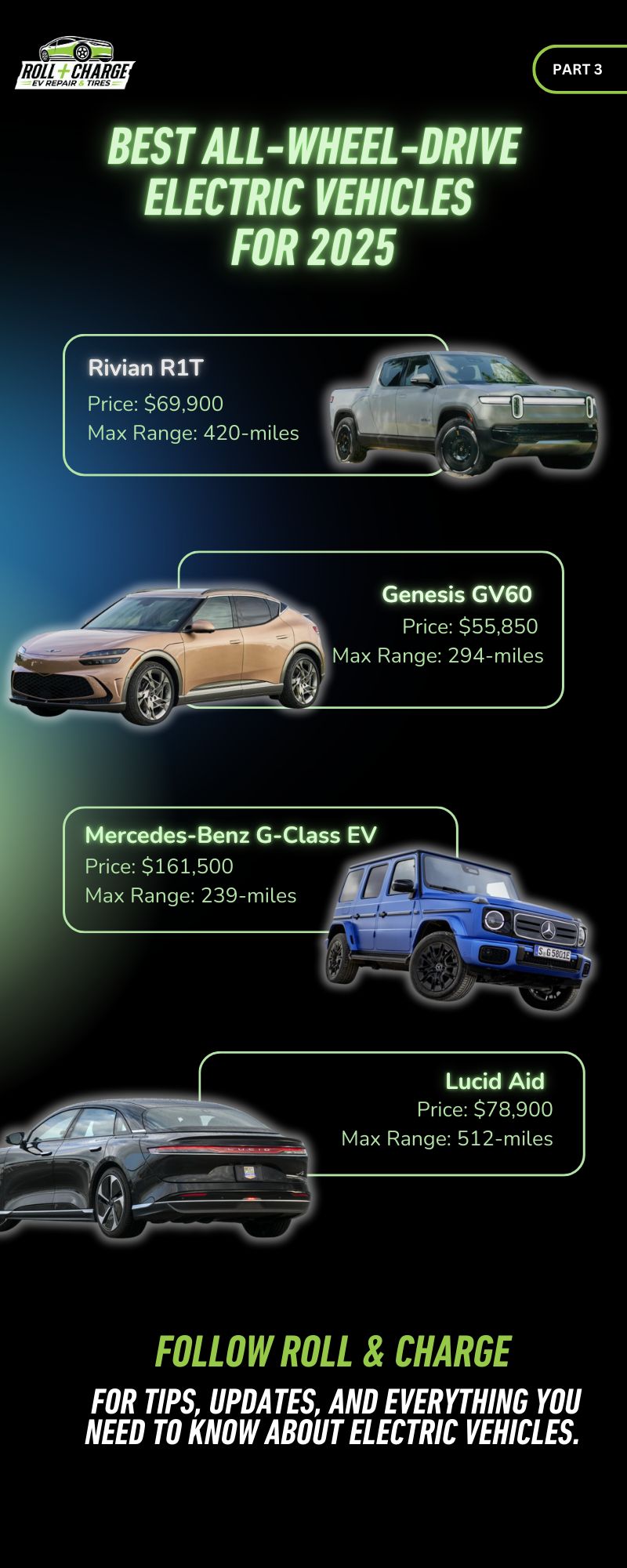
All-wheel-drive EVs often shine on unpredictable stretches—rain, wind, and uneven grip. For road trips, this matters because lateral traction and stability can reduce efficiency losses during spirited cornering or slippery highway conditions. The result can be fewer “why is my range shrinking?” moments.
Look for models that support robust fast-charging networks and that integrate charging stops into their route planning with minimal friction. The best systems allow you to add or swap charging locations on the fly, keeping your schedule intact.
Charging speed leaders usually combine high peak charging capability with intelligent battery temperature control. That combination can turn a typical break into an efficient reset: arrive, charge, resume—without the sense of waiting for the battery to “think about it.”
Finally, consider user experience design. Does the interface make it easy to confirm charger details, connector type, and expected power? Can you see charging progress and adjust departure time? Road trips are won in the menus as much as in the batteries.
The charging stop strategy: arrive prepared, leave unbothered
Here’s a simple, seasoned approach that prevents chaos: plan your first leg with a slightly conservative arrival buffer. Then let the car do what it does best—guide the next stop based on current conditions, not the fantasy of an ideal world.
At each charging stop, prioritize three actions. First, verify connector compatibility. Second, check whether the station is delivering full output to your stall—some stations split power between neighboring connectors. Third, set your departure time intentionally so the charging session feels like part of the itinerary rather than a dangling chore.
Short tip, long payoff: if your navigation suggests a charger that’s a few miles closer but likely to be congested, it can cost more time overall. A slightly farther, less crowded station can deliver a faster total journey.
Route management: elevation, wind, and the art of energy budgeting
Road trips don’t happen on flat lines. Energy use changes with elevation and wind like a mood swing. Some EVs handle these variables more gracefully through predictive modeling, especially when navigation includes topography awareness and adapts in real time.
When heading into hilly terrain, consider charging earlier rather than later. This isn’t about superstition—it’s about efficiency. A battery that’s charged in a better operating window can accept power more effectively and reduces the risk of arriving with less flexibility.
If you’re traveling through regions with variable weather, keep an eye on driving mode suggestions. A tiny adjustment—like optimizing drivetrain behavior—can preserve range without flattening the fun.
What to expect during your charge: the “time feel” matters
Estimated charging time is a forecast, not a contract. But the best 2025 EV experiences tend to have fewer surprises. A well-calibrated system gives you clarity: how long until you can depart, what power level you’re likely to sustain, and how your charge will change as the battery fills.
When you stop, treat it like a ritual. Grab water. Stretch. Let the car finish its thermal conditioning. This prevents the awkward scenario where you unplug earlier than planned and then regret it immediately on the next stretch.
Also note: charging speed can vary by season. Cold weather can reduce power acceptance. The EVs that precondition the battery—often prompted automatically by navigation—feel notably more “road-trip ready.”
Preparing your cabin and your schedule: less friction, more mileage
Navigation and charging speed are the technical spine, but the trip’s comfort determines whether you enjoy the journey. Many road-trip travelers prefer predictable cabin temperature. If the vehicle supports efficient preconditioning or scheduling, it helps reduce unnecessary energy draw during charging transitions.
Schedule your breaks similarly to how you schedule chargers. Plan for restroom stops, meals, and a brief walk. It’s not only practical; it resets attention. And attention is everything when you’re coordinating navigation updates, charger verification, and route tweaks.
Final take: choose the EV that keeps you moving
By now, the core truth should feel obvious: the best 2025 EV for road trips isn’t simply the one with the highest peak kilowatts. It’s the one that pairs navigation intelligence with charging speed you can trust—turning charging stops into smooth interludes instead of time leaks.
If you remember one thing, let it be this: the most successful road trips are engineered by the combination of route prediction, realistic charging availability, and a charging strategy that avoids last-minute pressure. When those elements align, the open road stops being a test and becomes a celebration.
So go on—plot the route, choose the charger strategy, and let the miles roll. The only remaining question is whether you’ll be the kind of traveler who takes the scenic detour… or the kind who charges first and asks questions later.