The first time you see the 2026 Toyota GR Corolla carve through a winter training course, it can feel almost unfair. One moment the snow looks like a blank canvas. The next, the hatchback is drawing confident arcs—polite, precise, and strangely eager to keep going. It’s easy to attribute the spectacle to “good tires” or “AWD.” But the Winter Test reveals a deeper story: this car’s fascination isn’t just about traction. It’s about composure, feedback, and the way its engineering seems to respect the chaos outside the windshield.
That common observation—“it sticks in snow”—is only the surface gloss. Yes, the AWD helps. But what truly invites lingering attention is how the car behaves while you chase grip: the progression of torque, the discipline of the drivetrain, and the subtle orchestration between traction control, stability systems, and driver input. Winter doesn’t merely test capability; it exposes personality.
A Winter Test Begins Before the Wheels Ever Turn
In a snow test, the obvious part is acceleration, braking, and cornering. The less obvious part is anticipation. Cold air changes everything: rubber firms up, surfaces become slicker than they look, and the “feel” of steering can shift from crisp to vague in an instant. That’s where a performance AWD platform either earns trust or becomes a guessing game.
With the 2026 GR Corolla, the opening phases of a winter run tend to calm your expectations. Throttle response doesn’t lurch. Steering doesn’t wander. Even during the initial roll-on, the car communicates traction limits early—almost like it’s teaching you the course. Short commands become clearer. Longer maneuvers become manageable. The snow is still unpredictable, but your inputs aren’t met with theatrical drama.
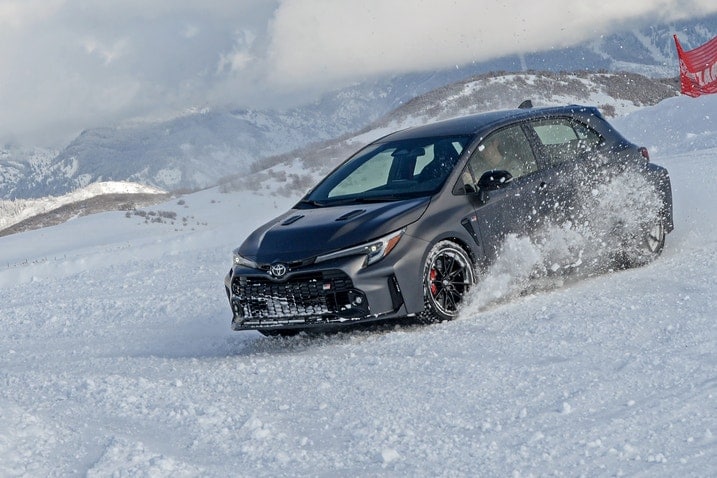
AWD in Snow: More Than “Power to All Wheels”
AWD in winter is often reduced to a single idea: send torque where it can grip. Yet snow is not a uniform substance. It transitions from powder to packed crust, from powdery drag to glassy glare. A system must react to micro-changes quickly, or else it turns into a delayed response—useful, but not inspiring.
The GR Corolla’s AWD character is the reason people keep returning to the idea of “snow training.” When the drivetrain senses slip, it doesn’t behave like a panic button. It behaves like a metronome—adjusting, rebalancing, and then smoothing out the next beat. That’s why drivers often remark on the car’s steadiness mid-corner. You can feel the tug of the system, but it doesn’t overwhelm your sense of direction.
Deeper still is how AWD interacts with the car’s wider performance architecture. The winter test isn’t only about sending torque—it’s about preserving stability while maintaining momentum. Momentum matters more than spectators realize. In snow, losing momentum means losing options.
The Steering Feedback That Makes Snow Feel Teachable
There’s a particular kind of delight that comes from steering which answers. Not just “turns the car,” but translates your intention into movement with minimal ambiguity. In winter, steering accuracy can vanish under heavy traction variation. If a car can’t maintain that dialogue, you end up overcorrecting—an exhausting cycle of small panic inputs.
The 2026 GR Corolla offers a different experience. Steering remains communicative even when the surface is temperamental. The front end feels loaded, then guided. You sense when grip is thinning rather than noticing only after the slide begins. That early communication is the real fascination: it makes you feel less like a passenger and more like a collaborator.
And here’s the deeper reason drivers get hooked. When a car provides credible feedback, you start tuning your habits. Your throttle becomes calmer. Your brake timing becomes more deliberate. Your confidence grows not because traction is magical, but because you’re learning the boundaries with each run.
Braking on Snow: Stability Under Deceleration
Braking in snow is rarely about pure stopping distance. It’s about attitude. A good winter car keeps itself composed while the tires negotiate a constantly changing friction coefficient. A shallow skid is one thing. A deep, chaotic shift in balance is another. The GR Corolla’s winter test highlights that distinction.
During repeated stops, the car tends to resist the “snap” behavior that can turn braking into a chore. You feel braking remain orderly—front-to-rear distribution working in tandem with traction control to avoid sudden sideways drama. Even when the surface is uneven or packed with melt-refreeze patterns, the vehicle’s deceleration feels managed.
Longer downhills reveal the subtlety. Heat cycling changes tire behavior, and snow can turn from powdery to slicker than expected. The GR Corolla maintains its composure through these transitions, encouraging smooth pedal discipline rather than forcing frantic corrections.
Cornering Dynamics: The Art of Staying Neutral
Cornering on snow is where fascination becomes obsession. The moment you enter a turn, you’re gambling with grip. But the best winter performers gamble intelligently—remaining neutral as traction wavers, then progressively offering rotation as the tires find purchase.
On the GR Corolla’s winter course, corner entry feels controlled. The chassis seems to respect geometry; it doesn’t throw surprises at the driver. Mid-corner, the AWD and stability systems work to keep the car’s attitude predictable. That predictability matters because winter drivers aren’t chasing lap times—they’re chasing reliability.
As the car transitions from entry to mid-corner, you can feel how the system prioritizes balance. The deeper fascination lies in the gradualness. Instead of an abrupt transition into a slide, the car tends to offer a warning. It teaches. It invites you to refine your line.

Throttle Control: Why Smooth Inputs Feel Faster in Snow
It’s counterintuitive, but in snow, smooth throttle is often the fastest throttle. Sudden power demands can overwhelm traction instantly, especially on patches of ice or compacted snow. The 2026 GR Corolla’s winter testing emphasizes this truth with almost psychological clarity.
When throttle inputs become progressive—more like a dial than a switch—the car uses AWD more effectively. Slip becomes smaller and shorter-lived. The chassis stays settled, letting you carry momentum without sacrificing control. You begin to understand that “faster” in winter isn’t about aggression; it’s about keeping the car pointed where you want it to go.
That’s why the car’s fascination deepens. It rewards maturity. It turns driving into a study of timing and restraint. Winter becomes less of an obstacle and more of an invitation to refine technique.
Tire Temperature, Traction, and the Psychology of Grip
One overlooked aspect of winter testing is tire temperature and compound behavior. A set of tires can feel magical at the start of a run and then turn moody as temperatures drop further or as snow becomes more abrasive. The 2026 GR Corolla’s test sessions demonstrate how consistent systems can’t substitute for physics—yet good engineering can mitigate the emotional whiplash.
When the car’s traction management is trustworthy, the driver is calmer. Calm translates into better inputs. Better inputs translate into more consistent grip. That feedback loop is addictive. It’s not merely that the car has capability—it’s that it makes capability usable.
Confidence Without Chaos: The Driver-Centric Outcome
At the end of a winter test day, the most meaningful metric is often intangible. Drivers remember not just what the car did, but how it made them feel while doing it. Did it surge into unpredictability? Did it demand constant vigilance? Or did it provide steady guidance, turning snow into a controllable environment?
The 2026 GR Corolla stands out because it avoids the extremes. It doesn’t feel like a lecture or a trap. It feels like a partner—one that respects your intentions and helps you correct mistakes before they become problems.
Outro: Why the 2026 GR Corolla Feels Like a Winter Compulsion
Snow doesn’t just test performance. It tests patience, rhythm, and humility. The 2026 Toyota GR Corolla’s winter test, with AWD in snowy conditions, shows why it continues to win attention: it transforms a hostile surface into a venue for control. The tires grip, the AWD distributes torque intelligently, and the stability logic holds the car’s attitude steady. But the fascination runs deeper than systems and specs.
What you take away is a sense that the car makes winter driving legible. It turns uncertainty into learning. It turns fear into finesse. And once you’ve felt that kind of composure in the snow—once the car has taught you how to read the surface—you don’t just remember the laps. You start planning the next one.