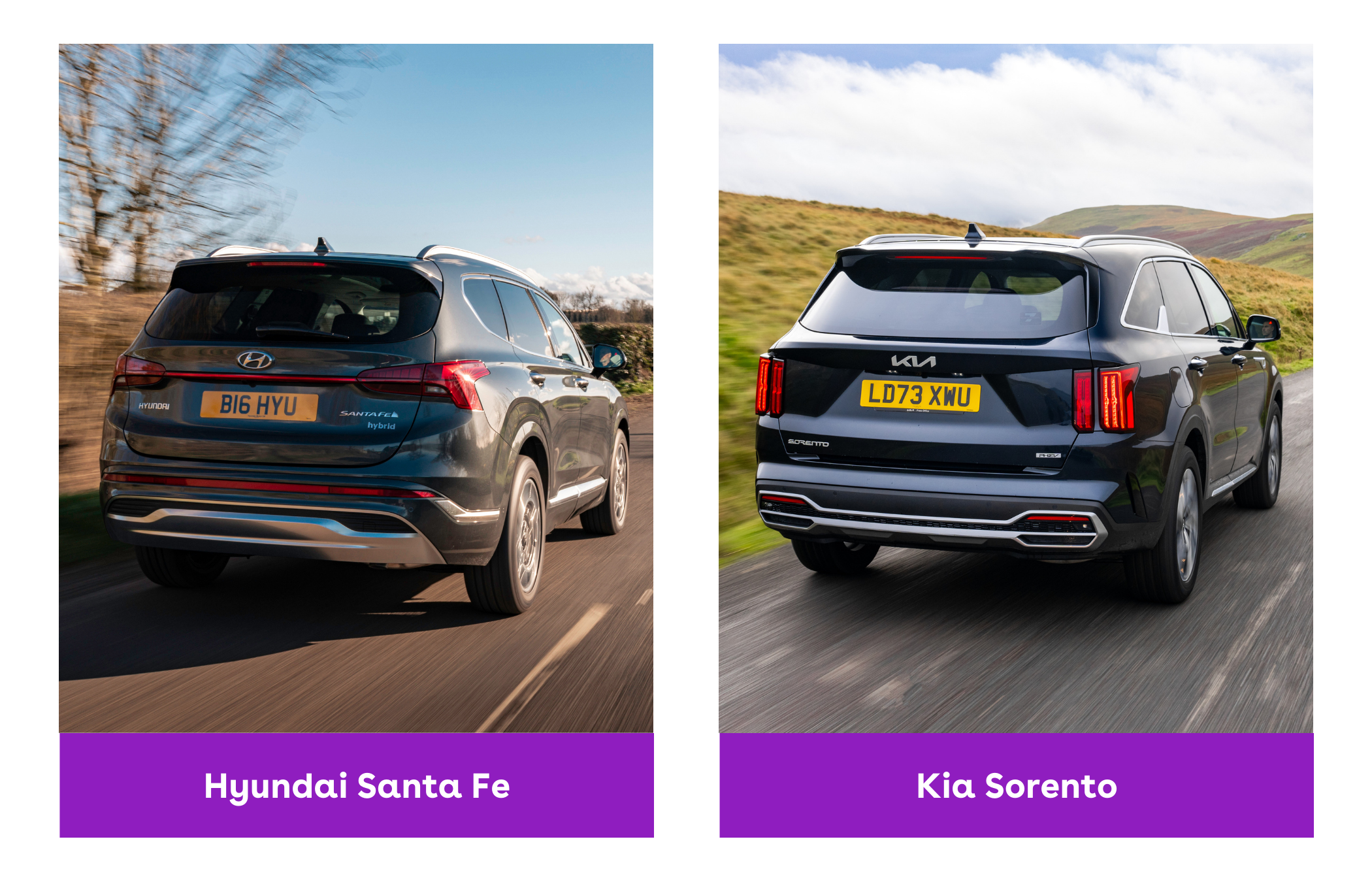
The midsize SUV arena is a battleground where power meets poise, where innovation duels with instinct, and where families seek sanctuary without sacrificing spirit. Two titans stand at the forefront of this skirmish: the Kia Sorento and the Hyundai Santa Fe. Each represents a distinct philosophy—one a symphony of bold design and cutting-edge tech, the other a masterclass in understated elegance and refined practicality. This isn’t just a comparison; it’s a clash of ideologies, a duel of personalities, where the right choice hinges on what you value most in a ride. Let’s dive into the heart of this midsize melee and uncover which SUV reigns supreme.
The Front Lines: Exterior Design and Presence
Picture the Sorento as a charismatic showman, draped in sharp angles and a bold grille that demands attention. Its front fascia is a study in assertiveness, with LED lighting that pierces the darkness like a lighthouse beam. The Sorento’s silhouette is sculpted, almost sculptural, with a sweeping roofline that gives it a coupe-like allure. It’s the kind of vehicle that turns heads in a parking lot and whispers, “I belong in the spotlight.”
Contrast that with the Santa Fe, a paragon of understated sophistication. Its design is a whisper rather than a shout, with smooth curves and a grille that exudes quiet confidence. The Santa Fe’s aesthetic is timeless, like a well-tailored suit—elegant, but never ostentatious. Where the Sorento commands, the Santa Fe charms. It’s the SUV for those who prefer to let their presence speak for itself.
Both vehicles offer a commanding road presence, but their approaches couldn’t be more different. The Sorento is the extrovert, the Santa Fe the introvert—yet both are undeniably striking in their own right.
The Inner Sanctum: Cabin Comfort and Tech
Step inside the Sorento, and you’re greeted by a cabin that’s as futuristic as a spaceship’s bridge. The dashboard is a digital canvas, dominated by a curved dual-screen display that seamlessly blends infotainment and instrumentation. The materials are premium, the stitching meticulous, and the ergonomics intuitive. It’s a space designed for the modern driver, where every button and dial feels like an extension of your fingertips.
But the Santa Fe’s interior is no less impressive. Here, the focus is on tranquility and space. The cabin is bathed in soft lighting, with ambient mood lighting that can be tailored to your mood. The seats are plush, almost cloud-like, and the panoramic sunroof bathes the interior in natural light. It’s a sanctuary on wheels, a place where stress melts away with every mile.
Both SUVs offer three rows of seating, but the Santa Fe’s second row is particularly spacious, making it a favorite for families with older children or frequent carpoolers. The Sorento, meanwhile, boasts a more tech-forward approach, with features like a rear-seat entertainment system that turns the back seats into a mobile cinema. It’s a battle of innovation versus comfort, and both sides have their merits.
The Engine Room: Performance and Driving Dynamics
The Sorento’s powertrain is a symphony of efficiency and power. Under the hood, you’ll find a turbocharged 2.5-liter four-cylinder engine paired with an eight-speed dual-clutch transmission, delivering a spirited 290 horsepower. It’s a setup that rewards aggression, with quick acceleration and a responsive throttle that makes merging onto highways feel effortless. The Sorento’s ride is firm, almost sporty, with a steering feel that’s precise and engaging.
The Santa Fe, on the other hand, offers a more refined driving experience. Its standard 2.5-liter four-cylinder engine produces 191 horsepower, but the available turbocharged 2.5-liter engine ups the ante to 277 horsepower. The Santa Fe’s ride is softer, more cushioned, with a suspension tuned for comfort rather than thrills. It’s the kind of SUV that glides over potholes and absorbs road imperfections with ease.
For those seeking adventure, both SUVs offer all-wheel-drive options. The Sorento’s AWD system is more performance-oriented, with a locking differential that enhances traction in slippery conditions. The Santa Fe’s AWD, meanwhile, is designed for all-weather confidence, with a system that automatically adjusts to changing road conditions. It’s a choice between agility and assurance, between the thrill of the drive and the peace of mind of a smooth ride.
The Cargo Hold: Practicality and Versatility
The Sorento’s third row is best suited for children or occasional use, as adult passengers will find the space tight. But when you fold the third row, the cargo area expands to a cavernous 44.2 cubic feet, with the second row sliding forward to create even more room. It’s a configuration that’s ideal for road trips or hauling large items, like a week’s worth of groceries or a set of golf clubs.
The Santa Fe’s third row is similarly compact, but its second row is more spacious, making it easier to access the rear seats. The cargo area behind the third row is 18.7 cubic feet, but fold the third row, and it balloons to 45.7 cubic feet. The Santa Fe also offers a clever “Easy Access” feature, where the second row slides forward automatically when you fold the third row, making it easier to load items into the back.
Both SUVs excel in practicality, but the Santa Fe’s slightly larger cargo area and more accessible third row give it a slight edge for families with growing kids or frequent travelers.
The Safety Net: Advanced Driver Assistance Systems
In the realm of safety, both SUVs are equipped with a suite of advanced driver assistance systems (ADAS) designed to protect you and your passengers. The Sorento offers features like Forward Collision-Avoidance Assist, Blind-Spot Collision-Avoidance Assist, and Lane Keeping Assist. It also includes a Highway Driving Assist system that can automatically adjust your speed and steering to maintain a safe distance from other vehicles.
The Santa Fe’s ADAS package is equally impressive, with features like Forward Collision-Avoidance Assist, Blind-Spot View Monitor, and Safe Exit Assist. The Santa Fe also includes a Highway Driving Assist system, as well as a Surround-View Monitor that provides a 360-degree view of your surroundings, making parking and maneuvering in tight spaces a breeze.
Both SUVs have earned top safety ratings from organizations like the IIHS and NHTSA, but the Santa Fe’s Surround-View Monitor and Blind-Spot View Monitor give it a slight edge in terms of visibility and ease of use.
The Final Verdict: Which SUV Wins the Duel?
The choice between the Kia Sorento and the Hyundai Santa Fe ultimately comes down to what you value most in a midsize SUV. If you crave a vehicle that’s bold, tech-savvy, and fun to drive, the Sorento is your champion. Its striking design, futuristic cabin, and spirited performance make it a standout choice for those who want to make a statement.
But if you prefer a vehicle that’s refined, comfortable, and practical, the Santa Fe is the clear winner. Its understated elegance, plush interior, and smooth ride make it the ideal choice for families and long-distance travelers who prioritize comfort and convenience.
Both SUVs are exceptional in their own right, each offering a unique blend of style, performance, and practicality. The Sorento is the extrovert, the Santa Fe the introvert—yet both are undeniably impressive. Whichever you choose, you’re guaranteed a ride that’s as memorable as the journey itself.
So, which side will you take in this midsize SUV duel? The choice is yours, but one thing is certain: the road ahead has never looked more promising.