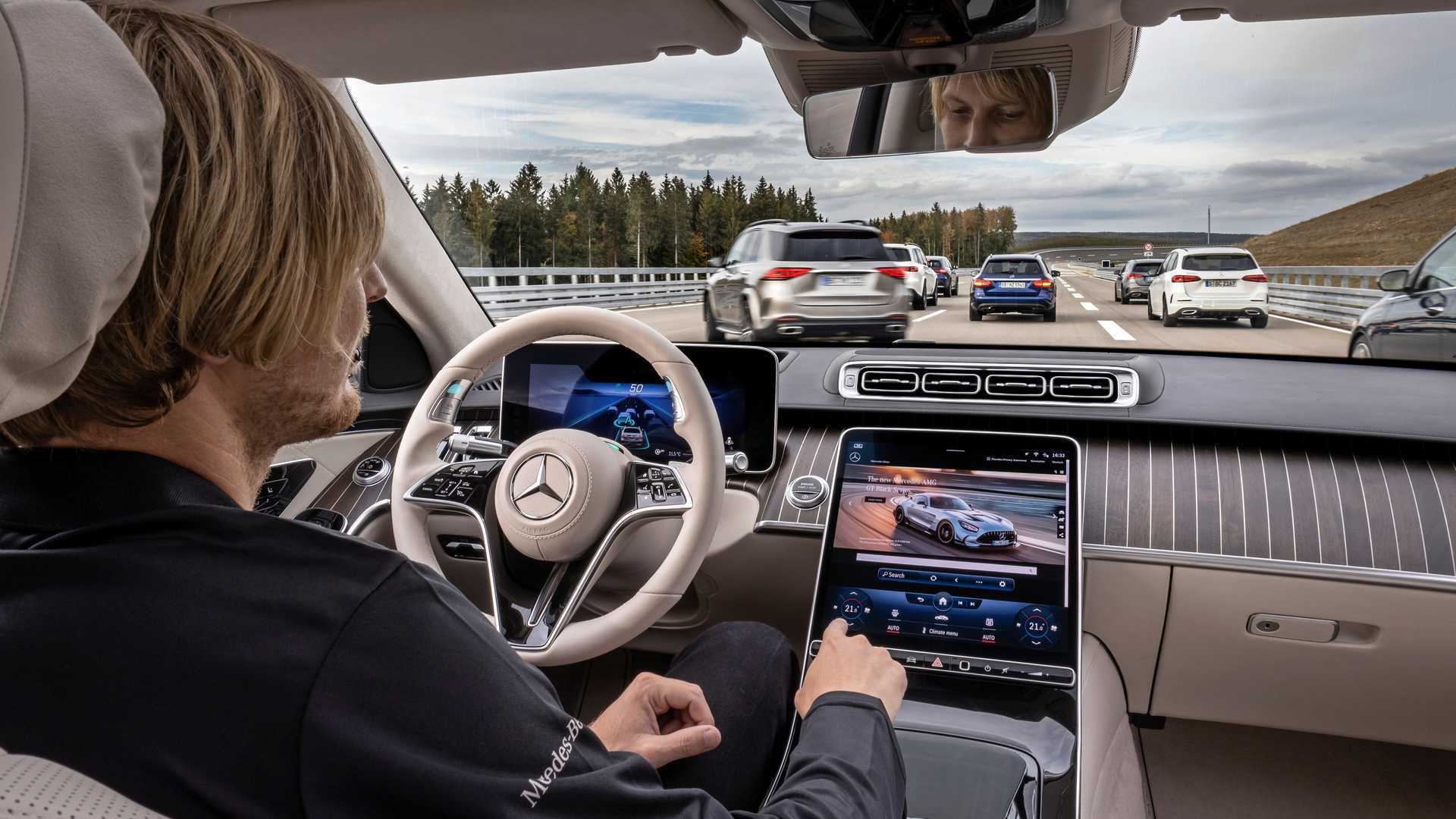
There is a particular moment in every long drive when the road begins to feel less like a path and more like a moving sentence—one you read with your whole body. Mercedes-Benz wants you to experience that sensation again, but with a new punctuation mark: hands-off capability. Its Drive Pilot, positioned at Level 3, doesn’t ask you to disappear. It asks you to trust—and then to stay ready for reality to reintroduce itself. It’s autonomy with a pulse you can feel, a system that treats the driver less like a passenger and more like a conductor standing near the orchestra, listening for the instant a note might drift.
In this review, the focus isn’t only on what the vehicle can do. It’s also on what it feels like to live inside that capability—where the steering wheel becomes a suggestion rather than a command, and where attention becomes a kind of quiet insurance. Drive Pilot’s unique appeal lies in the blend of confidence and restraint: a technology that is ambitious, yet unmistakably aware of the limits of the world outside its sensors.
What “Level 3” Really Means: Autonomy With Boundaries
Level 3 is often misunderstood as a full conversion to “driverless.” But Drive Pilot lives in a narrower, more interesting territory. Level 3 autonomy is a bargain: the car assumes dynamic driving responsibilities within defined conditions, and the driver’s role becomes conditional rather than continuous.
Think of it as a coat with a hood. When the weather is right—when visibility, mapping fidelity, and roadway geometry line up—the hood goes up and you’re sheltered. When conditions change, the hood comes back down and you’re expected to stand in the open air again. That transition is the emotional core of Level 3. It’s not merely technical; it’s psychological. The system invites you to step back, then reminds you that stepping back still requires awareness.
In practical terms, Drive Pilot is designed for specific highway or controlled road scenarios, where the car can reliably maintain lane position, speed, and safe spacing. During that window, it reduces workload: fewer micro-corrections, less constant vigilance. The driver remains present, and that presence matters. If the system asks for takeover, the driver must be ready—smoothly, promptly, and without hesitation that feels like panic.
Hands-Off Driving: The Appeal of Quiet Control
When Drive Pilot is active, the steering behavior changes from “direct command” to “managed intention.” You don’t feel the car fighting for the lane with frantic corrections. Instead, the vehicle glides with a measured steadiness, as though it’s translating road texture into a private choreography.
Hands-off driving isn’t just a convenience feature. It’s a profound shift in how time passes. Short gaps between vehicles feel less like they’re demanding immediate action and more like they’re being negotiated by the system. Long straight segments become meditative. That’s where the unique appeal emerges: Drive Pilot doesn’t eliminate the act of driving—it reassigns attention, pushing it outward. You may find yourself listening more carefully to the cabin, noticing signage sooner, or letting your mind wander to the trip ahead.
Still, the car’s calm is not an invitation to disconnect completely. Level 3 autonomy requires an understanding that the “hands-off” moment is contingent. The system can’t foresee every human decision, construction zone surprise, or weather caprice with perfect certainty. Its design philosophy is control with humility.

Driver Monitoring and the Return of Responsibility
The most revealing aspect of Drive Pilot is not how it drives; it’s how it checks in. Level 3 systems must determine whether the driver is able to resume control. That requirement shapes the experience, because it changes how the cabin feels: not like a cockpit of an airplane, but like a collaboration between human judgment and machine vigilance.
In Drive Pilot’s world, attention is not a vague concept. It becomes a measurable presence. If the system detects that the driver is not ready, it can decline to continue autonomy—or it can request takeover. This is where the metaphor of the orchestra conductor becomes especially apt. The conductor doesn’t play the violin, but the conductor must know when the melody needs a shift of tempo. The driver isn’t expected to stare at the road the entire time. But they are expected to be capable of re-entering the performance immediately.
The best outcome is a takeover that feels like a handoff, not a rescue. Ideally, the system creates a buffer: it requests takeover in time and with clear communication. When that clarity exists, the experience becomes reassuring rather than stressful.
How the System Handles Speed, Distance, and Lane Keeping
Driving at highway speeds is a constant argument between physics and unpredictability. Drive Pilot’s task is to keep that argument from turning into chaos. It maintains speed in relation to traffic flow and manages following distance so that braking and acceleration feel anticipatory rather than reactive.
Lane keeping is equally crucial. Good lane guidance doesn’t just keep the vehicle centered; it does so with a kind of editorial finesse. The car should correct smoothly, not jerkily. When the system is operating properly, lane changes and curvature navigation feel coordinated, as if the vehicle understands the road’s mood—not just its geometry.
Yet the real-world test lives in the gray zones: vehicles that cut in late, merges that happen faster than a human expects, construction detours that narrow the lanes unexpectedly. Drive Pilot’s strengths show most clearly when conditions are predictable. When unpredictability rises, the system’s limitations become part of the experience. That’s not a flaw; it’s transparency.
Comfort and Routine: Turning the Highway Into Something Else
Imagine commuting not as a sequence of chores, but as a transitional ritual. Drive Pilot can make the highway feel less like a test of endurance and more like a corridor where you can reset. The reduction in steering and speed-management tasks can soften fatigue, particularly on long stretches.
There’s a sensory element too. When the car drives smoothly, cabin vibrations change. The soundscape becomes more stable, the sense of motion less “jagged.” That stability can make your body feel less tense, which matters more than most people expect. Even subtle relaxation can improve the quality of concentration once you are back in full control.
It’s also a technology that fits modern routines. You may arrive less mentally worn, with clearer recall of why you drove where you drove. Autonomy, at its best, doesn’t just save attention; it returns it.
Safety Philosophy: Cautious Confidence Over Brash Autopilot
Drive Pilot’s safety philosophy can be summarized as cautious confidence. It doesn’t market itself as omniscient. It’s engineered to operate reliably within its defined environment, and that specificity is part of its credibility.
In an era where “autonomous” can sound like a promise with no fine print, Level 3 forces the fine print to become visible. The vehicle’s decisions are shaped by sensor inputs, roadway context, and system constraints. When the conditions are correct, the system feels capable and steady. When they are not, the vehicle returns responsibility to the driver without drama.
The best kind of safety isn’t only the avoidance of incidents. It’s also the avoidance of confusion. Drive Pilot’s success depends on communication—how clearly it signals when autonomy begins, when it remains available, and when it needs a human response.
Unique Appeal: A Technology That Teaches Coexistence
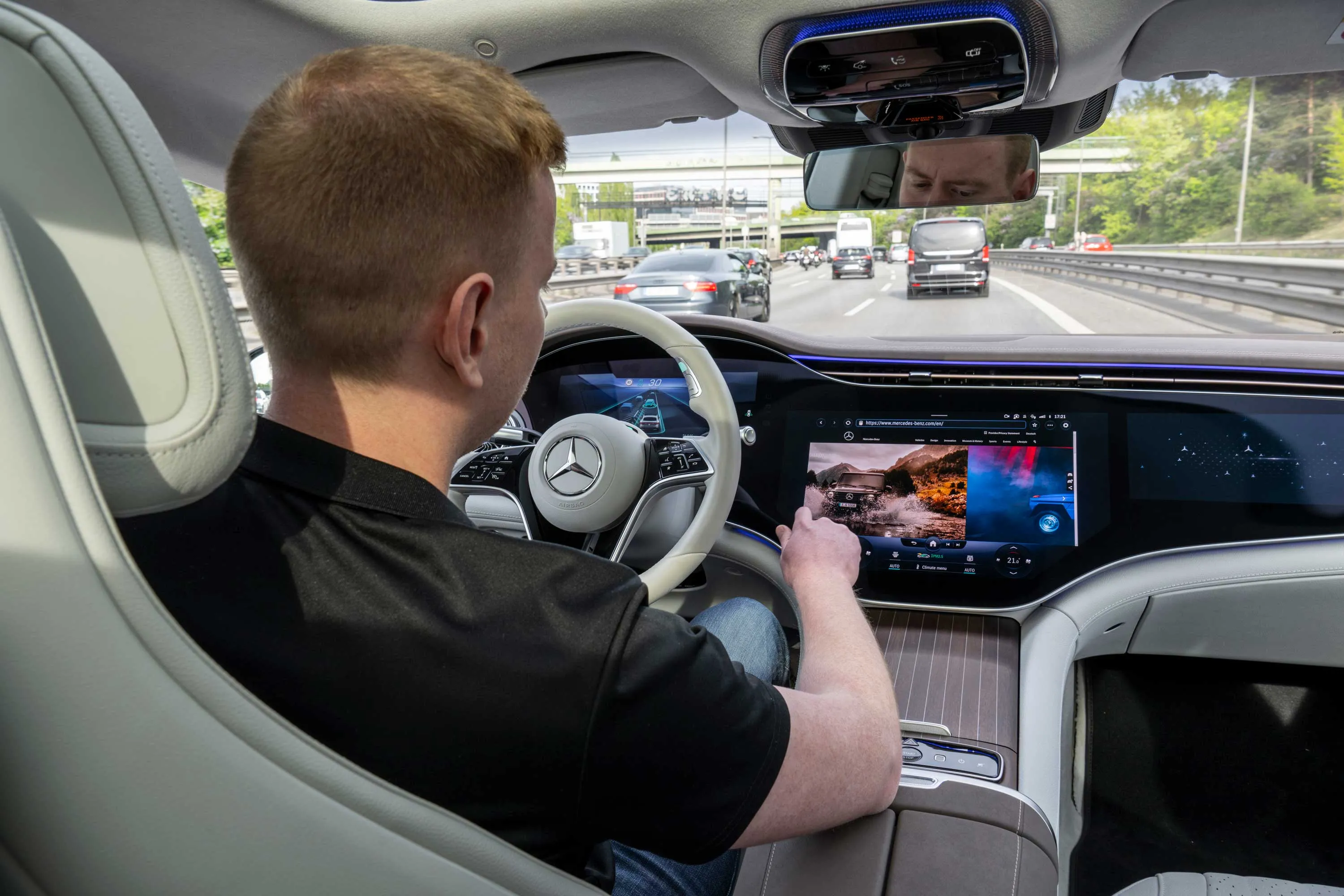
Many autonomy systems aim for replacement. Drive Pilot aims for coexistence. That distinction changes everything. The driver becomes a partner in a shared control loop, not an obstacle to be removed.
One of the most intriguing metaphors for Drive Pilot is that it turns the car into a transparent boundary. In that boundary, the vehicle handles the work you usually do constantly. Beyond it, you return to the familiar responsibilities of driving. This creates a rhythm—an alternating pattern of autonomy and agency.
That rhythm is also what makes Drive Pilot emotionally compelling. It offers the thrill of trust, but it doesn’t demand reckless surrender. It’s autonomy that feels like stepping into a calmer room while still hearing the outside world through a door you can open instantly.
Real-World Practicalities: Where It Shines and Where It Doesn’t
Drive Pilot isn’t a universal solution for every street, every situation, every weather pattern. Its effectiveness depends on operational design domain limits—road type, driving conditions, and geographic capability. When you’re within its intended environment, it can feel remarkably smooth and composed.
Outside that environment, you must treat it as what it is: a sophisticated assist system stepping aside when reality diverges from its expectations. The transition moments—beginning autonomy, monitoring availability, responding to takeover requests—are where users will notice whether the experience is truly premium or merely impressive.
For many drivers, the practical takeaway is simple: Drive Pilot feels most rewarding when it can run long enough to meaningfully reduce fatigue and repetitive workload. Short bursts may demonstrate capability, but long segments reveal character.
Conclusion: The Road as a Shared Stage
Mercedes-Benz Drive Pilot at Level 3 is not a leap into science fiction. It’s a deliberate step into a new kind of everyday relationship between human intention and machine execution. Its hands-off capability offers something rare in modern tech: relief that doesn’t remove responsibility, freedom that doesn’t pretend to be infinite.
When Drive Pilot works as designed, it feels like the car briefly becomes a calm navigator—turning highway monotony into a smoother flow and returning mental energy for what matters next. And when it asks you to take over, the experience reminds you of the oldest truth of driving: the road is never fully scripted. Drive Pilot doesn’t fight that truth. It collaborates with it—one measured, metaphorical beat at a time.