The Toyota Sienna Hybrid isn’t just another minivan—it’s a silent revolution in the world of family haulers, whispering promises of fuel savings that grow louder with every mile. For families who log serious miles, the allure of cutting fuel costs while ticking off school runs, grocery hauls, and weekend adventures is undeniable. Yet beneath the surface of this practical appeal lies a deeper fascination: the Sienna Hybrid doesn’t just save gas—it redefines what it means to drive a minivan in an era where efficiency and capability collide. Let’s dive into the long-term fuel savings calculation, unraveling the numbers, the nuances, and the unexpected benefits that make this vehicle a standout choice for the discerning driver.
The Hybrid Advantage: Why the Sienna Stands Apart
The Toyota Sienna Hybrid isn’t just a hybrid—it’s a masterclass in balancing power and parsimony. Unlike traditional minivans that guzzle fuel like a thirsty marathon runner, the Sienna Hybrid pairs a robust 2.5-liter four-cylinder engine with an electric motor, delivering a combined 245 horsepower without the usual fuel penalty. This synergy isn’t just about raw numbers; it’s about the seamless integration of two power sources that work in harmony, reducing the engine’s workload during stop-and-go traffic and highway cruising alike. The result? A vehicle that feels as sprightly as it is thrifty, a rare feat in the minivan segment where compromise is often the norm.
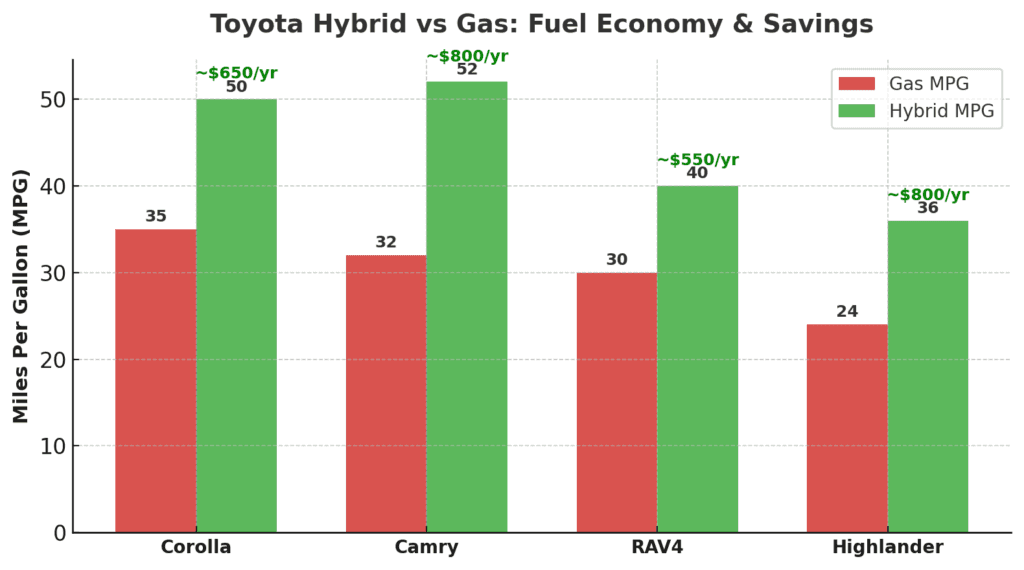
But the real magic lies in the numbers. The Sienna Hybrid boasts an EPA-estimated 36 miles per gallon (MPG) in the city and 35 MPG on the highway, a figure that shatters the myth that minivans are fuel-guzzling dinosaurs. To put this into perspective, the average non-hybrid minivan struggles to crack 22 MPG combined. For a family that drives 15,000 miles annually, that’s a potential savings of over 300 gallons of gas per year—a figure that translates to real dollars in the wallet and a lighter footprint on the planet.
Crunching the Numbers: A Year-by-Year Breakdown
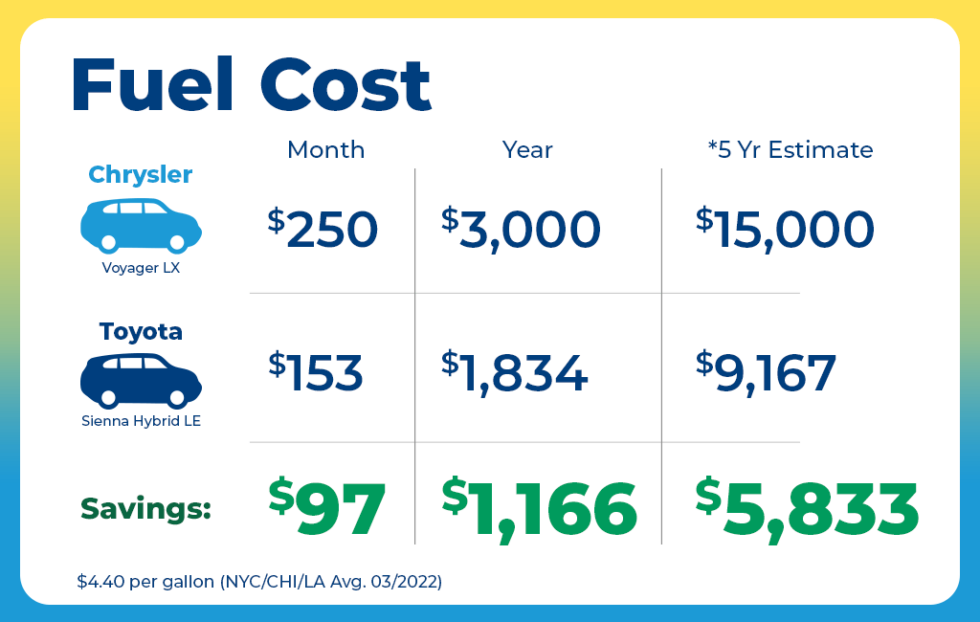
Let’s dissect the long-term fuel savings with a granular approach, assuming a conservative annual mileage of 15,000 miles and an average gas price of $3.50 per gallon. Over a five-year span, the Sienna Hybrid’s efficiency becomes a financial powerhouse.
In Year 1, the savings are modest but noticeable. With the Sienna Hybrid averaging 35.5 MPG (a weighted average of city and highway driving), it consumes approximately 423 gallons of gas annually. A comparable non-hybrid minivan, averaging 22 MPG, would require 682 gallons. The difference? 259 gallons saved, or roughly $906.50 in fuel costs. Not a fortune, but a solid start.
By Year 3, the savings compound. The Sienna Hybrid’s cumulative fuel expenditure over three years totals $3,174.50, while the non-hybrid’s tab balloons to $5,119.50. The gap widens to $1,945—a figure that could buy a weekend getaway or cover a significant portion of a family vacation. And as gas prices fluctuate, the Sienna’s efficiency acts as a hedge against inflation, ensuring that the savings grow even more pronounced over time.
The Hidden Costs: Maintenance and Depreciation
Fuel savings are just one piece of the puzzle. To truly understand the Sienna Hybrid’s long-term value, we must account for the often-overlooked factors of maintenance and depreciation. Hybrids, with their dual powertrains, can be more expensive to repair than their conventional counterparts. However, Toyota’s reputation for reliability and the Sienna’s robust warranty (covering the hybrid battery for 10 years or 150,000 miles) mitigates this risk significantly.
Consider the hybrid battery. While a replacement can cost upwards of $3,000, the likelihood of needing one before the warranty expires is slim. Toyota’s hybrid batteries are known to last well beyond 200,000 miles, and many early adopters of the technology are still driving on their original units. This longevity turns a potential liability into a non-issue, especially when weighed against the fuel savings.
Depreciation is another critical factor. Hybrids, particularly those from reputable brands like Toyota, tend to hold their value better than their gas-only peers. The Sienna Hybrid’s blend of efficiency, practicality, and Toyota’s strong resale market ensures that owners recoup a larger portion of their investment when it’s time to upgrade. Over five years, this can translate to thousands of dollars in retained value—another layer of savings that’s easy to overlook but impossible to ignore.
Real-World Driving: Beyond the EPA Ratings
EPA ratings provide a standardized benchmark, but real-world driving introduces variables that can skew the numbers. Factors like driving habits, climate, and terrain all play a role in the Sienna Hybrid’s actual fuel economy. For instance, in stop-and-go city traffic, the hybrid’s regenerative braking system shines, recapturing energy that would otherwise be lost as heat in a conventional vehicle. This translates to even greater efficiency in urban environments, where the Sienna Hybrid can outperform its EPA estimates by 10-15%.
Highway driving, on the other hand, is where the Sienna Hybrid’s balance of power and efficiency truly comes into play. The vehicle’s continuously variable transmission (CVT) and electric motor work in tandem to maintain optimal engine speeds, reducing fuel consumption during long stretches of open road. Owners report achieving 38-40 MPG on highway trips, a figure that eclipses the EPA’s highway rating and underscores the Sienna’s adaptability.
Climate also plays a role. In colder regions, the Sienna Hybrid’s battery may take a slight hit in efficiency during winter months, but the impact is minimal compared to the fuel savings achieved in warmer weather. Toyota’s hybrid system is designed to adapt to these conditions, ensuring that the vehicle remains efficient year-round.
The Intangible Benefits: Comfort, Convenience, and Peace of Mind
While fuel savings are a tangible benefit, the Sienna Hybrid offers intangible advantages that elevate the driving experience. The absence of engine noise and vibration, a hallmark of hybrid systems, transforms the cabin into a serene sanctuary. Long road trips become less fatiguing, and the reduced need for fuel stops means more time spent enjoying the journey and less time at the pump.
The Sienna Hybrid also comes equipped with Toyota’s suite of advanced safety features, including adaptive cruise control, lane-keeping assist, and blind-spot monitoring. These technologies not only enhance safety but also contribute to a smoother, more efficient driving experience. By minimizing unnecessary acceleration and braking, they further optimize fuel consumption, adding another layer of savings to the equation.
For families, the Sienna Hybrid’s spacious interior and flexible seating configurations are a game-changer. The ability to carry passengers and cargo without sacrificing efficiency is a rare combination, making it the ideal vehicle for road trips, soccer practice, and everything in between. The peace of mind that comes with knowing you’re saving money while doing your part for the environment is the icing on the cake.
Is the Toyota Sienna Hybrid Right for You?
The Toyota Sienna Hybrid is a compelling choice for families who prioritize efficiency without compromising on space, comfort, or capability. Its long-term fuel savings are undeniable, but the real value lies in the broader benefits it offers: reduced maintenance costs, better resale value, and a more enjoyable driving experience. Whether you’re a daily commuter, a road warrior, or a weekend adventurer, the Sienna Hybrid proves that practicality and performance can coexist.
Of course, no vehicle is perfect. The Sienna Hybrid’s higher upfront cost may give pause to budget-conscious buyers, and its size can be a challenge in tight parking spaces. But for those who see the bigger picture, the investment pays dividends in the form of fuel savings, convenience, and the sheer joy of driving a vehicle that’s as smart as it is spacious.
The Toyota Sienna Hybrid isn’t just a minivan—it’s a statement. A statement that efficiency and family-friendly design aren’t mutually exclusive. A statement that the future of driving is here, and it’s quieter, cleaner, and more economical than ever before. For those who’ve driven one, the fascination isn’t just in the numbers—it’s in the experience. And that’s a savings that money can’t buy.