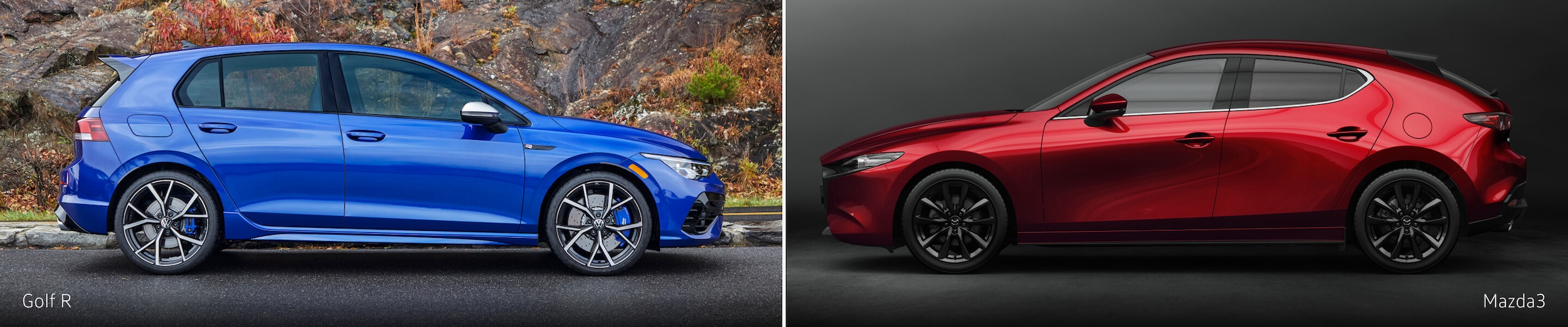
The moment people hear “affordable AWD performance,” their minds tend to sprint toward a familiar destination. For many enthusiasts, that destination is the Volkswagen Golf R—an icon of turbocharged poise wrapped in hatchback practicality. Yet in the background, something quietly sharpening its appetite has been gaining attention: the 2026 Mazda3 Turbo Hatch. And the reason it’s so fascinating isn’t merely that it can keep pace—it’s that it does so with a different philosophy. One that feels engineered to delight, not just to impress.
That’s the common observation: “Can the Mazda really hang with the Golf R?” But beneath that surface question lies a deeper curiosity. Why do drivers become transfixed by the idea of speed on a budget? Why do hatchbacks—tiny stage sets for big emotions—keep pulling at our confidence? Let’s take the scenic route through power, AWD character, handling, daily livability, and the little details that turn commuting into a kind of theater.
Two Hatchbacks, Two Personalities
Begin with the vibe. The Golf R wears its performance like a well-tailored uniform. It’s bold, sure, and instantly recognizable to anyone who knows what to look for. Its identity says: “I’m ready for the backroad at any moment.”

The 2026 Mazda3 Turbo Hatch, meanwhile, tends to feel less like a costume and more like a craft object. Even before discussing numbers, Mazda’s approach is often described as “intentional.” Short bursts of responsiveness. Calm composure. A sense that the car is reacting to your inputs rather than simply fulfilling a programmed script.
This is where fascination begins. Drivers don’t just chase speed. They chase interaction. And interaction is the magic difference between “fast” and “fun.”
Turbo Power on a Budget: Where the Fight Starts
At the heart of the comparison is forced induction. Both cars revolve around the turbocharged promise: compact engines delivering big energy, efficiently packaged for real-world driving. Turbo power has a particular charisma—there’s that moment when the engine clears its throat and the car starts speaking in a louder dialect.
The Mazda3 Turbo Hatch aims to deliver that moment without requiring the kind of financial gravity that often accompanies performance trims. Its “affordable” appeal is not a slogan; it’s a design constraint that can become a creative advantage. When engineers must be efficient, they tend to refine the steering of performance rather than simply amplify it.
The Golf R, by contrast, benefits from a performance ecosystem—systems tuned as a cohesive whole. It’s not only about peak output; it’s about how quickly the car can translate intent into traction and thrust. That holistic tuning is part of why the Golf R inspires loyalty.
What’s deeper, though, is the question of how each powertrain feels under stress: merging, exiting intersections, or climbing through traffic like a hiker refusing to stop. Turbo performance becomes a ritual. You start anticipating it. You begin to trust it.

AWD Character: Not All All-Wheel Drive Is the Same
“AWD” is a checkbox that many buyers assume is uniform. It isn’t. All-wheel drive can be reactive, predicative, or softly progressive—each approach changes the sensation of grip and the cadence of acceleration.
The Golf R’s AWD system is often celebrated for predictability. In wet weather, on slick pavement, or when the road is imperfect, it tends to feel composed—like it’s holding a secret map of available traction. That matters because power without confidence is just noise. AWD gives the engine’s enthusiasm a stage.
The Mazda3 Turbo Hatch brings a different form of AWD charm. Where some systems feel like they’re managing you, Mazda’s approach often feels like it’s collaborating with you. The car can feel less like it’s “taking over” and more like it’s helping your inputs land with intention. That makes spirited driving feel approachable, even when you’re testing the limits.
And here’s the fascination: AWD performance for the masses means more people can safely explore. It’s not only about lap times. It’s about turning cautious weather days into opportunities for traction confidence.
Handling and Steering Feel: The Subtlety That Wins Hearts
Numbers on paper are loud. Steering feel is quiet—but it changes everything. A hatchback lives or dies by its axis: how it rotates through corners, how it communicates surface texture, and how it treats your hands like they matter.
The Golf R has a reputation for stable, planted handling. When the car turns in, it often feels like the front end knows exactly what you’re asking. It’s the kind of confidence that lets you push without fear of surprise.
The Mazda3 Turbo Hatch, in contrast, tends to chase a more engaging rhythm. The steering can feel more conversational—responding with a sense of mechanical honesty that makes drivers want to try again on the next bend. Long sentences are fine for describing tire behavior, but the truth is simpler: it makes you want to drive.
Deep fascination often appears when two cars both feel “capable,” but in different emotional dialects. One might feel like precision. The other might feel like connection.
Braking, Tires, and the Real Meaning of Control
Control is the last word people think about when comparing performance models, yet it’s the first thing they feel when driving hard. Braking consistency, pedal modulation, and tire grip are where heroics become routine.
The Golf R typically leans toward confidence under repeated deceleration. Its performance orientation shows up in how it handles heat and how it maintains bite as the road gets more demanding.
The Mazda3 Turbo Hatch aims for a balance: strong stopping power with a pedal that encourages fine adjustments. That’s the difference between “I can stop” and “I can place the car exactly where I want it.”
Tires are the quiet accomplices in both stories. Grip transforms everything—acceleration, steering response, and braking stability. When grip improves, speed becomes a byproduct of control rather than a gamble.
Inside the Cabin: Comfort Meets Character
Here’s where the hatchback argument becomes surprisingly emotional. A performance car that’s unpleasant to live with is a performance car you stop enjoying. The Mazda3’s interior identity often emphasizes clarity and comfort, with materials and ergonomics that feel thoughtfully arranged. Even when the car is wearing its turbo intentions on its sleeve, the cabin can still feel like a place to exhale.
The Golf R also values daily usability. It tends to strike a balance between sportiness and routine. Visibility matters. Storage matters. Ride composure matters. In traffic, comfort is power—because it keeps you fresh enough to enjoy the driving you paid for.
Some buyers chase performance because they want theater. Others chase it because they want liberation. Both cars can offer that, but they deliver it through different cabin philosophies.
Fuel Economy and the “Go Fast” Reality
Affordable AWD performance only feels affordable if it doesn’t punish your budget every time you drive. Turbo engines can deliver efficiency when driven gently, yet still provide a surge when the moment calls for it.
The Mazda3 Turbo Hatch leans into the idea that you can live in boost when you want to and relax when you don’t. The Golf R, too, can be manageable—but its performance mindset can nudge drivers toward using more of what it has.
This is the deeper reason people keep coming back to these comparisons. It’s not just about who wins. It’s about who invites you to use the car. A good performance hatch makes your enthusiasm feel rational.
Technology and Driver Experience: Modern Life, Sporty Soul
Today’s performance cars are also information hubs—interfaces, driver-assist features, and infotainment systems that shape how you perceive speed and control. The Mazda3 tends to emphasize usability and a clean, driver-centric layout. Meanwhile, the Golf R often brings a more performance-tuned suite of functions.
In practice, the “best” setup is the one you actually use. The one that doesn’t distract you when you’re taking a corner a little faster than usual. The one that keeps your attention on the road while still offering the thrill you bought the car for.
Which One Fits Your Fascination?
If your idea of AWD performance is all about planted confidence and an icon-level track of capability, the Golf R is hard to ignore. It’s a car that tends to reward consistency. You press, it responds. You trust, it delivers.
If your idea is performance with a more artful personality—turbo energy wrapped in practical comfort—the 2026 Mazda3 Turbo Hatch stands out as the underdog that feels surprisingly persuasive. It’s the sort of car that turns “just a daily driver” into “I can’t wait to leave work.”
And maybe that’s the real fascination: both cars reduce the distance between everyday life and driving joy. They prove that speed doesn’t need to be expensive to be meaningful. AWD performance, in the affordable realm, becomes less about intimidation and more about participation.
Outro: The Hatchback That Makes You Want More
In the end, the 2026 Mazda3 Turbo Hatch vs VW Golf R matchup isn’t a simple contest. It’s a conversation between two interpretations of performance: one that arrives with a legendary confidence, and one that arrives with a quieter magnetism.
Whichever you choose, the real win is what happens after the test drive—when you start noticing traction on damp roads, when you look for opportunities to turn down familiar streets, and when you realize the car didn’t just accelerate. It changed your mood.
Affordable AWD performance isn’t merely a specification. It’s a doorway. Step through, and the ordinary becomes entertaining again.