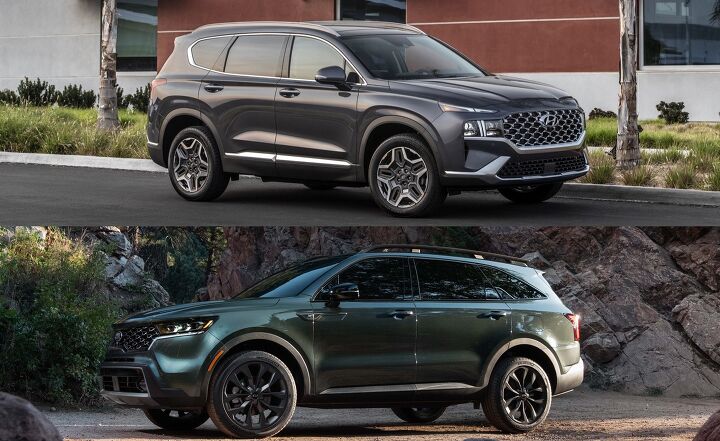
Two names, two badges, and one familiar dilemma—because the midsize crossover market has a way of turning choices into coin-flips. The Hyundai Santa Fe and the Kia Sorento wear remarkably similar ambitions: comfortable daily usability, enough cabin polish to feel “grown,” and the kind of road manners that make long drives seem shorter than they are. But here’s the playful question that lingers like a smudge on a windshield: which one will actually keep you entertained after the honeymoon phase?
Imagine you’re about to buy a vehicle, and the dealership lets you test it the way the real world does—by stacking micro-challenges on top of macro-decisions. Parking with a phone in one hand. Merging with an unsettled mind. Loading groceries and somehow finding room for the “extras” you swore you didn’t need. In that spirit, this head-to-head treats the Santa Fe and the Sorento as near-twins—close enough to be confusing, different enough to matter.
First Impressions: Styling with Personality, Not Just Presence
Both crossovers arrive with a confident stance, but their aesthetics don’t speak the same dialect. The Santa Fe tends to project a cleaner, more composed look—almost architectural. Its surfaces can feel intentionally sculpted, which is a subtle advantage when you want the vehicle to look fresh years after purchase.
The Sorento, by contrast, often leans toward a slightly more expressive design language. Its visual rhythm—grille shape, lighting signature, and overall silhouette—can read as more “animated” from certain angles. That doesn’t automatically mean it’s better. It means it’s more likely to pull you in every time you walk up to it.
)
Now the challenge: pick one route for a week—preferably a mix of city blocks and a predictable commute. Watch how you feel when you see each one in your driveway. That emotional calibration often ends up more influential than the brochure promises.
Cabin Comfort: Where “Nice” Becomes “Livable”
The midsize class is less about grand gestures and more about micro-comfort. Your shoulders want restraint. Your knees want permission. Your passengers want the kind of quiet that doesn’t require an apology.
The Santa Fe typically emphasizes an airy, easy-to-navigate layout. Controls can feel intuitive, and the seat comfort often leans toward supportive softness rather than gimmicky firmness. That matters on a weeknight drive when you’re tired and your brain is already negotiating with the next day.
The Sorento generally aims for a similarly relaxed atmosphere, with a cabin feel that can come across as slightly more “feature-forward.” Depending on trim, you may find cabin textures and available amenities that make the vehicle feel like a small lounge. It’s the kind of environment where you stop thinking about the car and start thinking about the destination.
Playful challenge: on your next drive, ask yourself—without checking—where your eyes naturally land. Do they drift toward the driver’s display? Do they settle on the center stack? The model that becomes “invisible” in a good way will feel superior within weeks.
Space and Practicality: The Art of Fitting Real Life
Space isn’t just a number. It’s the difference between “we’ll make it work” and “we made it work without stress.” For many buyers, the Santa Fe and Sorento both provide the essentials: room for passengers, manageable cargo access, and practical storage options that don’t feel like afterthoughts.
If your household includes a mix of commuters, kids, or gear-heavy weekends, pay attention to three things: seat-folding simplicity, cargo-area usability, and rear-seat access. A car can have respectable total volume but still frustrate you with awkward openings or tight loading angles.
The Santa Fe’s practicality tends to feel straightforward, with cargo space that’s easy to approach and organize. The Sorento can feel similarly competent, particularly when configured for family needs. In both cases, the “best” one is often the one that makes you stop re-stacking your life before you can even start your day.
Challenge twist: perform a home test. Before purchasing, load a couple of tote bags, a backpack, and a folded blanket into each vehicle. Don’t optimize—just simulate your actual week. Then notice which one feels calmer.
Powertrains and Driving Feel: Efficient Confidence vs. Responsive Ease
Under the hood, these vehicles aim for the sweet spot: enough power for merges, enough composure for daily driving, and an efficiency story that doesn’t punish your habits. The Santa Fe typically offers a driving demeanor that feels smooth and predictable, often encouraging a relaxed throttle style.
The Sorento usually tries to balance comfort with a more immediate sense of responsiveness. Depending on configuration, it may feel slightly more eager when you ask for acceleration or need to adjust speed quickly. That can be valuable in real traffic, where decision timing matters.
But driving feel is personal. One driver hears “smooth” and thinks “sleep,” while another hears it and thinks “stress relief.”
Playful question: when you merge onto a highway, do you like your car to behave like a patient librarian—or like a friendly athlete? Choose accordingly.
Technology and Infotainment: The Interface That Either Helps or Haunts
Midsize crossovers live and die by their user experience. Touch responsiveness, menu clarity, voice controls, and smartphone integration all shape how often you look away from the road.
The Santa Fe often delivers an infotainment setup that feels approachable and easy to learn. Its strength is in avoiding friction. Fewer steps. Less searching. More “oh, that’s where it is.”
The Sorento frequently competes with a similar tech-forward mentality, with trim levels that can elevate the overall feel. Some drivers may appreciate the way the system presents options, while others may prefer the Santa Fe’s more straightforward flow.
Challenge: in a dealership, set up your phone connection without asking for help. If the process makes you sigh, you’ve found your warning sign. If it feels quick and natural, you’ve likely found the interface you’ll enjoy living with.
Safety and Driver Assistance: Peace of Mind, Not Just Beeping
Safety tech is meant to reduce uncertainty, not create new annoyances. Both the Santa Fe and Sorento commonly offer a suite of driver assistance features, and both can make daily driving feel more manageable in stop-and-go traffic and on longer stretches.
To evaluate them properly, focus on behavior: how they handle lane centering, how smoothly they adjust braking, and whether alerts feel helpful or intrusive. A system that’s too sensitive can become a constant source of mental noise. A system that’s too passive can leave you doubting it when you need trust the most.
Playful challenge: ask a salesperson to demonstrate key features on a short test route. Then, after the drive, rate your mental calm—before looking at feature lists. The best safety system is the one that lets you exhale.
Ownership Experience: The Long Game of Costs and Confidence
Beyond the first month, ownership becomes a story of maintenance intervals, warranty perceptions, and how comfortably the vehicle fits your lifestyle. Both brands generally build reputations around reliability and serviceability, though exact experiences vary by region, trim, and driving patterns.
Consider tire costs, typical service needs, and how frequently you expect to use advanced features. Also factor in resale intuition—how the market tends to value each model’s blend of practicality and brand desirability.
The real ownership challenge isn’t finding the lowest price. It’s avoiding the buyer’s curse where the vehicle looks perfect on day one and annoying on day 400.
Which One Wins? Choose the Twin That Matches Your Daily Plot
So, Santa Fe or Sorento—how do you decide without turning it into a spreadsheet duel? Think in terms of your routines. If you prioritize a composed, easy-to-live-with feel and a calm cabin experience, the Santa Fe often aligns naturally. If you want a slightly more expressive personality and a feature-forward vibe that can feel more lounge-like, the Sorento can feel like the better match.
But the decisive factor is rarely one single spec. It’s the sum of moments: the way the car responds to your inputs, the comfort that shows up after an hour, the clarity of the tech interface, and the practical ease of moving through your week.
Outro: Your Road, Your Riddle
Buying a midsize crossover is less about picking a winner and more about choosing the companion that fits your life’s rhythm. The Santa Fe and Sorento are close enough to feel like twins—yet different enough to influence your everyday mood.
Now take the final playful step: schedule two test drives back-to-back. Drive them the way you actually drive. Then ask the same question after each one—which car makes me feel more at home while I’m doing nothing special? Because that’s the real verdict.