Ever caught yourself smiling at a car that doesn’t merely arrive, but conducts the road like an orchestra? That’s the feeling the BMW i4 tends to summon—quietly, almost mischievously—especially when you’re choosing between two flavors of electricity: the i4 eDrive35 and the i4 M50. Here’s the playful question to set the stage: do you want a serene daily partner, or a slightly feral, turbocharged-in-spirit edge—even though it’s electric all the way? And now for a potential challenge: imagine you’ve test-driven both back-to-back. Could you still justify the upgrade with a straight face, knowing the eDrive35 can already feel remarkably lively?
Let’s take a guided tour through how these two models distinguish themselves—beyond the spec sheet—covering performance character, everyday usability, charging realities, interior atmosphere, handling theatrics, and the subtleties that only show up when you live with the car for more than a weekend.
First impressions: identical silhouette, different intentions
From a distance, the i4 wears the same modern BMW demeanor—sleek, purposeful, and a touch predatory in the way it holds a line. Up close, the differences begin to read like personality traits. The eDrive35 often comes across as the composed one: smoother pacing, a calmer response cadence, and a “glide-first” philosophy. The M50, meanwhile, feels like it’s always halfway through a spirited argument with the laws of physics.
Even before you press the pedal, your brain anticipates the motor’s mood. That anticipation matters. Electric torque is instantaneous, but the way that torque is delivered—softly metered or sharply weaponized—can change the entire emotional register of the drive.
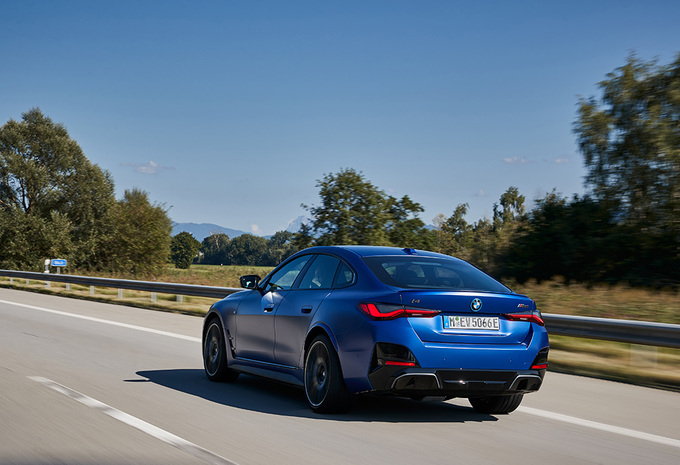
Powertrain philosophy: eDrive35’s smooth thrust vs M50’s athletic bite
The heart of the comparison is the electric drive setup. The eDrive35 emphasizes efficiency and effortless acceleration. Its response tends to feel cohesive—less like a punch, more like a rapid lift of gravity. You press, and the car moves forward with confident intent. The experience is often best described as effortless momentum.
The M50, however, is built for drama. It typically delivers stronger acceleration, and more importantly, it does so with a sense of coordination that feels “trained.” When you demand performance, the M50 doesn’t just go faster—it feels more capable in the way power is organized across the drive cycle. Short sprints become satisfying, but so do longer, rolling pulls where stability and traction have to be maintained with composure.
Here’s the challenge embedded in this section: if your daily route includes frequent stoplights and occasional highway merges, the eDrive35 might already feel like overkill. The M50’s allure may arrive only when you intentionally seek out sharper inputs—slower corners, faster exits, and the kind of driving that turns confidence into a grin.
Acceleration and real-world feel: numbers aren’t the whole story
Yes, the M50 typically posts quicker acceleration. But the emotional difference lives in the tempo of power. The eDrive35 can feel almost “natural,” as if the car is meeting you halfway. The M50 can feel like the car is leaning in toward your intent—especially when you modulate throttle quickly, or when road surface grip changes mid-corner.
Longer drives reveal another distinction. The eDrive35 tends to remain calm even when you ask more. The M50 has a greater appetite for intensity, and it invites you to keep exploring the performance envelope. If you’re the kind of driver who finds pleasure in using all the available margins, the M50 becomes harder to resist.
Driving dynamics: steering, suspension character, and corner confidence
BMW’s handling language has always been a blend of precision and feedback. In the i4, the eDrive35 often prioritizes balance and comfort—still capable, but tuned for everyday harmony. You’ll notice a certain steadiness, with the chassis feeling composed over imperfect pavement. That makes it ideal for city commuting and smoother highway cruising.
The M50 typically leans toward sportier dynamics. Expect a more taut stance and a sharper connection between your inputs and the car’s response. Turning feels more immediate. Body motions are generally more controlled under enthusiastic driving. In the real world, that means corner exits can feel cleaner, and changes of direction can feel less like negotiations and more like decisions.

Cabin ambiance: technology, ergonomics, and the quiet luxury of EV life
Step inside and both models deliver the modern BMW interior experience: clean interfaces, a driver-focused layout, and a sense of material quality that prevents the cabin from feeling overly futuristic or disposable. The differences are more about the feel of the ride than the “look” of it.
The eDrive35 often pairs well with a relaxed ownership style. It supports long drives with minimal fuss. The infotainment interface and driver display make navigation and trip planning straightforward, which is crucial for EV ownership where route awareness becomes part of the ritual.
The M50 adds a slightly more performance-flavored atmosphere—think of it as the cabin equivalent of extra instrumentation: the space still feels premium, but it nudges you toward spirited inputs. The result is a dual-personality effect: it’s comfortable enough for daily errands, but it doesn’t forget what it’s meant to do when you feel like doing it.
Range and efficiency: the calm advantage of eDrive35
Electric vehicles are often evaluated by a number, but experienced by weather, driving style, and speed. The eDrive35 is typically the efficiency-minded option in this lineup, making it a strong contender for commuters and families who want predictable usability.
In practice, that means fewer worries on typical routes and less frequent recalibration of plans. The M50 can still manage daily life beautifully, but its performance appetite may lead you to use more energy when you’re tempted to explore acceleration and sportier driving.
Consider this scenario: you drive mostly suburban roads, moderate speeds, and you charge at home. In that life, the eDrive35 may feel like the smartest expression of EV practicality. But if your days include more motorway speed, enthusiastic throttle use, or frequent “one more run” moments, the M50’s advantage can become a performance tax you willingly pay.
Charging experience: planning, convenience, and the reality of voltage
Charging is where confidence becomes currency. Both i4 variants benefit from an increasingly mature charging ecosystem, but your experience depends on how often you charge away from home and what chargers are available.
The eDrive35’s efficiency can translate into more distance per session, which can reduce the frequency of long stops. The M50’s higher performance potential may encourage you to charge more often if you frequently lean into acceleration—though this is less about limitation and more about human behavior.
There’s a smart way to choose here: map your typical week, then compare the number of charging events you’d perform. The model that better matches your rhythm will feel like the better decision, even if the other one is objectively faster.
Comfort versus character: who is each model really for?
The eDrive35 is for drivers who want electric smoothness, modern comfort, and BMW’s everyday competence—without turning every drive into a mission. It’s the “keep it easy, keep it sharp” choice. You’ll probably find joy in efficiency, calm momentum, and the satisfaction of being effortlessly quick when you need it.
The M50 is for drivers who want the i4 to behave like a sport sedan in an electric costume—without losing the practicality that makes a daily EV sensible. It suits people who love testing traction, exploring throttle maps, and enjoying the sense that the car is eager to respond.
Value and ownership: the decision that isn’t just financial
Value isn’t only what you pay. It’s also what you’ll use. If you rarely exploit performance, the M50 can feel like paying for a temperament you seldom call upon. If you do crave spirited driving—if you treat weekends like opportunities to drive rather than merely commute—the M50 can become a permanent source of enthusiasm.
So here’s a refined challenge to end the deliberation: choose the car you’d want on a random Thursday after a long workday. Not the car you think you’ll justify. The car you’d actually want to take when the schedule loosens and the road opens.
Conclusion: eDrive35 for serenity, M50 for spectacle
The BMW i4 isn’t a single story. It’s a split narrative: the eDrive35 offers calm confidence, efficiency-friendly driving, and a surprisingly spirited feel when you ask for it—while the M50 turns that same foundation into a more athletic, more eager experience.
If you want smooth daily propulsion and the freedom to charge less often, the eDrive35 makes a compelling case. If you want the i4 to feel like it’s always ready for a sharper conversation with the road, the M50 earns its keep.
Either way, the i4 proves something delightful: electric driving doesn’t have to be dull or distant. It can be intimate, playful, and—when you choose the right configuration—deeply satisfying.