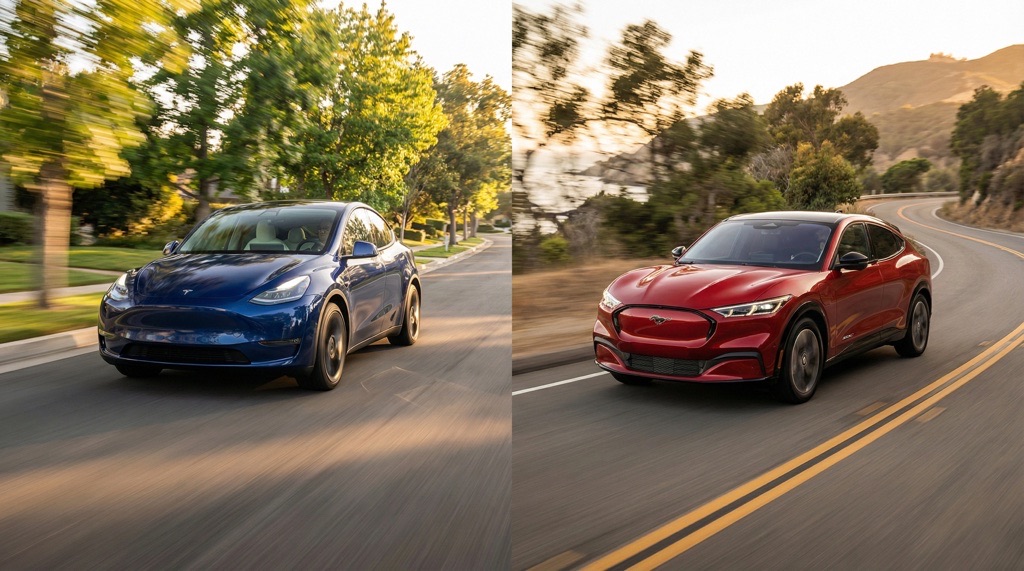
The EV family SUV has become a kind of modern hearth: it’s where errands gather, where weekend stories begin, and where the quiet hum of electricity feels almost like a promise. In 2025, two names stand at the crossroads of this promise—the Tesla Model Y and the Ford Mustang Mach-E. They both carry families, strollers, bikes, and the occasional impulse to take the long way home. Yet they do so with distinct philosophies. One feels like a well-orchestrated digital symphony, the other like a confident road-trip performer with a stylish grin.
Think of the Model Y as a sleek spacecraft that happens to seat five. The Mach-E is more like a polished trail explorer—still futuristic, but with a driver’s pulse running underneath. Choose between them, and you’re really choosing between two “languages” of EV life: one optimized for software momentum and frictionless efficiency, the other for engaging driving character and Ford’s practical, human-scaled design sensibility.
Design Philosophy: Minimalism vs Motion-First Personality
The 2025 Model Y leans into aerodynamic restraint. Its exterior reads like streamlined punctuation, as if every line were edited down to the essentials. Inside, the cabin often feels like a minimalist lounge, where controls are simplified and visibility becomes a priority. It’s not just aesthetics—it’s a mood. The airiness, the clean surfaces, and the centralized screen evoke a sense of calm authority.
The Mustang Mach-E wears its identity more openly. Even when parked, it suggests forward motion. The body styling carries a playful athleticism, and the cabin layout tends to feel more familiar—like it wants to be navigated by instinct. In family terms, that familiarity can be comforting. It’s the difference between a futuristic spaceship dashboard and a cockpit that still recognizes how people think.

Space and Practicality: Who Makes Room for Real Life?
Family SUVs live or die by their willingness to accommodate chaos. Back seats need to handle backpack bulges; cargo areas need to swallow groceries, sports gear, and the mysterious items that appear only during school season.
The Model Y generally excels at maximizing usable volume with efficient packaging. Its cargo area can feel surprisingly generous for the size, and the rear seat posture often supports longer rides without turning the journey into a backache seminar. Fold-down configurations typically offer flexibility for everyday hauling—whether it’s a weekend run to the hardware store or a beach bag full of sand-friendly gear.
The Mach-E also targets practical family needs, with a layout designed around accessibility. Door openings, seat comfort, and everyday ergonomics matter—especially when children need fastening and unloading needs speed. Depending on trim and seating arrangement, the Mach-E can deliver a satisfying blend of rear-seat usability and cargo versatility.
In short: both are family-ready. The Model Y tends to feel like it’s engineered for maximum efficiency, while the Mach-E feels like it’s designed for comfortable, intuitive day-to-day flow.
Charging Experience: The Electricity Rhythm
EV ownership is less about horsepower and more about cadence—how smoothly charging fits into daily life. If gas cars are about frictionless refueling, EVs are about learning a new rhythm. The goal is to make that rhythm disappear into routine.
The Model Y often stands out for its integrated ecosystem approach. Navigation planning, in-car guidance, and software-driven features aim to reduce uncertainty at charging stops. It’s like having a seasoned co-pilot who predicts the next beat—quietly, consistently, without fuss. For families, that matters. Kids don’t care about charging anxiety. Parents do.
The Mach-E also offers a strong charging story, with charging guidance and practical access to charging networks. Its user experience tends to prioritize straightforward usability. Some drivers prefer the “just tell me the route” feel—less futuristic mystique, more direct clarity. That can be especially helpful for those who want EV life without overthinking.
Performance and Driving Feel: Efficiency vs Enthusiasm
Performance is the kind of feature you notice in small moments. The way the car responds at the merge. The steadiness through a turn. The calm composure when the road narrows. These things shape whether a drive feels like transportation or a refreshing escape.
The Model Y often delivers punchy acceleration with minimal drama. Its torque delivery can make city driving feel effortlessly brisk. The steering and ride tuning typically aim for confidence without strain—like a firm handshake, not a wrestle. On longer highway stretches, it tends to feel composed and predictable.
The Mustang Mach-E, however, carries a more overt enthusiasm. The name itself is a wink to performance heritage, and that energy shows in driving dynamics and feel. It can feel more “alive” to many drivers—less like a software appliance, more like a machine that wants to be enjoyed. For families who occasionally want the car to feel fun rather than merely competent, the Mach-E can be particularly appealing.
Choose the Model Y if you want a soothing, efficient glide with instant response. Choose the Mach-E if you want performance character that keeps the steering wheel connected to your intentions.
Technology and Infotainment: A Digital Planet vs a Familiar Constellation
The Model Y’s tech is famously software-forward. Its interface can feel like a digital planet: centralized, streamlined, and constantly evolving. Updates can bring new capabilities over time, turning the vehicle into a living platform rather than a static object. This is the appeal of software momentum—features arriving after purchase instead of feeling like everything was “final on day one.”
The Mach-E’s technology tends to feel more grounded in familiar driver interactions. Its infotainment and control approach can be easier for a broad range of drivers—especially households where one person adjusts settings frequently while another just wants “the basics, fast.” The result is often a sense of comfort and habitability.
Both approaches can be excellent. The question is which you crave: a continuously upgrading digital cocoon, or a more conventional interface that reduces learning curve friction.
Safety and Driver Assistance: Confidence Without Overstatement
In a family SUV, safety is not a marketing slogan—it’s the baseline expectation. Driver assistance features should feel like a protective net, not a substitute for attention.
The Model Y typically emphasizes advanced driver-assistance capabilities integrated into its software ecosystem. Many drivers appreciate the way it can support routine driving tasks and help reduce mental load—particularly on long commutes where concentration is costly.
The Mach-E also offers driver-assistance technologies designed to support safe driving in various conditions. Its approach often feels more transparent and grounded, with emphasis on assistive guidance rather than dramatic autonomy vibes.
Ultimately, both vehicles aim for robust safety support. The difference lies in how they deliver confidence: one through a software-centric experience, the other through a driver-centric framework.
Cost of Ownership and Family Budget Reality
Even the most alluring EV eventually meets the ledger. Families care about maintenance predictability, insurance considerations, and overall operating costs—not just sticker price. Electric powertrains can reduce some categories of wear compared with combustion vehicles, and both the Model Y and Mach-E benefit from that fundamental advantage.
Depreciation, charging costs, and charging efficiency will vary by lifestyle and region, but the broader story remains consistent: EVs can be economical to run when charging is planned intelligently. The Tesla ecosystem may offer convenience that helps optimize charging decisions. The Mach-E may appeal to those who prefer a conventional service experience while still enjoying the benefits of electric efficiency.
Think of cost of ownership as the “hidden plot” of EV life. The best choice is the one that fits your family’s actual weekly cadence, not just the car’s headline specs.
Ownership Appeal: Which One Feels Like Your Next Chapter?
Both the 2025 Tesla Model Y and the Ford Mustang Mach-E are compelling family SUV options, but they create different emotional flavors. The Model Y can feel like a forward-leaning refuge: quiet, efficient, and backed by a technology ecosystem that wants to keep improving. It’s an EV that can make daily life feel smoother, like someone tidied the world while you drove.
The Mach-E, meanwhile, offers a different kind of enchantment. It blends modern electrification with a distinct personality, encouraging drivers to enjoy the journey as much as the destination. It’s a vehicle that often feels like it’s bringing energy to the driveway—less “appliance,” more “partner.”
Final Verdict: Two Roads, One Family Destination
If your family values software polish, integrated charging guidance, and a minimalist, low-friction driving experience, the Tesla Model Y is a compelling choice. It’s efficiency with a futuristic pulse—an SUV that feels like it’s learning your routines.
If your family prioritizes spirited driving character, familiar cabin ergonomics, and an electric SUV with an expressive identity, the Ford Mustang Mach-E can feel like the more naturally engaging companion. It’s dynamic, stylish, and ready for everyday adventure.
Either way, you’re not just buying transportation. You’re choosing a daily rhythm—one that replaces gasoline noise with electric calm, and turns ordinary trips into small, quietly memorable chapters.