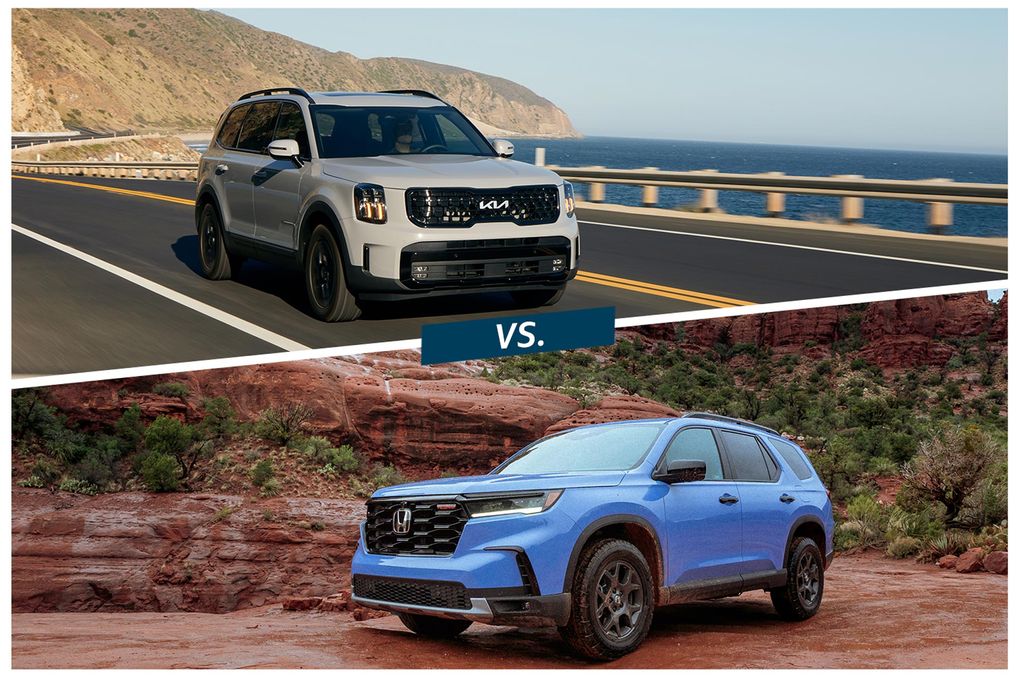
There’s a particular kind of quiet tension that fills a family room right before a road trip begins. It isn’t about packing snacks or lining up playlists. It’s the car seat ritual: the unblinking scrutiny of buckles, the practiced tug on straps, the slow confirmation that everything is aligned with the real world—not just the brochure. In that moment, the choice between a 2025 Honda Pilot and a 2025 Kia Telluride stops being a debate of badges. It becomes a question of how smoothly everyday life can be secured.
This “Car Seat Installation Test” doesn’t chase perfection. Instead, it investigates the most common observation: one SUV can feel easier to install a child seat in, while the other can feel more finicky. That difference is real. But it’s also a doorway into something deeper—why certain vehicles invite confidence, and why others reward patience.
Let the installation begin.
First Impressions: The Seat-Belt Story Starts Before You Clip
Before the first buckle clicks, the body remembers. The hand reaches for the seat base, the eye checks for visible belt routing, and the brain searches for the easiest path from “setup” to “secure.” Both SUVs offer family-friendly layouts, but their personalities diverge at the margins.
The Honda Pilot tends to feel deliberately user-oriented. Controls are easy to find, seat contours are intuitive, and the cabin doesn’t seem to hide the mechanics of child-seat installation. The floor plan reads like it was designed to reduce hesitation. Shorter reaches, calmer sightlines, and fewer “Where is that latch again?” moments can change the entire mood of the task.
The Kia Telluride, on the other hand, often feels more “architectural.” The space is generous, yet the installation experience can become slightly more choreography-driven. That doesn’t necessarily mean it’s worse—it means the SUV’s geometry may require a more intentional approach. When a vehicle asks for patience, it can still deliver a confident final result. It just doesn’t always get there as quickly.

Test Setup: What “Installed” Actually Means
It’s tempting to treat installation as a binary event: installed or not. But real installation is a sliding scale of outcomes. A seat can be latched, yet not tightly seated. It can be positioned correctly, yet the belt path can create subtle slack. It can even be secure enough to pass a quick tug test, then drift later as the vehicle settles.
In this test, the criteria matter:
Access: How easily a parent can reach the belt path and latch points.
Tension: Whether the seat base settles with minimal effort.
Stability: Whether the seat moves more than expected when pushed at the belt path.
Visibility: Whether the installation cues are obvious enough to reduce second-guessing.
In other words, the focus isn’t on theatrics. It’s on the mechanics that create confidence—or cause doubt.
Front Seat Access and Rear Entry: The “Negotiation” Factor
Most installations happen in the rear, but the rear is rarely the first point of contact. Climbing in and reaching back can turn a simple job into a logistical puzzle, especially when a child seat already installed in a nearby position limits space.
Here, the Pilot often earns points for practical ergonomics. The door openings feel friendly to movement, and the seating position makes it easier to guide a child seat into place without contorting your arms. Short, controlled movements reduce the chance of snagging straps or misplacing a buckle.
The Telluride can feel similarly accommodating, but the negotiation factor may be higher. Depending on the exact seat configuration used, the process can demand a more methodical approach. A common observation—“This one is trickier”—often comes from the way hands must work around seat contours and belt geometry. The belt route may be clear, yet it might not invite immediate intuition.
And that’s one of the deeper reasons these installations fascinate families: the experience is tactile. The cabin either responds quickly to human motion or insists on a more deliberate rhythm.
LATCH vs Seat Belt Mechanics: Where the Real Differences Hide
Every family has preferences—some rely on LATCH anchors, others choose the seat belt route. The test must respect that reality, because “easy” is often a function of the chosen method.
With LATCH, installation hinges on anchor placement and the ability to line up the seat base while tightening straps. If the anchors are positioned so the base can be guided naturally, the seat tightens with less fuss. That’s where the Pilot often feels encouraging: fewer micro-adjustments and fewer moments of wondering if something is just slightly misaligned.
With the seat belt, the dance is different. Belt geometry, buckle placement, and how the belt pulls through the routing path become the stars. The Telluride can be perfectly capable here, but its belt-driven installation may invite more careful tightening. A common observation that one SUV “holds the seat better” can actually be traced to how the belt path directs the tensioning forces at the exact points that reduce movement.
Notice the subtle shift. The question isn’t simply whether the seat is secure. It’s whether the SUV makes security feel effortless.
Second-Row Installation: The “Tightening Satisfaction” Test
Once the child seat is in the correct position, the real drama begins: tightening. Parents remember the feeling of a seat that “locks in” after the last adjustment. That sensation is more than comfort. It’s mechanical reassurance.
In the second row, the Pilot often supports smoother base seating due to approachable space around the seatback and base area. The difference becomes evident during the final push test at the belt path. The seat tends to settle in a way that feels predictable.
For the Telluride, the installation can be just as stable once dialed in. Yet the path to stability may involve additional steps—checking routing, re-seating the base, and verifying that slack is removed. The Telluride’s fascination for many families comes from that very process. There’s a sense of control available, but it rewards attentiveness.
Long story short: one SUV may deliver speed; the other may deliver precision. Both can be safe. Both can be excellent. But the emotional journey differs, and emotion matters when safety tasks repeat day after day.
Third-Row Reality: Flexibility With Character
Many SUVs promise practicality with clever marketing. Real life is less poetic. The third row is where the installation experience becomes more sensitive to reach, space, and seat access.
In the Pilot, third-row access often feels like a straightforward extension of the second row workflow. Folding and returning the seats generally supports repeat use without requiring a technical manual. When families use the third row for occasional trips, the Pilot tends to align with a “grab-and-go” mentality.
The Telluride is also built for family logistics, but the third row can require a more careful handling approach—particularly when you’re installing or adjusting a seat that needs firm alignment. The benefit is that the system is robust. The cost is time. That tradeoff can feel frustrating in the short term, yet oddly satisfying to families who appreciate methodical setups.
Here, fascination deepens. Some people enjoy the tactile certainty of meticulous installation. Others want the job done quickly because the day has already moved on.
Harness Routing and Daily Use: The Aftermath Matters
Installation is the beginning, not the conclusion. Once the seat is installed, daily use determines whether the choice becomes a daily ally or an ongoing chore.
Harness routing—pulling straps, adjusting height, and managing buckle alignment—can be influenced by how the seat position interacts with the vehicle’s interior architecture. If the seat sits in a spot that restricts arm movement, harness adjustments become slower and more frustrating.
Both the Pilot and Telluride can support child-seat compatibility well. The differentiator is often how much parents have to contort during routine tightening and loosenings. Over time, small ergonomic frictions become a noticeable pattern. And patterns are what families feel most strongly.
Common Observation, Reframed: Why One Feels Easier
The most common observation is usually stated plainly: “One installs easier.” But that statement contains hidden causes. Ease isn’t only about space—it’s about alignment cues, belt routing friendliness, anchor accessibility, and the ability to eliminate slack quickly.
The Pilot’s reputation for intuitive cabin geometry can reduce uncertainty. It’s the SUV equivalent of a friendly checklist. Meanwhile, the Telluride’s installation experience may demand more deliberate steps due to the way belt paths and mounting points interact with common child-seat designs.
Neither approach is automatically better. They’re just different philosophies of interaction. One invites speed. The other invites attention. And that difference—between haste and precision—is exactly why this comparison captivates real households.
Safety Notes and Practical Advice
Even the best-installing SUV can’t compensate for incorrect setup. Always consult the child seat manual and the vehicle owner’s manual. Confirm that the seat base is tightly secured at the belt path and that the harness fits correctly for your child. If possible, use a certified child passenger safety technician to verify installation, especially when switching between rear-facing and forward-facing modes.
Also, practice when the day is calm. Installation feels easier when you’re not rushing. If you learn the rhythm in good conditions, you’ll carry that confidence into every future trip.
Conclusion: Two Great SUVs, One Decision That Feels Personal
After the car seat installation test, the outcome often becomes more emotional than mechanical. The 2025 Honda Pilot frequently stands out for the way it supports quick, reassuring setup. The cabin tends to reduce hesitation, making parents feel like they’re doing the job right on the first pass.
The 2025 Kia Telluride often earns admiration for its stable, methodical potential. It may ask for more careful adjustments, but it can reward that attention with a firm, confidence-building result. The fascinating part isn’t merely which one is “easier.” It’s why each SUV shapes the parent experience differently—through geometry, routing, and the subtle choreography of tightening.
In the end, both vehicles can serve families well. The best choice is the one that turns installation into a repeatable ritual—secure enough to trust, and intuitive enough to breathe.