The compact SUV segment is on the cusp of a tectonic shift. Two titans—Hyundai’s 2026 Tucson and Kia’s 2026 Sportage—are locked in a silent war of evolution, each promising not just refinement, but a fundamental reimagining of what a family hauler should be. This isn’t just another mid-cycle refresh. It’s a reckoning. A moment where design philosophy clashes with raw utility, where technology transcends screens, and where the very idea of “family car” is being rewritten in real time. Buckle up. We’re about to dissect a showdown that doesn’t just compare specs—it redefines expectations.
Picture this: a suburban driveway at dawn. The sun spills over the rooftops, casting long shadows across two sleek silhouettes—one angular and assertive, the other fluid and futuristic. Both vehicles hum with quiet confidence, their presence a statement before the engine even roars to life. This is more than transportation. It’s a declaration of intent. And as we peel back the layers of the 2026 Hyundai Tucson and Kia Sportage, what emerges isn’t just a choice between two cars. It’s a choice between two philosophies of modern mobility.
The Great Exterior Evolution: Sculpted in Light and Shadow
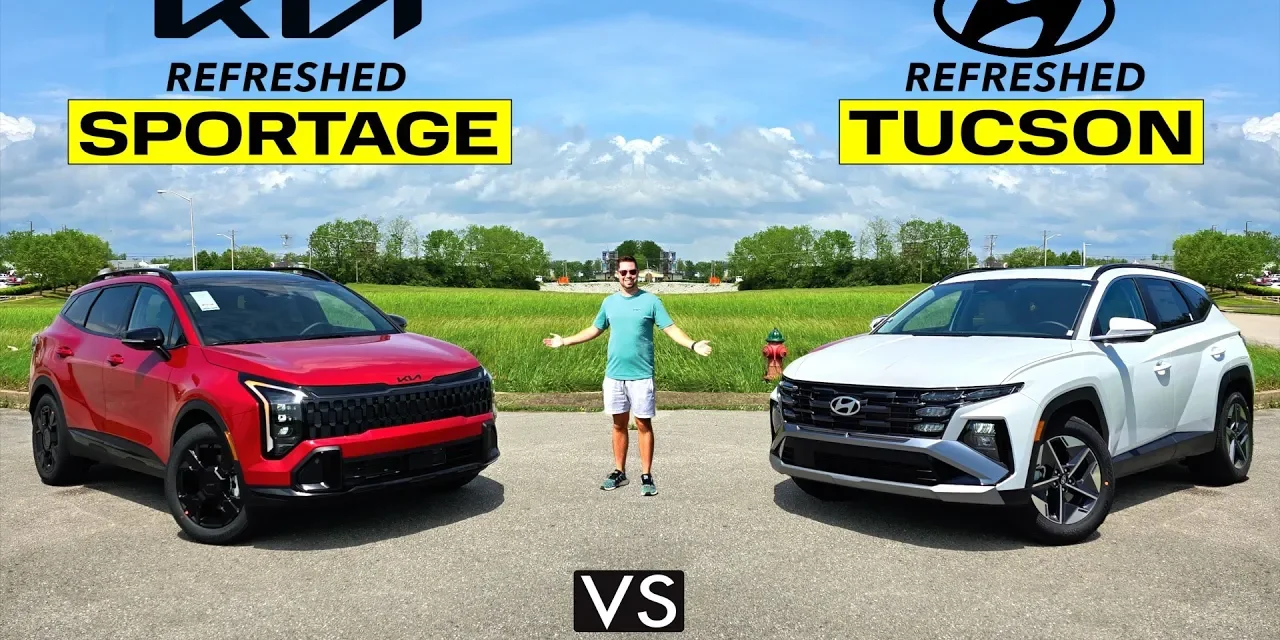
The first battle is fought in the language of design. Hyundai’s 2026 Tucson doesn’t just evolve—it undergoes a metamorphosis. The front fascia is a study in aggressive elegance, with a grille that resembles a digital waterfall, cascading down in a pixelated cascade of light. The headlamps are razor-thin, slicing through the air like the edge of a katana, while the body lines ripple with kinetic energy, as if the vehicle is caught mid-stride. It’s not just a car. It’s a kinetic sculpture, frozen in motion.

Kia’s Sportage, by contrast, embraces a more organic philosophy. Its design language is rooted in the natural world—think of a river carving through stone over millennia. The grille is a cascading waterfall of chrome and black, flanked by angular LED pods that resemble crystalline formations. The body is wrapped in flowing, almost liquid curves, with a roofline that dips dramatically toward the rear, giving the Sportage a sense of forward momentum even when stationary. It’s a design that whispers rather than shouts, yet commands attention through sheer presence.
Both vehicles are clad in advanced materials—lightweight composites and high-strength steel—ensuring that their visual drama doesn’t come at the cost of structural integrity. But the real story lies in their proportions. The Tucson stretches longer, its wheelbase extended to maximize rear legroom, while the Sportage’s shorter wheelbase lends it a nimble, almost athletic stance. Which one feels right? That depends entirely on whether you prioritize space or agility.

Interiors: Where Tech Meets Tactile Luxury
Step inside, and the battle shifts from the external to the internal. Hyundai’s 2026 Tucson interior is a masterclass in digital minimalism. The dashboard is a sweeping, uninterrupted expanse of soft-touch materials, punctuated by a dual 12.3-inch curved OLED display that floats above the center console like a hologram. The steering wheel is flat-bottomed, wrapped in perforated leather, and adorned with capacitive touch controls that respond to the lightest touch. It’s a cockpit designed for pilots, not passengers.
Kia’s Sportage, meanwhile, takes a more tactile approach. The cabin is a symphony of contrasting textures—open-pore wood, brushed aluminum, and ultra-soft Alcantara. The center console is sculpted like a piece of modern art, with physical buttons and rotary dials that provide haptic feedback, a nod to the tactile purists who still crave the reassurance of a physical switch. The dual screens are integrated seamlessly into the dashboard, but Kia’s software prioritizes customization, allowing drivers to rearrange widgets and menus like a digital mood board.
Both vehicles feature ambient lighting systems that shift hues based on driving mode—cool blues for efficiency, warm ambers for comfort, and pulsating reds for sport. But where Hyundai leans into a futuristic, almost clinical aesthetic, Kia embraces warmth and texture. It’s the difference between a spaceship and a sanctuary.
Powertrains and Performance: The Silent Revolution
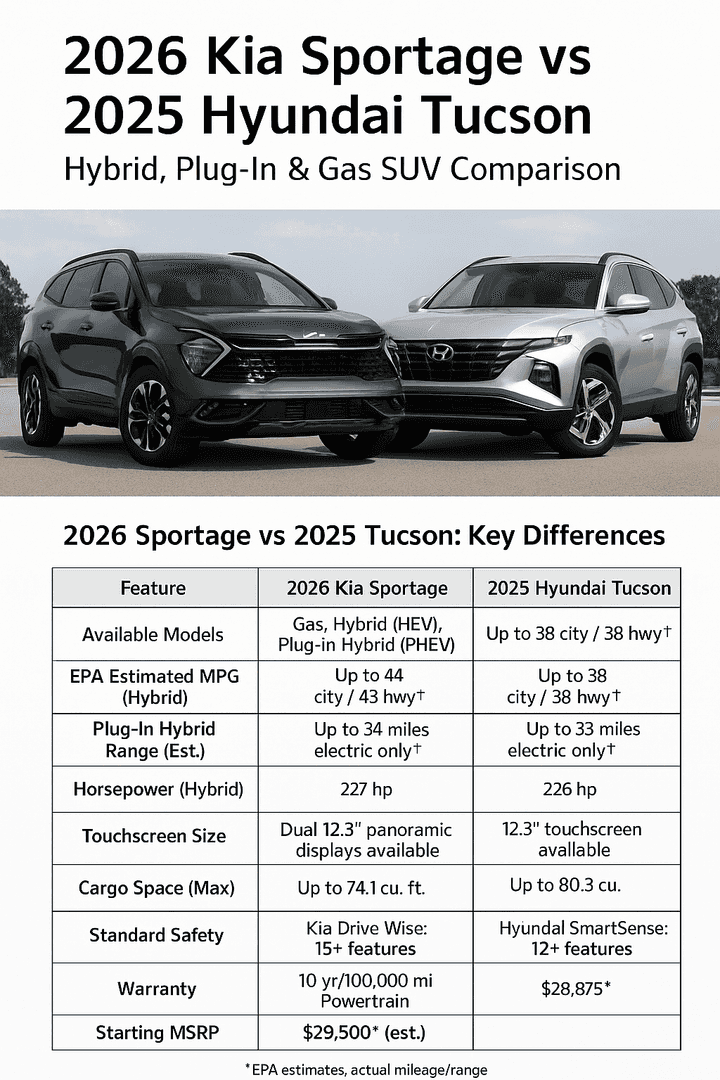
Beneath the skin, both SUVs are undergoing a powertrain revolution. Hyundai’s 2026 Tucson introduces a new hybrid powertrain that pairs a 1.6-liter turbocharged inline-four with a 48-volt mild-hybrid system and a 60-kilowatt electric motor. The result? 227 horsepower and 260 lb-ft of torque, delivered with the kind of linear acceleration that makes traffic lights feel like a suggestion. But the real innovation lies in the transmission—a new eight-speed dual-clutch automatic that shifts with the precision of a Swiss watch.
Kia’s Sportage, on the other hand, goes all-in on electrification. The base model features a 1.6-liter turbocharged engine paired with a 44-kilowatt electric motor, but the headline act is the all-electric Sportage GT-Line, which boasts a 77.4 kWh battery and a claimed range of 280 miles. It’s not just an electric vehicle—it’s an electric statement. The Sportage’s e-AWD system distributes power dynamically, ensuring that every corner is met with confidence, while the regenerative braking system adapts in real time to road conditions, maximizing efficiency without sacrificing engagement.
Both vehicles offer all-wheel drive as standard, but the way they deploy it tells a story. Hyundai’s HTRAC system is reactive, adjusting torque distribution based on wheel slip and driver input. Kia’s Dynaic Torque Distribution system, meanwhile, is predictive, using GPS and camera data to anticipate road conditions before they become a problem. It’s the difference between reacting to the road and mastering it.
Tech and Connectivity: The Digital Dashboard
The modern compact SUV isn’t just a vehicle—it’s a digital ecosystem. Hyundai’s 2026 Tucson features the latest iteration of its Bluelink system, which now includes over-the-air software updates, real-time traffic optimization, and a voice assistant that understands natural language queries. The augmented reality heads-up display projects navigation cues directly onto the windshield, turning the road ahead into a digital canvas. It’s not just a heads-up display—it’s a heads-up experience.
Kia’s Sportage counters with its UVO Connect system, which integrates seamlessly with Apple CarPlay and Android Auto, but goes further with a suite of advanced driver-assistance systems (ADAS) that include predictive cruise control, lane-keeping assist, and a 360-degree camera with object detection. The Sportage’s digital cockpit is designed to be intuitive, with a focus on reducing driver distraction. The infotainment system learns from your habits, prioritizing the apps and functions you use most, while the ambient lighting system subtly shifts to indicate incoming calls or messages.
Both vehicles feature wireless charging pads, multiple USB-C ports, and a suite of biometric sensors that monitor driver alertness. But where Hyundai’s approach is expansive—prioritizing raw capability and connectivity—Kia’s is refined, focusing on seamless integration and user experience. It’s the difference between a toolbox and a Swiss Army knife.
Safety and Practicality: The Unseen Battleground
In the compact SUV wars, safety isn’t just a feature—it’s a foundation. Hyundai’s 2026 Tucson comes standard with Hyundai SmartSense, a suite of advanced safety technologies that includes forward collision warning, blind-spot monitoring, and rear cross-traffic alert. But the real innovation lies in the vehicle’s structural design. The Tucson’s body structure is reinforced with ultra-high-strength steel, creating a safety cage that absorbs and distributes impact energy more effectively than ever before. The crumple zones are engineered to deform in a controlled manner, dissipating energy away from the cabin.
Kia’s Sportage, meanwhile, features Kia Drive Wise, a comprehensive ADAS package that includes adaptive cruise control with stop-and-go functionality, traffic sign recognition, and a forward collision-avoidance assist system that can automatically apply the brakes if it detects an imminent collision. The Sportage’s safety philosophy is proactive rather than reactive, using sensors and cameras to anticipate hazards before they become a problem. It’s not just about avoiding accidents—it’s about preventing them.
Practicality is where the two vehicles diverge most sharply. The Tucson offers up to 38.7 cubic feet of cargo space behind the rear seats, expandable to 70.1 cubic feet with the seats folded. The Sportage, with its shorter wheelbase, offers 35.4 cubic feet behind the rear seats, expandable to 65.7 cubic feet. But the Tucson’s longer wheelbase translates to more rear legroom, making it the better choice for families with tall passengers. The Sportage, however, makes up for it with clever storage solutions, including under-floor compartments and modular cargo organizers.
The Final Verdict: Which SUV Wins the Soul?
Choosing between the 2026 Hyundai Tucson and Kia Sportage isn’t just about specs or features. It’s about which vehicle aligns with your vision of the future. Do you crave the bold, futuristic design of the Tucson, with its digital cockpit and expansive tech suite? Or do you prefer the organic, tactile elegance of the Sportage, with its natural materials and intuitive interface?
If you’re a driver who values space, power, and cutting-edge technology, the Tucson is your chariot. It’s a vehicle that doesn’t just keep up with the times—it redefines them. But if you’re someone who prioritizes refinement, connectivity, and a more organic driving experience, the Sportage is the clear choice. It’s a vehicle that understands that the best technology isn’t just functional—it’s invisible.
One thing is certain: the compact SUV segment will never be the same. The 2026 Tucson and Sportage aren’t just competitors. They’re harbingers of a new era—one where vehicles are more than machines. They’re extensions of ourselves, reflections of our values, and gateways to the future. The choice isn’t just between two cars. It’s between two visions of what mobility can be.
So, which one speaks to you? The bold innovator or the refined perfectionist? The answer lies not in the brochure, but in the driveway. Where do you see yourself in five years?