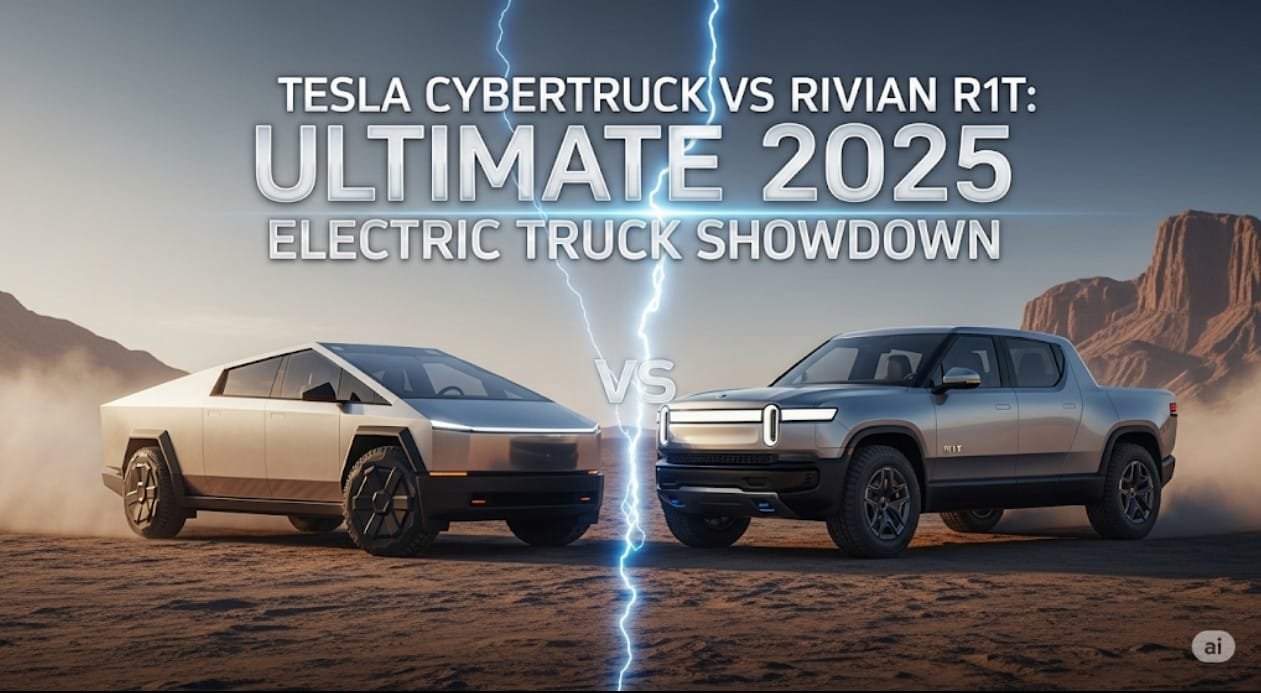
The electric truck revolution is here, and two titans stand at the forefront: Tesla’s angular Cybertruck and Rivian’s rugged R1T. These aren’t just vehicles; they’re statements—bold declarations that the future of transportation is electric, capable, and unapologetically bold. But which one deserves your attention? The answer isn’t as simple as picking a side. It’s about understanding the nuances that set them apart, from their avant-garde designs to their real-world performance, and the ecosystems they’re building around them. This isn’t just a comparison; it’s a deep dive into what makes each truck a game-changer in its own right.
The Design Philosophy: Form Meets Function in Stark Contrast
The Cybertruck’s design is a polarizing masterpiece of industrial minimalism. Its sharp, angular lines and stainless-steel exoskeleton aren’t just for show—they’re a deliberate rejection of conventional automotive aesthetics. Tesla’s approach is rooted in efficiency; every crease and fold serves a purpose, from aerodynamics to structural rigidity. The result is a vehicle that looks like it rolled off the pages of a sci-fi novel, yet is engineered to withstand the rigors of off-road adventures. Rivian, on the other hand, embraces a more organic, adventure-ready aesthetic. The R1T’s flowing curves and integrated lighting strips evoke a sense of motion, even when stationary. Its design is a love letter to the outdoors, with a focus on practicality—think integrated gear mounts, flush door handles, and a panoramic glass roof that floods the cabin with natural light. Where the Cybertruck screams “future,” the R1T whispers “adventure.”
Performance Under the Hood: Power, Precision, and Off-Road Prowess
Beneath their exteriors, these trucks are engineering marvels. The Cybertruck’s performance is defined by raw, unfiltered power. With a tri-motor setup boasting up to 845 horsepower and a 0-60 mph time of just 2.6 seconds, it’s one of the quickest production trucks ever made. Its all-electric drivetrain delivers instant torque, making it a beast in both straight-line acceleration and towing scenarios. Rivian’s R1T, while slightly less powerful in its base configuration (600+ horsepower), makes up for it with a more refined and adaptable powertrain. Its quad-motor system allows for precise torque vectoring, enabling the R1T to tackle off-road terrain with uncanny agility. The R1T’s adaptive air suspension can raise or lower the ride height on the fly, while its tank-turn capability (thanks to independent wheel rotation) turns it into a mobile agility course. For those who prioritize speed, the Cybertruck wins. For those who crave versatility, the R1T takes the crown.

Range and Charging: The Lifeblood of Electric Trucks
Range anxiety is a relic of the past for both these trucks, but their approaches to energy efficiency and charging infrastructure couldn’t be more different. The Cybertruck’s massive 123 kWh battery pack (in the tri-motor variant) delivers an estimated 340 miles of range, though real-world conditions often dip closer to 300 miles. Tesla’s Supercharger network is the gold standard, offering unparalleled charging speeds and widespread availability. Rivian’s R1T, with its 135 kWh battery pack, edges out the Cybertruck with up to 314 miles of range. Rivian’s charging strategy is equally robust, with its Adventure Network of fast chargers strategically placed near outdoor recreation hubs. Both trucks support 220+ kW charging, but Tesla’s network remains more extensive, especially in urban areas. For long-haul travelers, the Cybertruck’s charging infrastructure is a clear advantage. For weekend warriors hitting remote trails, the R1T’s targeted charging network might be more appealing.
Interior and Tech: Where Innovation Meets Practicality
Step inside either truck, and you’re greeted by a futuristic cockpit that redefines what a pickup should be. The Cybertruck’s interior is a study in minimalism, with a yoke-style steering wheel, a single 17-inch touchscreen, and a near-total absence of physical buttons. The cabin is spacious, with ample headroom and a panoramic glass roof that bathes the interior in natural light. Rivian’s R1T, however, takes a more user-friendly approach. Its interior is a symphony of tactile controls and intuitive interfaces, with a 12.3-inch touchscreen flanked by physical knobs for climate control. The R1T’s cabin is equally roomy but feels more inviting, with premium materials like vegan leather and open-pore wood trim. Both trucks offer ample storage solutions—Rivian’s “gear tunnel” is a standout feature—but Tesla’s focus on simplicity contrasts sharply with Rivian’s emphasis on comfort and convenience.
Safety and Crash Testing: Engineering for the Worst-Case Scenario
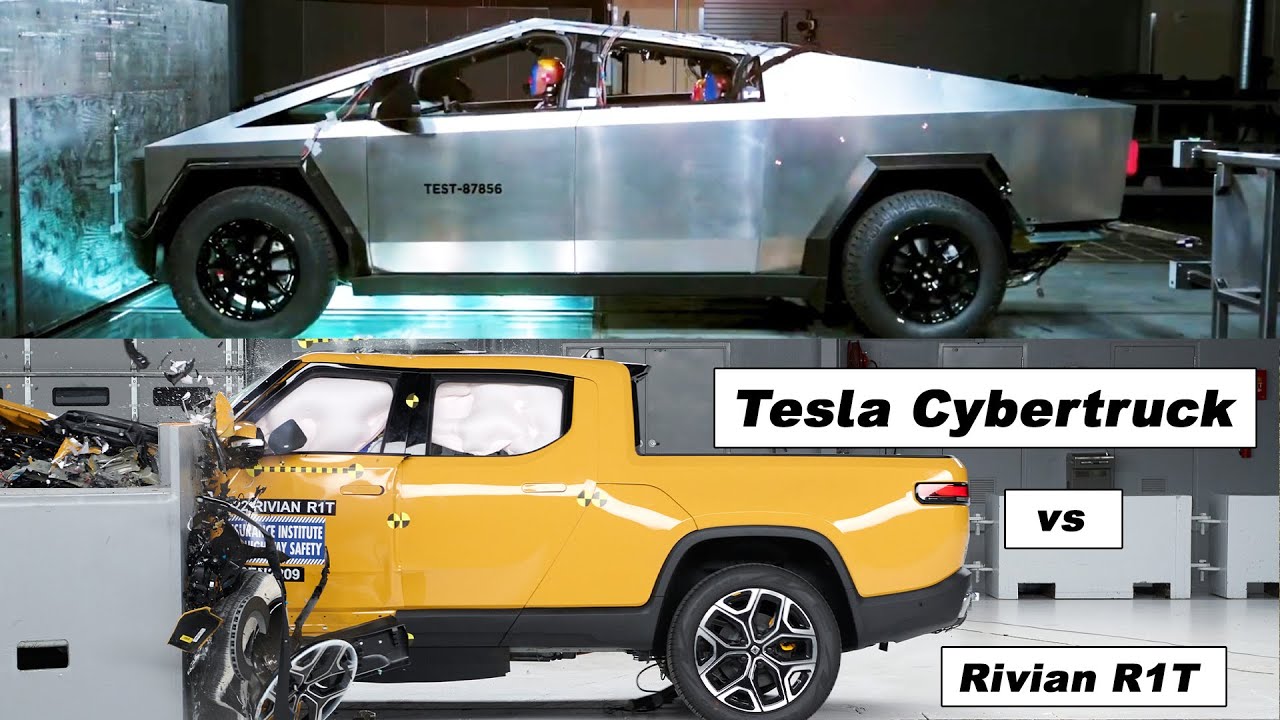
Safety is non-negotiable, and both trucks have undergone rigorous testing to prove their mettle. The Cybertruck’s stainless-steel exoskeleton and ultra-rigid frame are designed to absorb and deflect impact forces, while its advanced driver-assistance systems (ADAS) include features like Autopilot and Tesla’s proprietary collision avoidance tech. Rivian’s R1T, meanwhile, has earned top safety ratings from organizations like the IIHS and NHTSA, thanks to its reinforced safety cage and innovative crumple zones. Both trucks come standard with multiple airbags, blind-spot monitoring, and automatic emergency braking. However, the Cybertruck’s unconventional shape presents unique challenges in crash compatibility, while the R1T’s more conventional design may offer better protection in collisions with smaller vehicles. For families prioritizing safety, the R1T’s proven track record might be more reassuring.
Price and Value: The Bottom Line for Buyers
Cost is often the deciding factor, and here’s where the two trucks diverge significantly. The Tesla Cybertruck starts at around $60,990 for the single-motor RWD variant, but the quad-motor and tri-motor versions can push the price well above $100,000. Rivian’s R1T, on the other hand, begins at $73,000 for the Launch Edition, with higher trims exceeding $90,000. Both trucks qualify for federal tax credits (up to $7,500 in the U.S.), but Tesla’s broader availability and lower base price give it an edge for budget-conscious buyers. Rivian’s premium pricing reflects its focus on luxury and adventure-oriented features, but it also means higher maintenance and insurance costs. For those seeking a no-frills, high-performance electric truck, the Cybertruck is the clear value leader. For those willing to pay a premium for a more refined and capable vehicle, the R1T justifies its price tag.
The Verdict: Which Truck Fits Your Lifestyle?
Choosing between the Tesla Cybertruck and the Rivian R1T isn’t just about specs or aesthetics—it’s about aligning with a vision. If you’re drawn to the Cybertruck’s raw power, cutting-edge design, and unmatched charging network, this is the truck for you. It’s a statement piece, a technological tour de force that prioritizes performance above all else. The R1T, however, is the choice for those who see their truck as an extension of their lifestyle. Its blend of off-road capability, refined interior, and adventure-ready features make it the ideal companion for explorers and families alike. Neither truck is perfect, but both represent the pinnacle of what electric trucks can achieve. The real question isn’t which one is better—it’s which one speaks to you.
As the electric truck market evolves, one thing is certain: the future of driving is here, and it’s electrifying. Whether you’re behind the wheel of a Cybertruck or an R1T, you’re not just driving a vehicle—you’re driving the future.