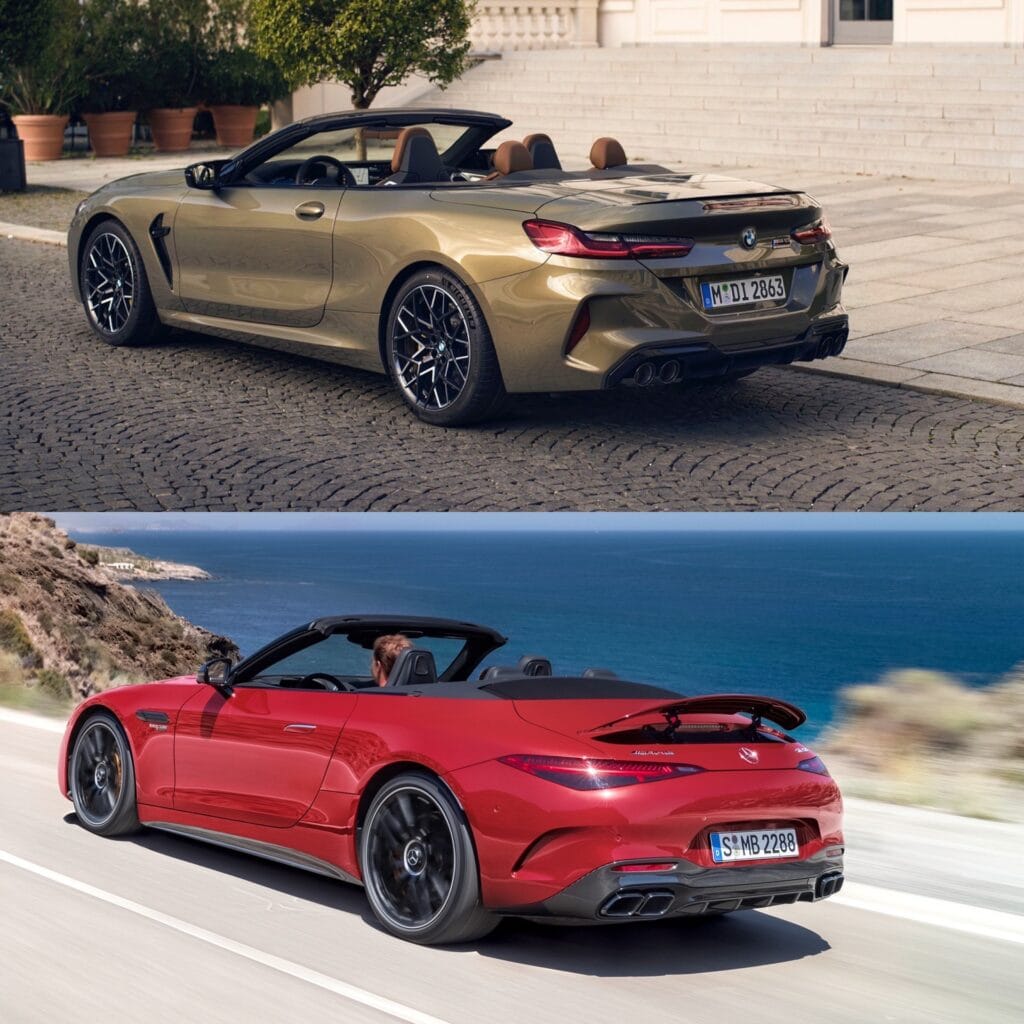
The sight of a luxury drop-top still has the power to stop a conversation mid-sentence. There’s something alchemical about translating engineering into breeze—about the way a roofless cabin turns sunlight into atmosphere and transforms speed into theater. Yet when the conversation shifts from romance to reality, a familiar observation surfaces: two grand tourers, two halos of prestige, and yet one might feel less “eventful” in daily life than enthusiasts expected. That’s the paradox at the heart of the comparison between the 2026 Mercedes-AMG SL 63 and the BMW M8 Convertible—both built to seduce, both designed to impress, and both demanding that the buyer understand what kind of fascination they’re actually chasing.
On paper, the differences can look like simple math—power output, curb weight, pricing tiers, and headline performance. In the cabin, though, the truth is more nuanced. The SL 63 speaks a language of occasion. The M8 Convertible answers with a kind of muscular poise. And the deeper reason people keep coming back to this class of car isn’t merely speed; it’s the precise way each machine negotiates the boundary between flamboyance and control.
Both are luxury performance drop-tops. But one is tuned like a charismatic host, and the other like an elegantly restrained athlete. Choosing between them means deciding which temperament will feel most alive on your busiest roads—and on your quietest evenings.
First Impressions: How Presence Becomes a Kind of Proof
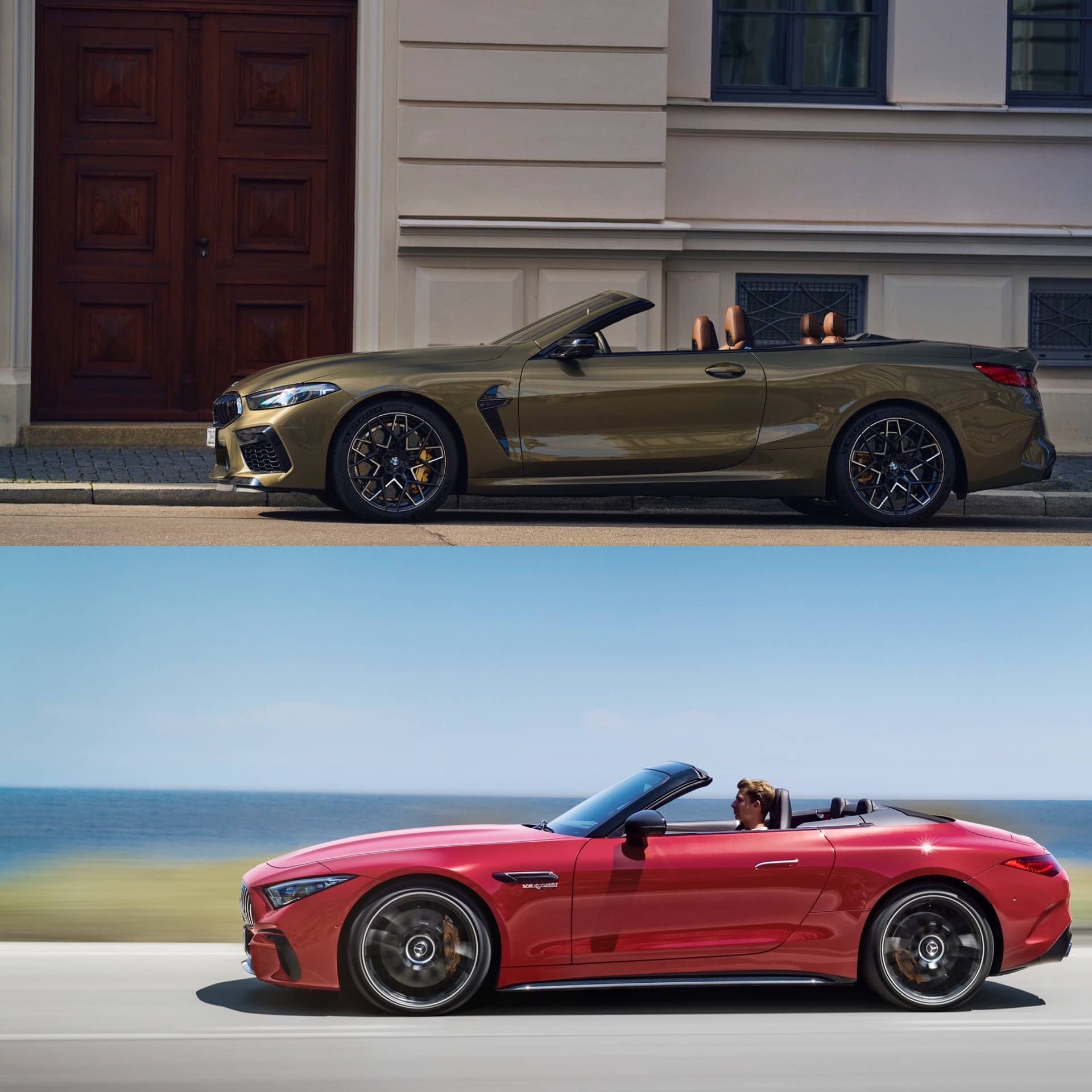
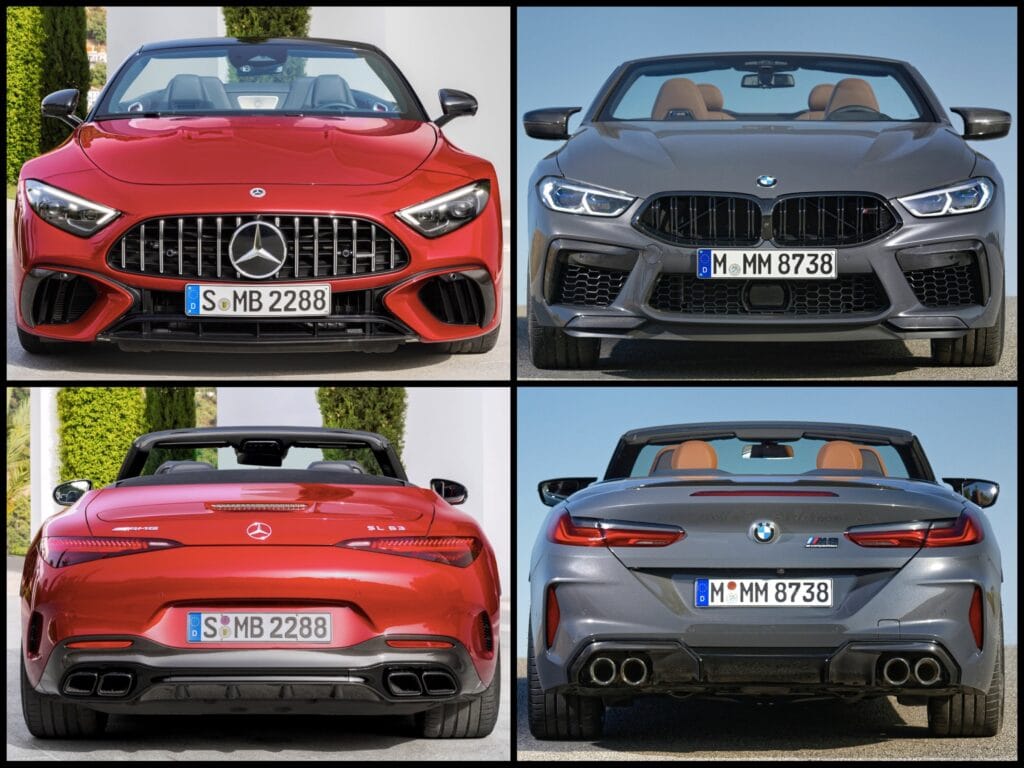
Park the two cars side by side and the conversation begins instantly. The Mercedes-AMG SL 63 arrives with the visual confidence of something that has lived in the spotlight for decades. Its silhouette has a curated dramatic arc—sleek, deliberate, and almost ceremonial. The front end feels composed rather than aggressive. Even when it’s daring, it never looks accidental.
The BMW M8 Convertible, meanwhile, is a different species of charisma. It projects dominance through proportions and surface tension. The overall shape reads like a long-striding statement: low, wide, and composed to look fast even when stationary. It has a certain predatory polish—less pageant, more prowling elegance.
It’s common to assume that “more aggressive” automatically means “more thrilling.” But fascination rarely follows the obvious path. People don’t just buy drama; they buy a daily rhythm they can inhabit. The SL’s theater tends to feel episodic—each drive becomes a scene. The M8’s confidence feels continuous—its athletic calm doesn’t ask to be noticed, it simply commands respect.
The Top-Down Experience: Breeze, Insulation, and the Art of Atmosphere
A drop-top is never just a convertible. It’s an acoustic contract. It’s also an insulation philosophy—how the car filters the world when the roof disappears.
When the 2026 SL 63 opens up, it tends to create an “outdoor lounge” sensation. The cabin remains composed, with wind management tuned to keep conversation possible and comfort uninterrupted. The result is that the drive feels refined even at spirited speeds. You don’t just feel the weather; you feel the car’s attempt to domesticate it.
The BMW M8 Convertible offers a more overtly sporty exposure. The sensation is immersive—less about cocooning, more about engaging. At certain speeds, the experience becomes delightfully tactile: you notice airflow, the rhythm of the chassis, and the immediacy of the engine’s presence. For some drivers, that rawness is the whole point. For others, it can feel like the car is less interested in smoothing the edges.
This is where the common observation emerges: some owners expect drop-top cars to feel equally perfect in all scenarios. Yet the fascination deepens precisely because the cars don’t behave the same. One is built to keep you in a premium bubble. The other is engineered to pull you closer to the mechanical pulse.
Engine Character and Sonic Identity: More Than Horsepower
The Mercedes-AMG SL 63 carries its performance like a confident magician. AMG tuning typically favors a sense of urgency without stripping the engine of elegance. Power arrives with a confident shove, but the delivery often feels rounded—like torque translated into motion with intent. The soundtrack, too, has a theatrical signature. It doesn’t merely announce itself; it dramatizes the throttle response.
The BMW M8 Convertible, in contrast, often feels like a high-precision instrument that learned to smile. BMW’s performance character emphasizes mechanical clarity. Throttle inputs tend to feel direct, and the car’s acceleration can feel tightly coordinated—less like an explosion, more like a precisely timed release. The exhaust note frequently carries a slightly different texture: a deeper, more metallic resonance that can sound both grand and focused.
Here’s the subtle truth: the “drop-top experience” is not only about wind and sun. It’s about how sound interacts with openness. A convertible turns audio into a moving landscape. The SL tends to sound more cinematic. The M8 tends to sound more industrially satisfying. Neither approach is inherently better. The better question is: do you want your performance to feel like spectacle, or like mastery?
Chassis Tuning and Road Feel: Compliance vs Precision
Luxury performance is a balancing act between pliancy and composure. The SL 63 generally aims for a grand-touring equilibrium. Its suspension philosophy often prioritizes coherence—keeping the ride structured over imperfect pavement while still allowing the chassis to respond with poise when you push.
The M8 Convertible often feels more like it’s built to reward confident driving. It can deliver a more immediate sense of steering feedback and a more connected feeling between tires and road. That doesn’t mean it’s harsh; rather, it can feel intent-focused—less “floating lounge” and more “performance salon.”
This is where many buyers sense a performance “drop” after expecting hyperbole. The SL 63 might feel slightly more serene even when you want aggression. The M8 might feel more thrilling but less forgiving when the route turns rough. The thrill isn’t missing—it’s simply filtered through a different design worldview.
Interior Atmosphere: Luxury as Material Culture
Inside, the competition becomes less about spec sheets and more about sensory architecture. The SL 63 typically offers a premium cabin that feels deliberate and opulent, with materials and controls arranged to create calm. The seating position often encourages a relaxed authority—the kind of posture that makes a driver feel like the day belongs to them.
The M8 Convertible is usually about driver-centric luxury. It tends to feel slightly more performance-oriented in its ergonomics, with controls and displays arranged to keep you engaged. Even in a relaxed cruise, the cabin can feel like a cockpit designed for quick decisions.
People often notice “small differences” and dismiss them as trivial. But those differences accumulate into a personality. The SL can feel like refined hospitality; the M8 can feel like focused ambition. Choose the one that matches your preferred emotional tempo.
Technology and Driver Interaction: Modern Glamour, Practical Consequences
Both cars bring advanced driver assistance and infotainment features typical of high-end grand tourers. The real distinction often lies in usability. How quickly the interface disappears into the background. How naturally the system supports navigation, audio, and comfort settings.
In a convertible, technology has a higher duty cycle. Your senses are already busy—sound is changing, airflow is present, and the vehicle’s openness can affect how you perceive speed. A well-integrated system becomes an anchor. A clunky one becomes a distraction. That can subtly influence how “fast” or “slow” the car feels—an emotional illusion driven by friction and ease.
Common Observation, Explained: Why One Might Feel Less “Magical” Than Expected
Many prospective buyers expect the same kind of magic: hit the switch, drop the roof, press the pedal, and instantly feel transformed. Sometimes reality lands differently. One car might feel more refined than expected. Another might feel more raw. Both can be right. The fascination doesn’t come from uniformity—it comes from mismatch between expectation and execution.
The Mercedes-AMG SL 63 can feel less “wild” to drivers who want convertible chaos. It tends to prioritize serenity, refinement, and a sense of control. For those who chase grandeur, it can feel perfectly tuned. For those expecting a street-dominating brute, it may seem restrained.
The BMW M8 Convertible can feel more exuberant in the moment but less effortless over time for drivers who want plush composure. It can deliver thrills quickly—then remind you that this is still a performance machine, not a floating lounge chair.
The deeper reason people remain fascinated is that both designs offer a distinct answer to the same desire: to feel alive without losing sophistication.
Which One Fits You? A Temperament-Based Decision
If your idea of a luxury drop-top is occasion-driven elegance—a car that turns airports, city evenings, and coastal drives into curated memories—the SL 63 is likely the more satisfying companion. It’s the choice for drivers who want performance with a velvet glove and a confident sense of ceremony.
If your ideal is sport-forward glamour—a convertible that feels tightly connected and responds with athletic intent—the M8 Convertible may feel more instinctive. It suits those who treat driving as a continuous conversation with the road.
There isn’t a single “better” option. There’s a better match. The fascination comes from how the car embodies a driver’s preferred brand of exhilaration.
Final Take: The Real Luxury Is Emotional Fit
In the 2026 landscape of luxury performance drop-tops, the Mercedes-AMG SL 63 and the BMW M8 Convertible stand as two persuasive arguments. One argues for serenity with spectacle. The other argues for precision with flamboyance. Both can be extraordinary. Both can disappoint if expectations are built from stereotypes rather than temperament.
When you choose correctly, the roofless moment stops being an accessory and becomes a signature. Sunlight becomes a ritual. Sound becomes a dialogue. Performance becomes a feeling you carry for days afterward. That’s the part that never drops from the calculation—no matter what anyone says about “magic” or “reality.”