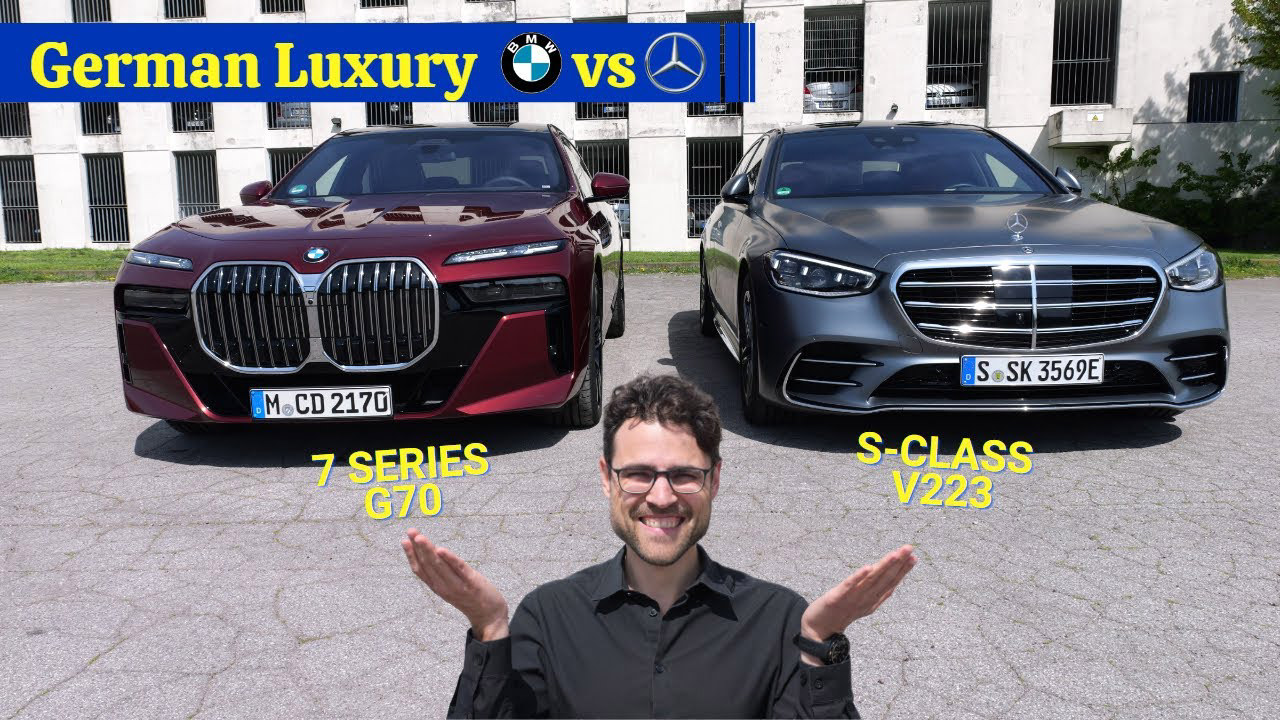
There are luxury sedans, and then there are flagships—the kind that don’t merely transport you, but choreograph an entire mood around the occupants. When the conversation turns to BMW 7 Series vs Mercedes S-Class, it isn’t really about who has a longer list of features. It’s about worldview. One car leans into the sensation of purposeful dynamism, the other into serenity engineered to an almost ceremonial degree. Either way, the promise is the same: a shift in perspective.
Imagine stepping into each cabin as if entering different universes. In one, the air feels tuned for engagement—responsive, alert, slightly anticipatory. In the other, everything slows down into composure—quietly confident, like a private room with perfect acoustics. The question becomes less “Which is better?” and more “Which kind of luxury resonates?” Curiosity follows, and rightfully so.
Flagship Presence: The First Impression That Sticks
Both sedans wear authority the moment you notice them. The BMW 7 Series often presents itself with an assertive stance—clean geometry, crisp surfacing, and a look that suggests motion even when standing still. It’s a design language built for people who read the road with their eyes.
The Mercedes S-Class, meanwhile, tends to arrive with an almost effortless gravity. The front-end styling often communicates refinement more than aggression. Even the lighting signatures have a calm confidence, like they’re designed to reassure rather than persuade.
What’s fascinating is how these impressions can change your expectations before you even start the engine. Luxury, here, is not only what you experience—it’s what you feel immediately, in the subtle physics of perception.

Cabin Philosophy: Driver-Engagement vs Sanctuary
The heart of the debate lives inside. The BMW 7 Series typically leans toward a driver-centric atmosphere—even in high-comfort trim. Controls, display logic, and interface behavior are often arranged to encourage command. The cabin can feel like a cockpit without becoming harsh; it’s controlled, but never cold.
The Mercedes S-Class is commonly experienced as a sanctuary. The interface often prioritizes smoothness and reduced cognitive load—less frantic navigation, more “everything just works.” It’s luxury as a soft landing. Passengers frequently describe the S-Class as a place where time becomes negotiable.
In practice, this means the same trip can feel different. One car invites you to participate. The other encourages you to dissolve into comfort.
Materials and Craftsmanship: Luxury That You Can Almost Hear
Both models chase excellence through tactile detail—leather grain, stitching consistency, trim alignment, and the way surfaces meet at edges. But their signatures differ.
BMW often emphasizes a sense of precision and modernity—surfaces that look engineered rather than merely upholstered. Mercedes tends to lean into a more traditional richness, sometimes with elaborate design flourishes that feel deliberate and warm.
There’s a particular kind of craftsmanship that reveals itself when you touch things repeatedly. In a flagship cabin, even the act of adjusting a seat can become a ritual—micro-movements that feel resolved rather than improvised.
Powertrains and Performance: Executive Calm With Different Chemistry
Both cars offer impressive performance capabilities, but the character can diverge in noticeable ways. The BMW 7 Series often communicates readiness—power delivery that feels linear and purposeful, steering that can feel communicative, and a general sensation that the vehicle is prepared to respond at any moment.
The Mercedes S-Class frequently champions smooth propulsion and effortless overtaking. Acceleration may feel less like an event and more like an extension of the cabin’s composure. Even when pushing hard, the ride can remain civil—an act of refined containment.
It’s less about absolute numbers and more about the chemistry of motion. One sedan can make you want to press forward just to see how it handles your intent. The other makes you want to relax precisely because it absorbs everything.
Ride Quality and Comfort Tech: The Battle of Softness vs Stability
Flagship comfort is never accidental. It’s engineered through suspension tuning, damping strategies, and electronic control systems that interpret road texture like a language.
The BMW 7 Series can deliver a balance that feels composed yet alert. Depending on configuration, ride comfort may present as controlled suppleness—less float, more structured cushioning. Even rough sections can feel managed rather than merely tolerated.
The Mercedes S-Class is famous for isolating occupants from the world. The suspension behavior often aims at tranquility first—reducing intrusion and smoothing harshness. It can feel as though the car creates a private envelope around you.
Curiosity naturally arises here: which approach suits your daily life? City surfaces with their unpredictable fractures demand one kind of intelligence. Long-road comfort demands another.
Infotainment and Connectivity: Interfaces That Shape Attention
Modern flagships aren’t just cars; they’re mobile command centers. The BMW 7 Series typically presents a driver-oriented digital experience—clear pathways to key functions and a layout that often rewards confident navigation. The system can feel like it wants you to explore.
The Mercedes S-Class frequently emphasizes ease and fluid interaction. The interface can feel less like a menu labyrinth and more like a guided lounge—commands delivered with minimal friction. Even simple tasks can feel surprisingly elegant.
Beyond the interface, connectivity matters: smartphone integration, navigation refinement, voice behavior, and how quickly the system responds. These are the details that transform a “nice feature” into a daily delight.
Safety and Driver Assistance: Confidence Through Forethought
Both sedans prioritize safety technology that grows more capable year after year—adaptive systems that watch, predict, and assist. In flagship territory, advanced driver assistance isn’t merely about alerts; it’s about reducing uncertainty.
The BMW 7 Series tends to offer a suite of assistance features designed to help maintain lane discipline, manage distance, and reduce driver workload in routine situations. It’s a philosophy of informed control.
The Mercedes S-Class often focuses on comprehensive situational awareness, aiming for smooth intervention that feels integrated rather than abrupt. The goal is confidence that doesn’t break the rhythm of driving.
When you consider these systems together, you discover something subtle: the assistance strategy influences your mental state. That state, in turn, reshapes how “luxury” feels in motion.
Rear Comfort and Chauffeur-Mode Luxury
If you think luxury is only for the driver, the S-Class and 7 Series challenge that assumption. Many flagship owners are either chauffeured or prioritize passenger space.
The BMW 7 Series can offer rear-seat refinement that supports long-distance ease—comfortable seating positions, premium sound, and features that turn the back row into a cocoon with purpose.
The Mercedes S-Class often pushes passenger luxury into a nearly lounge-like territory—an environment where the world outside becomes distant. Rear comfort can feel like the car is designed for conversations, not commutes.
In this category, the question becomes: do you want rear luxury as “high comfort,” or as “elevated ceremony”?
Cost of Ownership and Value Mindset: What Luxury Really Costs
Flagship sedans come with higher maintenance expectations, more specialized components, and premium service requirements. Yet value isn’t purely financial; it’s also experiential—the satisfaction of ownership, the consistency of quality, and the way the car’s character fits your lifestyle.
Both models can deliver strong long-term appeal when maintained properly. Insurance costs, tire choices, brake wear patterns, and service intervals will vary by driving habits. The smartest buyers compare not only the purchase price but also the rhythm of ownership.
Luxury is a commitment. The more you align the car’s personality with your habits, the more that commitment feels justified.
The Final Choice: Two Flagships, Two Definitions of Luxury
Choosing between the BMW 7 Series and the Mercedes S-Class often feels like picking between two philosophies of calm.
If you crave a sense of directed energy—comfort with a pulse—BMW may feel like the better fit. The cabin can encourage engagement, the driving dynamics can feel ready to respond, and the presence can project confidence without surrendering control.
If your definition of luxury is serenity engineered with care—comfort that erases road harshness and quiets the world—Mercedes can feel like the unmistakable answer. The S-Class often treats the journey like a ritual, with thoughtful integration and lounge-like composure.
Either way, the shift in perspective is real. These are not simply cars you drive. They are environments you enter—each designed to transform the ordinary into something quietly extraordinary.
Outro: The Journey Beyond Specs
In the end, flagship luxury is never only about spec sheets. It’s about how a seat supports you after hours. It’s about whether the cabin makes your mind exhale. It’s about the way the car responds when the road suddenly changes its mood.
BMW 7 Series and Mercedes S-Class both promise a higher standard. The curiosity isn’t “which one wins”—it’s “which one understands the kind of comfort you’re actually searching for.” And when you ask that question honestly, the answer becomes surprisingly clear.