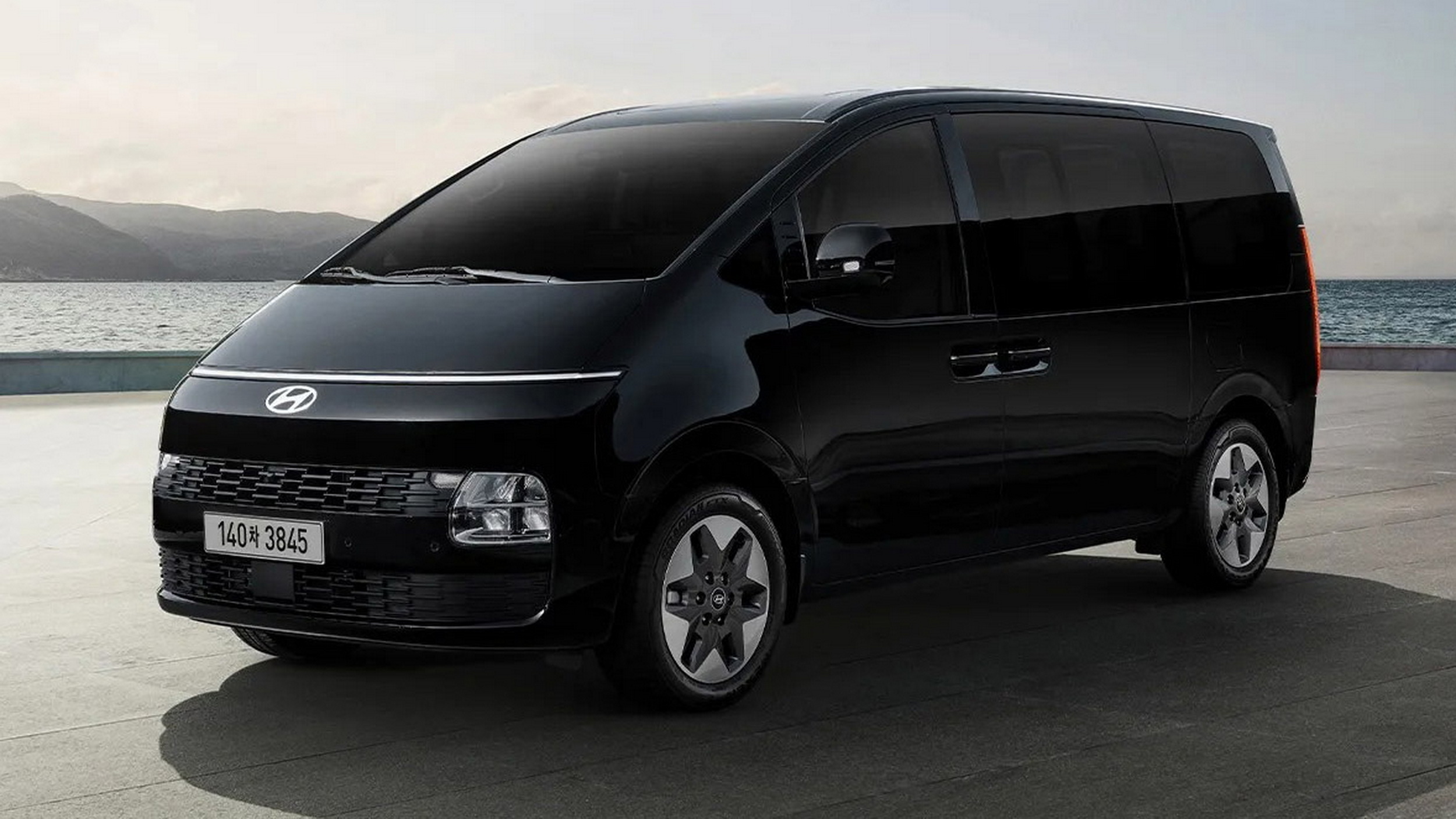
The Hyundai Staria isn’t just a minivan—it’s a rolling manifesto of what happens when a car designer trades in the safety of convention for the thrill of the avant-garde. Sleek, asymmetrical, and draped in a silhouette that looks like it was sketched by a cyberpunk architect, this vehicle dares to ask: What if minivans weren’t the beige boxes of suburban tedium, but the bold, boundary-pushing chariots of tomorrow? Yet, as it stands poised on the precipice of a potential U.S. debut, a tantalizing question lingers: Will American roads ever be ready for a minivan that looks like it belongs in a sci-fi film rather than a soccer mom’s driveway?
With its panoramic glass roof, sliding coach doors that whisper of luxury, and an interior that feels like the cockpit of a spaceship, the Staria isn’t merely transporting passengers—it’s transporting perceptions. But before we dive into the Staria’s audacious design and the seismic shift it could bring to the U.S. market, let’s address the elephant in the room: Can a vehicle this futuristic ever shed its “weird” label and become a mainstream sensation?
The Staria’s Design: A Love Letter to the Unconventional
The Staria’s exterior is a masterclass in defying expectations. Gone are the rounded, bulbous shapes of traditional minivans. In their place, sharp creases, angular headlights that resemble the visor of a stormtrooper, and a roofline that swoops down like the dorsal fin of some aquatic leviathan. It’s as if Hyundai took a scalpel to the minivan genre and sculpted something entirely new. The color palette—often featuring bold two-tone schemes—further cements its status as a rolling art piece.
But the Staria isn’t just about looking the part; it’s about feeling it. Step inside, and the futuristic theme continues. The dashboard curves like a crescent moon, the center console floats in a sea of open space, and the seats swivel to face one another, turning the cabin into a mobile lounge. It’s the kind of interior that makes you want to host a dinner party in your minivan—or at least pretend you’re in a luxury yacht. The panoramic glass roof doesn’t just let in light; it bathes the cabin in an ethereal glow, making every drive feel like a stroll through a futuristic atrium.
Yet, for all its innovation, the Staria’s design isn’t without its critics. Some call it polarizing. Others say it’s too “out there.” But isn’t that the point? The Staria doesn’t want to blend in—it wants to stand out, to challenge, to redefine what a family vehicle can be. And in an era where cars are increasingly becoming rolling computers, why shouldn’t a minivan look like it’s from the year 2150?
Performance and Practicality: The Staria’s Secret Superpowers
Of course, a vehicle this striking must deliver more than just good looks. Under the hood, the Staria flexes its muscles with a range of powertrains, including a turbocharged 2.2-liter diesel and a 2.5-liter gasoline engine, both paired with an 8-speed dual-clutch transmission. But the real star of the show might be the upcoming Staria Hybrid and, eventually, the Staria Electric—rumored to pack enough punch to leave the VW ID. Buzz in its dust. With instant torque and whisper-quiet acceleration, the Staria proves that futuristic design doesn’t have to come at the expense of performance.
Practicality, too, is a key player in the Staria’s roster. Despite its sci-fi aesthetic, it doesn’t skimp on space. The sliding doors open wide enough to accommodate a stroller, a wheelchair, or a particularly enthusiastic golden retriever. The cargo area is cavernous, and the modular seating allows for configurations that range from a cozy family hauler to a mobile office. It’s the kind of vehicle that can adapt to life’s chaos without breaking a sweat—whether you’re schlepping kids to soccer practice or hauling a week’s worth of groceries from the farmers’ market.
But here’s where the Staria’s potential challenge in the U.S. market becomes glaringly apparent. American consumers are notoriously skeptical of vehicles that deviate too far from the norm. The minivan segment, in particular, has long been dominated by models that prioritize bland reliability over bold design. The Staria, with its avant-garde styling, risks being dismissed as a novelty—something for enthusiasts and futurists, but not for the masses. Can it overcome this perception and prove that practicality and panache can coexist?
The U.S. Market: A Gamble Worth Taking?
The big question looming over the Staria like a storm cloud is whether Hyundai will dare to bring it to the U.S. The American market has a complicated relationship with minivans. Once the darlings of suburban families, they’ve been largely supplanted by SUVs, which offer the same space with a dash of ruggedness. But the Staria isn’t just another minivan—it’s a statement. And statements, by their very nature, are risky.
Bringing the Staria to the U.S. would be a bold move. It would require Hyundai to sell American consumers on the idea that a minivan can be cool, that it can be aspirational, that it can be more than just a utilitarian box on wheels. It would mean marketing a vehicle that looks like it belongs in a Blade Runner sequel to an audience that’s more accustomed to seeing minivans in the parking lots of PTA meetings.
Yet, the potential rewards are enormous. The Staria could carve out a niche for itself as the ultimate family adventure vehicle—a minivan for people who don’t want to sacrifice style for space. Imagine road trips where the kids are entertained by the panoramic roof, where the adults can swivel their seats to enjoy a meal or a movie, where the whole family arrives at their destination looking like they stepped out of a sci-fi flick. It’s a vision of family travel that’s as aspirational as it is functional.
But the Staria’s success in the U.S. would hinge on more than just its design. Hyundai would need to address practical concerns, such as pricing, dealership support, and after-sales service. The Staria would need to prove that it’s not just a flashy concept car but a reliable, everyday vehicle capable of handling the rigors of American roads. And perhaps most importantly, it would need to convince consumers that they don’t have to choose between practicality and personality.
The Staria’s Place in the Future of Mobility
The Hyundai Staria isn’t just a minivan—it’s a glimpse into the future of mobility. In a world where cars are increasingly becoming extensions of our digital lives, the Staria embraces that evolution with open arms. Its advanced infotainment system, wireless charging pads, and over-the-air update capabilities make it a vehicle that’s as connected as it is comfortable. It’s a minivan for the age of smartphones, smart homes, and smart everything.
But the Staria’s futurism extends beyond its tech. It’s a vehicle that challenges the status quo, that dares to ask why minivans have to be boring. In a market dominated by SUVs and crossovers, the Staria offers something different—a vehicle that prioritizes space, comfort, and style without apology. It’s a reminder that practicality doesn’t have to come at the expense of personality.
As the automotive industry hurtles toward an electric and autonomous future, the Staria stands as a testament to the power of design. It proves that a vehicle can be both functional and fantastical, that it can cater to the needs of families while also appealing to the inner dreamer. Whether it ever makes it to U.S. shores remains to be seen, but one thing is certain: the Staria is more than just a minivan. It’s a revolution on wheels.
The road ahead is uncertain, but the Staria’s journey is far from over. If Hyundai dares to bring it to America, it could change the way we think about family vehicles forever. And if not? Well, at least we’ll always have the memories of a minivan that dared to dream.