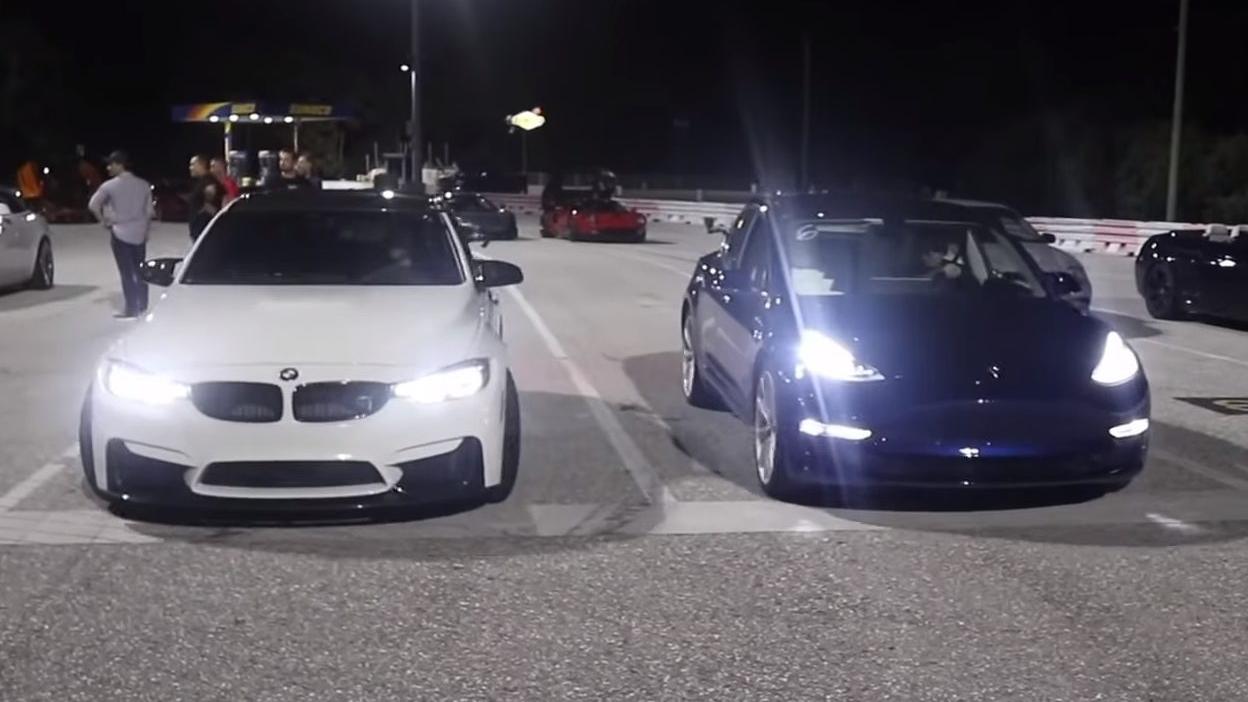
Imagine two kinds of speed. One arrives with a silent electrostatic certainty, the other with the brash confidence of a tuned combustion legend. Now add a simple, playful provocation: can a 2026 Tesla Model 3 Performance truly keep pace with a BMW M340i xDrive when the road turns into a contest of nerve, traction, and intent?
Here’s the twist—because challenges rarely come neatly. The BMW arrives with composure and mechanical flourish, yet the Tesla answers with instantaneous torque and ruthless efficiency. And when conditions shift—wet asphalt, imperfect traction, a roll-on sprint—the “obvious” winner might end up being the one with the better plan. Let the duel begin.
Setting the Scene: Two Different Philosophies of Fast
The 2026 Tesla Model 3 Performance speaks the language of modern velocity. Its power delivery is immediate, its response measured in milliseconds rather than moments. No waiting, no lag, no drama. Just a surge that feels like the car is already thinking ahead.
The BMW M340i xDrive, meanwhile, is a masterclass in dynamic balance. It’s not merely quick—it’s engineered for momentum. That straight-six rhythm, turbocharged and deliberate, has a certain theatricality. Press the accelerator and it stretches its legs with a confident pull. It’s fast in the way a well-rehearsed performer is fast—timed, graceful, and hard to unseat.
So when you ask which is faster, you’re really asking which philosophy better matches the moment: electric immediacy or BMW’s controllable surge.
Power Under Pressure: Torque Delivery and “Feel”
In a sprint scenario, the Tesla’s advantage often begins at the pedals. Electric torque is delivered with uncanny linearity—what you command is what you get. That means launches can feel like a single, uninterrupted event. A traction-limited moment might appear, but the torque curve typically avoids the kind of hesitation some combustion cars experience during transitional gear changes.
The M340i does not stumble, though. Its power is delivered through a more traditional actuation: boost builds, the engine climbs into its effective range, and the car moves with confident acceleration. The xDrive system helps immensely, distributing grip so the driver doesn’t have to fight for traction at every throttle blip.
Ask yourself this: when acceleration becomes a game of traction management, which car feels more obedient—Tesla’s instant torque or BMW’s mechanically mediated pull?
Launch Control vs. Traction Drama
Launch conditions can flip the story in under a second. In cooler weather, tires bite more consistently, and both cars can feel dramatically faster. In warmer or wet conditions, traction becomes the gatekeeper.
The Tesla’s electronics can preempt certain slip behaviors, smoothing the transition from standstill into acceleration. Still, a heavy initial surge can reveal tire limits. The M340i’s xDrive provides a different sort of safety net: it can shuffle grip across the axles with confidence, yet torque still arrives through an engine’s characteristic delivery.
Here’s the potential challenge: you may “win” the race on paper, but lose it on the road if your tires, surface, or technique don’t match the car’s strengths. If you can’t repeat launches consistently, you can’t fairly crown a champion.
Aerodynamics and Efficiency: The Hidden Authors of Speed
Speed isn’t only about horsepower; it’s also about resistance. The 2026 Model 3 Performance benefits from a shape optimized for airflow and a chassis designed to reduce drag penalties at higher velocities. That can make it feel particularly strong in mid-to-high-speed stretches—those moments when many cars start paying the aerodynamic tax.
The BMW M340i is also crafted for real-world speed, with aero details that support stability at pace. But efficiency is the Tesla’s natural habitat. An electric drivetrain typically wastes less energy as heat, and its power delivery remains consistent across varying temperatures—assuming the battery is in a favorable state.
So if the race extends beyond the first few heartbeats, the question changes. Is the contest still about acceleration, or has it become about how long you can sustain momentum?
Handling and Chassis: Corners Don’t Care About Badges
Acceleration is the opening argument. Handling is the closing argument. When the road curves, weight transfer becomes a tyrant, and grip becomes an unspoken contract.
The Tesla’s chassis tuning often emphasizes sharp response and predictable balance. Instant torque can be a blessing in corners if traction holds, but it also demands careful throttle modulation. The driver who treats the throttle like a metronome tends to ride the limit more effectively.
The M340i brings a different confidence: a chassis that feels composed and communicative, with xDrive aiding stability under load. The car tends to encourage progress—smooth entry, firm mid-corner composure, and a steady climb out.
And here’s the playful challenge to consider: if you were forced to choose a single skill—late braking, early throttle, or calm steering—does the Tesla reward your instinct faster, or does the BMW repay your patience more generously?
Braking and Thermal Management: Who Works Better Under Repeated Use
Repeated runs reveal character. The Tesla uses regenerative braking alongside friction braking, which can reduce brake wear and maintain pedal feel consistency—though performance depends on battery state and thermal conditions. When the battery is ready, the system can be remarkably effective.
The BMW relies on its conventional braking setup, which is predictable and strong, with the xDrive system helping stability during deceleration. In extended sessions, brake temperatures matter, and how the car dissipates heat becomes a quiet determinant of endurance.
Consider a scenario: two drivers do back-to-back pulls. The “fastest” car on a fresh start might not be the best after several attempts. The challenger isn’t just speed—it’s stamina.
Interior Atmosphere: Driver Engagement vs. Digital Calm
Performance isn’t only about mechanical outcomes. It’s also about focus. The Tesla’s cockpit can feel futuristic and composed—an environment that encourages a certain kind of attention. Controls are minimalistic, and the interface can feel like a clean command center.
The BMW’s cabin often leans into tactility. Switchgear and traditional layout create a rhythm of familiarity. It’s the kind of interior that invites a driver to feel connected, not mediated.
In a high-stakes comparison, this matters. If the driver feels more confident and less distracted, lap times quietly improve.
Everyday Usability: The Race That Happens Between Lights
Real ownership includes city traffic, highway merges, and the occasional spontaneous acceleration test. The Tesla tends to shine in smooth low-speed response and effortless power. Its electric nature makes commuting feel less about gear selection and more about seamless motion.
The M340i delivers a different satisfaction: a classic performance drive that’s still civilized. Engine sound, shifting behavior, and drivability contribute to a “ready when you are” character.
So when you face the everyday challenge—those short bursts between lanes—what matters more to you: the Tesla’s silent punch or the BMW’s dramatic pull?
Visual Snapshot: The Cars at Speed

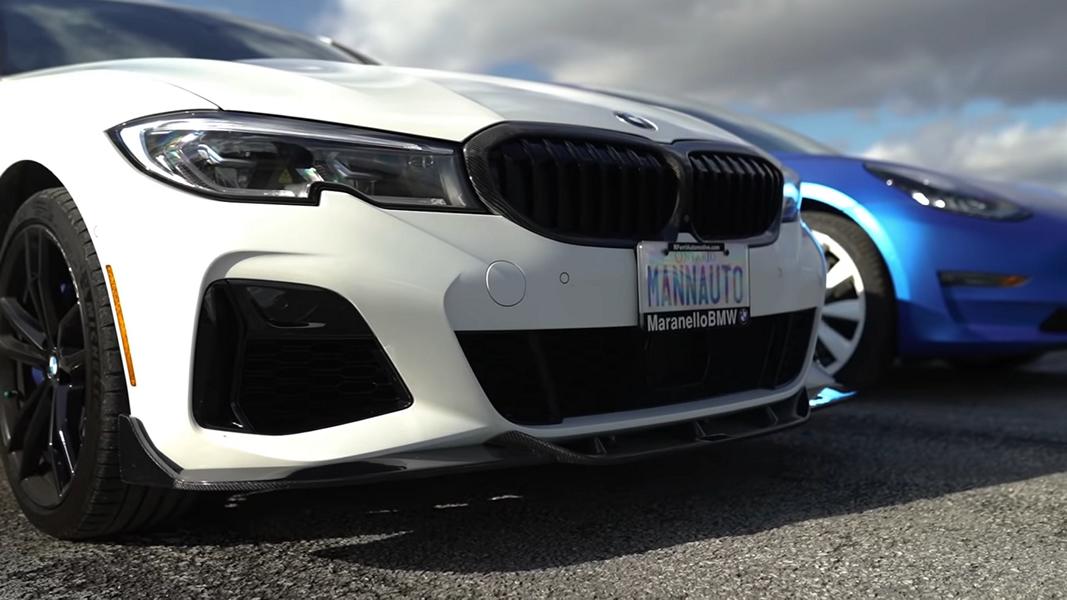
Even without numbers, you can feel the contrast. One car looks like the future built for immediacy. The other looks like it’s ready to negotiate with physics using sheer mechanical finesse.
So, Who Wins the Real Contest?
Here’s the honest conclusion: the “winner” depends on what you mean by speed and how you measure it. In straight-line acceleration, the 2026 Tesla Model 3 Performance often presents a formidable case through instant torque and consistent response. The BMW M340i xDrive counters with balanced traction, confident power delivery, and an engaging chassis feel that supports spirited driving.
But the most meaningful answer lies in the conditions you’re willing to challenge. Track? Wet road? Cold tire day? Sustained acceleration or a single launch? Each scenario rewrites the standings.
If you want a playful takeaway, treat the comparison like a friendly duel between two superpowers. The Tesla wins when immediacy rules. The BMW wins when composure and engineered momentum matter more than raw instant thrust. And the moment you step behind the wheel, the true judge becomes your own technique.
Final Word: Your Next Test Is the Decider
The 2026 Tesla Model 3 Performance vs BMW M340i xDrive isn’t just a comparison—it’s an invitation. Pick a route with a mix of straights and corners. Repeat a few runs. Pay attention to traction, braking feel, and how the car behaves when you push it beyond the first thrill.
Then ask the same playful question again. Not “which is faster?” but which one makes you feel more capable at speed? That answer usually lasts longer than any single number.