The word “safe” can be slippery. It’s easy to say it, harder to prove it. In the world of modern automobiles, safety is no longer a single feature—it’s an ecosystem of engineering decisions, materials, crash-compatibility strategies, and driver-assist systems working in concert. That’s precisely why IIHS Top Safety Pick+ recognition has become a kind of shorthand for disciplined design and measurable results.
As 2026 models begin to settle into dealer lots and spec sheets, drivers are looking for more than just a new grille or a refreshed infotainment layout. They want reassurance that the vehicle around them—before and after impact—was built with uncommon rigor. This article explores what readers can expect from the safest 2026 SUVs that carry IIHS Top Safety Pick+ status, how these winners tend to be configured, and what the designation practically means for real-life driving.
Why IIHS Top Safety Pick+ Matters in Real Life
Imagine driving a family route you’ve repeated for years: school zones, crosswalks, hurried highway merges, and the occasional sudden braking in traffic. Safety isn’t tested on perfect roads. It’s tested under controlled conditions meant to simulate the chaos that can happen anywhere.

The Top Safety Pick+ benchmark is not just about surviving a single crash scenario. It’s about achieving consistent excellence across multiple categories—front-end protection, side-impact performance, roof strength, head restraint effectiveness, and vehicle-to-pedestrian considerations where applicable. The “plus” element also underscores the importance of advanced front crash prevention and specific lighting evaluations, ensuring the SUV can both avoid and mitigate harm.
Long sentences can feel like a manual, and this isn’t one. The bottom line is straightforward: a Top Safety Pick+ SUV is one that earnestly anticipates danger rather than simply enduring it.
What “Safest” Looks Like: The Anatomy of a Top Performer
When you scan a winning lineup, patterns emerge. Safety victories usually come from a combination of robust structural design and intelligent restraint/monitoring systems. These SUVs tend to use reinforced zones engineered to manage crash energy—so the cabin remains more stable while crumple structures do their job.
There’s also the matter of “injury biomechanics,” a phrase that sounds clinical but is actually practical. Head restraints, seat geometry, and how airbags deploy can substantially affect how forces travel through the body in an impact. The most dependable SUVs don’t rely on one heroic component. They harmonize their safety systems like a well-rehearsed orchestra.
In a modern cabin, the safety story is also digital. Driver-assist tech—adaptive cruise control, lane centering, collision warning, and automatic emergency braking—acts as a second set of eyes. Some models are tuned to detect vulnerable scenarios earlier than you might expect.
IIHS Winners You’ll Notice: The 2026 SUV Personality Spectrum
Not every Top Safety Pick+ SUV will feel identical behind the wheel. “Safety” doesn’t erase personality; it shapes it. Some winners emphasize composure at highway speeds. Others prioritize visibility and easy maneuvering for urban commutes.
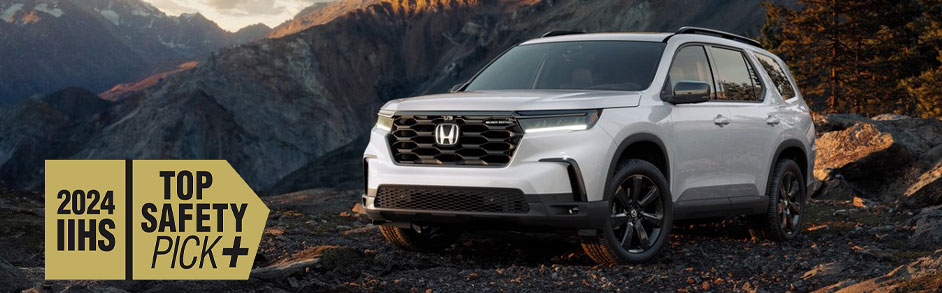
Consider the 2025 Honda Pilot’s recognized safety achievement as a preview of the kind of engineering discipline that can carry forward into the next model cycle. The Pilot’s reputation for earning Top Safety Pick+ status reflects a design philosophy centered on crashworthiness and mitigation technologies. As shoppers move through 2026 inventories, they’re often comparing vehicles that offer different driving temperaments while still aligning with the same stringent safety metrics.
For readers, this matters because the “safest” choice should also be the one you’ll actually drive confidently. A safety rating is a promise; comfort and control are the delivery.
From Front Crash Prevention to Night-Time Clarity: The “Plus” Advantage
Many people think safety is mostly about what happens during a crash. That’s only half the plot. The other half is anticipation—technology that intervenes before impact, and lighting systems that extend visibility when perception is hardest.
Top Safety Pick+ standards typically reflect both avoidance and mitigation. When a vehicle can detect a potential collision earlier and respond with braking support—or in some cases full automatic braking—it reduces the odds that an event escalates into something severe.
Lighting performance is the quiet hero here. Headlamps that illuminate the road edge and reduce glare can materially improve reaction time. In fog, rain, and nighttime transitions, the difference between “visible” and “clearly visible” is often the difference between late decisions and timely ones.
How to Shop Smart: Reading Safety Specs Without Getting Lost
Even with IIHS recognition, shopping can become a maze. Trim levels can change the availability of key driver-assist systems, and some packages may be required to achieve the safest configuration. The designation is tied to the vehicle as tested, not necessarily every possible build.
To shop efficiently, readers can look for three practical categories:
1) Standard driver-assist equipment: Confirm whether collision warning, automatic emergency braking, and lane support are included in the trim you’re considering.
2) Lighting and visibility packages: If headlights are upgrade-dependent, verify that your chosen configuration matches the tested evaluation.
3) Seating and restraint details: While the SUV may earn the designation overall, verifying child-seat compatibility and head restraint behavior in real seating positions can make everyday use safer and calmer.
Short checklist habits prevent long regrets.
Safety Beyond Crashes: The Overlooked Comfort of Protection
There’s a less advertised kind of safety: the way an SUV behaves when you’re tired, stressed, or distracted. Smooth acceleration, predictable steering response, and firm yet compliant braking translate into fewer abrupt corrections. That matters because real-world incidents often begin as tiny hesitations that snowball.
Many IIHS winners also tend to offer stability systems calibrated for confident control. A strong chassis and well-tuned suspension help keep tires planted and weight transfer predictable. It’s an unglamorous form of safety—almost like good handwriting. You don’t notice it until the alternative looks messy.
Choosing the Right Safety Fit: Family, Commuter, and Adventure Use
Safest 2026 SUVs are not one-size-fits-all. A family with car seats has different concerns than a commuter who spends hours in stop-and-go traffic. And a road-tripper who navigates variable weather needs a different blend of traction, driver support, and visibility.
Family-focused buyers should pay close attention to rear-seat usability. A vehicle can be structurally safe and still become frustrating if access to the rear bench is difficult or if anchors aren’t straightforward. A safe SUV should be safe in practice, not just in test scenarios.
Commuters often benefit most from adaptive cruise and lane centering—systems that reduce cognitive load. Long sentences come with long days; the right SUV helps shorten the mental fatigue.
Adventure-minded drivers should prioritize confidence in poor conditions. Even the safest SUV can be undermined by inadequate tires or poorly matched driving habits. Safety is an equation, and tires are part of the arithmetic.

What to Expect During the Test Drive: The Human Side of Safety
Before you sign paperwork, safety should become tangible. On a test drive, evaluate visibility first: hood line, mirror positions, blind-spot coverage, and how clearly the SUV communicates what’s happening around it.
Then check control behaviors. Engage driver-assist features and observe whether they feel cooperative or intrusive. A well-calibrated system should be confident without being erratic. It should also allow you to correct course quickly when you choose to.
Finally, test seat comfort and restraint interaction. The safest design in the world is less effective if the seating position causes you to adjust constantly. Safety is partly engineering, partly habit, and partly human fit.
The Road Ahead: Building Confidence in 2026
Safest 2026 SUVs that earn IIHS Top Safety Pick+ recognition represent more than an award badge. They reflect deliberate engineering choices and a commitment to both crash protection and proactive prevention. That dual focus—endurance plus anticipation—is what turns “safe on paper” into “safe in motion.”
When you approach your purchase with both curiosity and discipline—matching trims, confirming required technology, and validating comfort during a test drive—you don’t just buy an SUV. You acquire a quieter kind of confidence. The kind that lets your attention return to the road rather than the worst-case scenario.
As 2026 lineups continue to expand, the safest winners will remain recognizable by their consistency: strong structures, meaningful prevention systems, and the practical clarity that helps drivers perceive danger early. In a world where unpredictability is inevitable, that clarity is its own form of safety.