There’s a particular kind of wonder that arrives when you realize your car can become a power station. Not in some distant, sci-fi way—more like a quiet, practical transformation that happens with a button press. Many EV drivers notice it for the first time during an outing: the campsite is tucked into trees, the kitchen is more ambition than equipment, and yet a refrigerator hums as if the grid is nearby. That small moment can feel like an offbeat miracle. But the fascination runs deeper than convenience alone. Vehicle-to-Load (V2L) doesn’t merely “add outlets” to an EV; it reframes what electricity means in motion, in leisure, and in emergency readiness.
Let’s walk through what makes V2L compelling—technically, emotionally, and socially—while keeping one eye on the details that determine whether the experience feels seamless or fiddly.
What “Vehicle-to-Load (V2L)” really means
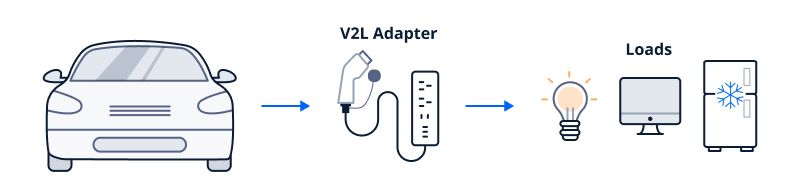
Vehicle-to-Load is the capability of an electric vehicle to supply electrical power to external devices. Think of it as the EV acting as a generator, but with the precision of a modern battery management system rather than the clatter of combustion. The EV’s battery can feed energy to household-style appliances, power tools, and charging needs—through specific ports and adapters designed for safe output.
It’s easy to reduce V2L to a simple slogan—“power your gear.” Yet that phrase hides a meaningful shift. With V2L, the vehicle is no longer only a consumer of electricity. It becomes a node in the local energy story.
Why people fall for it so quickly
At first glance, V2L is straightforward: plug something in, get electricity. Still, the emotional appeal is oddly specific. It makes everyday dependencies feel negotiable. When your EV can power a mini-fridge, run lighting at dusk, or keep laptops alive for work at a remote desk, you stop thinking like a commuter and start thinking like a prepared traveler.
There’s also a psychological inversion at play. Traditionally, “power” is something you chase—find outlets, carry extension cords, search for campsites with shore power. V2L flips the search into a backdrop. You carry capability. The road becomes a reservoir of possibility.
And then there’s the practical satisfaction: watching a device draw power from the EV feels tangible. Unlike abstract battery percentages, V2L gives immediate feedback. The experience is visceral. It makes energy feel less like bookkeeping and more like agency.
How the power actually gets from battery to your devices
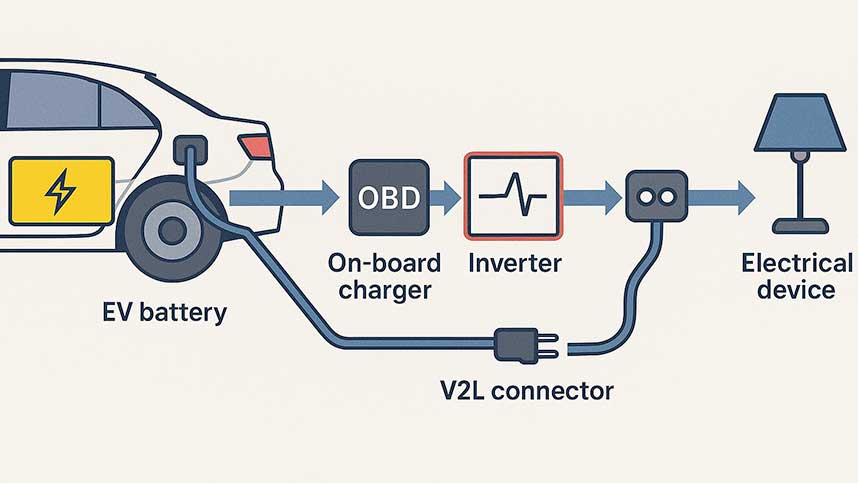
To deliver usable electricity, the EV must convert and manage energy safely. Batteries typically provide direct current (DC). Many external devices expect alternating current (AC), or at least require a stable output profile. That means the EV uses power electronics—often involving an inverter—to shape the battery’s energy into the appropriate electrical form.
But the fascinating part is not just conversion. It’s regulation. Modern EV systems guard against overheating, overcurrent situations, and voltage instability. This is where the battery management system earns its keep. It monitors cell conditions and ensures the output doesn’t compromise vehicle safety or long-term health.
So when V2L works well, it feels frictionless. That smoothness is the product of behind-the-scenes choreography, not luck.
Common use cases: from camping comfort to home backup
V2L reveals itself in layers of usefulness. Some drivers treat it as a lifestyle upgrade; others treat it as a resilience tool. Both perspectives can be true simultaneously.
Outdoor life: powering a cooler, charging headlamps and cameras, running a small coffee maker, or keeping a portable speaker alive during evening setup. Even short trips gain a new rhythm when you can treat your vehicle as a reliable supply.
Work and mobility: running laptop chargers, powering a workstation, or maintaining equipment for on-site tasks. Remote work often depends on battery management, and V2L adds an extra layer of steadiness.
Home backup: during outages, V2L can support essentials such as lights, routers, or medical devices where compatible. This doesn’t replace a full backup system, but it can bridge critical gaps—long enough to restore grid power or switch to alternate arrangements.
Event readiness: powering microphones, lighting, or charging stations during community gatherings where access to outlets is unpredictable.
In each case, the pattern is similar. V2L helps you expand your “available power horizon.” You carry more than transportation—you carry electricity you can deploy.
Ports, adapters, and the practical checklist
V2L is not a universal feature with the same connectors across every EV model. Some vehicles include a built-in outlet; others require an adapter or a compatible accessory kit. That matters, because the quality of the connection affects safety and performance.
Before using V2L, it helps to treat the first session like a rehearsal. Verify the vehicle’s supported power output, confirm whether the device requires AC or DC power, and ensure the total load is within the EV’s limits. Using the right cables prevents nuisance problems—like tripping breakers—or worst-case complications.
It’s also wise to think about surge loads. Many devices briefly draw more power when they start up, even if their steady-state consumption is modest. The EV may handle the surge, but matching expectations prevents disappointment.
Finally, consider ventilation and placement. If the vehicle is running output for extended periods, keeping the surroundings tidy and avoiding enclosed airflow blockages supports reliable operation.
Battery impact: the deeper tradeoff beneath convenience
It’s tempting to view V2L as “free electricity” because the source is already inside the vehicle. But the EV battery is finite, and power delivery uses energy at a measurable rate. The fascination grows when people learn to estimate consumption and plan thoughtfully.
Longer sessions with multiple devices can drain the battery faster than expected. Refrigeration loads can be deceptively continuous; lighting and charging are intermittent but can still add up. A helpful approach is to calculate approximate watt-hours: estimate device wattage, multiply by runtime, and compare it to the EV’s available energy reserve. This turns a vague feeling into a confident plan.
Yet the real elegance is in how EVs manage the balance. Many systems aim to protect battery health, throttling output as needed and maintaining safe operating conditions. Still, the deeper reason V2L feels magical is that it invites energy literacy. It turns “miles” into “power budgets,” and that perspective shift can be oddly empowering.
Power quality, stability, and why “it runs” isn’t the whole story
Not all electricity is the same. Some devices—particularly electronics with sensitive power supplies—prefer stable output. V2L systems generally provide regulated power designed for consumer loads, but understanding this nuance helps set realistic expectations. If you’re powering something delicate, start with a small test device. If it performs normally, you can scale up with more confidence.
Power quality also influences user experience. A stable supply yields fewer interruptions, less device stress, and smoother startups. When V2L is properly implemented in a vehicle, it tends to feel like a normal outlet—an outcome that people often notice immediately because it reduces the friction of uncertainty.
Operational best practices for a confident V2L session
Adopting a few habits can transform V2L from an experiment into a dependable routine.
Plan your load: Start with essential devices. If you’re running lighting and chargers, you’ll likely be fine. If you’re powering high-draw appliances, confirm compatibility and limits.
Stagger usage: Rather than turning everything on at once, run critical items first. This reduces surge peaks and helps the EV manage output smoothly.
Mind runtime: If output is needed for hours, monitor battery status and keep an eye on how quickly capacity is moving.
Use safe equipment: Quality extension cords and rated adapters matter. Improvisation can be the enemy of reliability.
Keep a recharge plan: If you’ll drain the battery substantially, ensure you have a strategy for recharging after the session.
These practices don’t just prevent problems. They extend the narrative satisfaction. You’re no longer reacting to a device’s behavior—you’re orchestrating it.
V2L versus related features: what’s the difference?
People sometimes bundle V2L with other EV power capabilities. It helps to distinguish them. Vehicle-to-Load focuses on supplying power to external devices. Vehicle-to-Home (and related “backup” concepts) typically indicates a more structured setup to support home circuits, often with additional safety hardware and installation.
Another concept sometimes discussed is Vehicle-to-Grid (V2G), which involves feeding power back into the grid under certain conditions. That’s a different ecosystem, governed by regulations, infrastructure, and utility agreements. V2L remains the most approachable entry point for most users because it doesn’t require the same grid-level coordination.
In practice, V2L is often where fascination becomes habit. It’s tangible. It’s immediate. It turns “what if” into “here’s what it can do.”
The story behind the fascination: energy as flexibility
Why does V2L captivate so many people? Because it changes the choreography of daily life. Electricity stops being a fixed location. It becomes mobile, conditional, and responsive. That’s a subtle revolution in mindset.
When you can power your gear from your vehicle, you make choices with fewer constraints. The weekend itinerary expands. The emergency plan gains a new line item. The sense of control increases—even if the actual power reserve is limited. Control is rarely only technical. It’s also emotional. V2L supplies reassurance.
And perhaps that’s the deepest reason for the fascination: it feels like a bridge between modern mobility and resilient independence.
Conclusion: Power your gear—and your possibilities
EVs with Vehicle-to-Load (V2L) invite a fresh relationship with energy. They turn a car into a practical power companion, capable of running essential devices, supporting outdoor comfort, and providing backup utility when the grid falters. The experience is compelling not just because it works, but because it expands what you feel you can do.
Use the right ports and adapters, respect load limits, and think in power budgets. Then V2L becomes more than a feature. It becomes a toolkit for confidence—one that travels with you, quietly electrifying every moment you decide to be prepared.