Honda has long built its reputation on engineering that feels almost conversational—practical, dependable, and quietly confident. Yet the electric era asks for a different kind of performance: not only horsepower and range, but also pace, clarity, and an instinct for what everyday drivers actually need. The Honda Prologue arrives as the company’s first mainstream EV attempt, a vehicle engineered to look familiar in the driveway while delivering something new under the skin. It is the moment where Honda’s careful design philosophy meets a modern, battery-powered worldview—one aimed at making EV ownership feel less like a leap of faith and more like a logical next step.
Why the Prologue matters: an EV built for the middle
Many EV launches begin with a halo model—sleek, expensive, and often aimed at early adopters with deep pockets and deep curiosity. The Prologue takes a different stance. It is positioned as a mass-market proposition, which means it is designed to meet drivers where they already are: commuting, road-tripping, hauling kids and groceries, and planning around real-world charging. That “mainstream” intent changes everything. The Prologue’s value isn’t only its technology. It’s also the sense that EVs can be approached with the same decision-making framework used for gas-powered purchases—trim options, usable space, and an ownership experience that doesn’t require an enthusiast’s spreadsheet.
In narrative terms, the Prologue reads like a bridge. Not a replacement for every vehicle. Not a statement that combustion is obsolete tomorrow. Instead, it is a bridge between decades of Honda trust and the new expectations of electrified motoring.
Design language: familiar Honda proportions with an EV presence
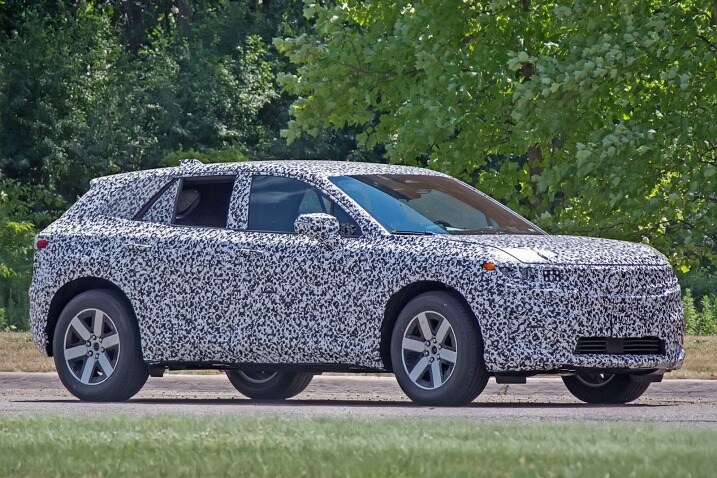
At first glance, the Prologue carries a recognizable SUV stance—clean lines, practical proportions, and an interior layout meant for frequent use. Still, EVs have their own visual gravity. The front end, lighting signatures, and overall stance help signal that this isn’t simply a gas SUV with a battery swap. The shape supports aerodynamic efficiency while preserving the real-world ergonomics people associate with the brand.
Design is more than aesthetics; it influences heat management, airflow, and how efficiently the vehicle can glide through everyday driving. The Prologue balances those considerations while keeping the cabin atmosphere approachable—less “tech pod,” more “family command center.”
Interior experience: comfort-first usability
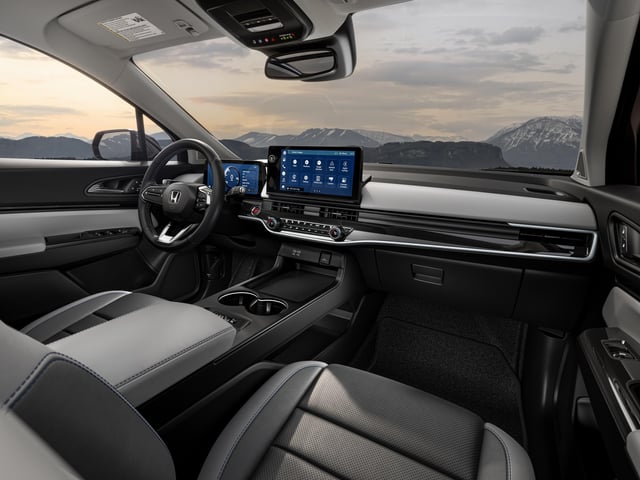
Honda’s interior playbook has always leaned toward comfort and intuitive control placement. In the Prologue, that philosophy remains central. The cabin is styled to reduce cognitive friction—fewer confusing menus, more direct access to key functions, and a driver’s environment that doesn’t demand constant attention. Short trips should feel effortless. Long ones should feel composed.
Space matters in a mass-market vehicle. The Prologue’s design aims for practical cargo utility and passenger accommodation, keeping the everyday choreography of door loading, seat adjustments, and visibility front-and-center. It’s the kind of interior that doesn’t just look clean; it behaves cleanly, too.
Materials and fit contribute to the sense of quality. EVs often face criticism for feeling “too futuristic.” The Prologue counters by creating a cabin that feels grounded—calm surfaces, logical spacing, and a driving position that makes the vehicle feel immediately familiar.
Powertrain fundamentals: the logic of electric torque
Electric motors provide torque instantly, and the Prologue leans into that characteristic. The result is acceleration that feels immediate and linear, without the mechanical drama of shifting gears. Drivers get a smoother, quieter response at the wheel—one that changes how overtakes and merges feel during normal traffic rhythms.
But torque isn’t the whole story. EV performance also depends on software calibration: how the vehicle meters power at different speeds, how it manages traction, and how it balances efficiency with responsiveness. The Prologue is built to deliver an EV driving experience that’s neither timid nor frantic. It aims for confidence, especially in variable conditions.
Range, efficiency, and real-world expectations
When shoppers weigh EVs, the range question is rarely theoretical. It’s the daily commute plus a hypothetical detour. The Prologue’s goal is to make range feel manageable rather than mysterious. Efficiency is shaped by multiple factors: tire selection, driving style, ambient temperature, and route conditions. Honda’s approach focuses on building a vehicle that can remain consistent across normal circumstances, not just optimized tests.
Range anxiety often begins with uncertainty. With mainstream EVs, reducing that uncertainty matters as much as increasing the miles on paper. The Prologue’s effectiveness should be understood as a sum of its power management strategy, aerodynamic decisions, and the vehicle’s ability to predict and communicate energy usage.
Charging strategy: planning that fits normal life
Charging is where most ownership stories are either won or lost. The Prologue’s mainstream positioning implies a mindset: charging should be feasible for people who do not want to become part-time energy consultants. Home charging is typically the preferred rhythm for EV owners, since it turns evenings into preparation and reduces weekday friction.
Public charging introduces variability—station availability, connector types, and charging curves. The Prologue’s design and software should help drivers interpret these realities with clarity: showing energy estimates, guiding routing decisions, and making it easier to understand what charge level to target for the next leg. The best charging systems do not just display numbers. They reduce decision fatigue.
Technology content: infotainment, driver assistance, and clarity
Modern vehicles live or die by their interfaces. The Prologue offers the kind of technology readers expect in a contemporary SUV: a touchscreen-driven infotainment system, connectivity features, and an ecosystem designed for day-to-day use. The key is responsiveness and legibility. An EV dashboard cannot feel laggy or cryptic when the vehicle is already asking drivers to think about energy.
Driver assistance features—lane guidance, adaptive behavior, and collision mitigation—become especially important in an EV because the driving experience is so smooth that it can encourage longer attention intervals. The Prologue’s technology should support focus rather than distract from it. The most compelling systems help you stay oriented, whether on a morning commute or a late-night highway run.
Driving dynamics: an SUV that behaves like an SUV
Electric vehicles can sometimes feel too stiff or too floaty, depending on suspension tuning. The Prologue is tuned for the everyday: stability through corners, composure over uneven pavement, and steering feel that supports confident lane changes. This is not about turning the SUV into a track weapon. It’s about delivering a confident, predictable rhythm—especially for drivers who want the practicality of an SUV without sacrificing refinement.
Regenerative braking also shapes the experience. When used well, it can create a smooth, controlled deceleration feel, reducing reliance on the brake pedal during normal driving. When it’s poorly implemented, it becomes a source of inconsistency. The Prologue’s character is best understood as the balancing act between smoothness, control, and predictable deceleration behavior.
Ownership and practical considerations: costs, maintenance, and lifestyle fit
EV ownership is often summarized by cost, but cost is only part of the story. Maintenance changes when the powertrain changes. Fewer moving parts can reduce certain wear items, though tires, brake components (especially when regenerative braking is heavy), and routine service remain relevant. The Prologue’s mainstream approach implies straightforward ownership planning: a vehicle that can be serviced through established channels and supported by a clear service roadmap.
Insurance and charging costs vary by region, but many drivers find EV budgeting more stable because electricity pricing and charging patterns can be monitored more easily than fuel price swings. For commuters, that stability can feel like a quiet advantage.
Marketing and positioning: Honda’s cautious optimism
Honda’s first mass-market EV effort is also a communications story. The brand has an identity—reliable engineering, thoughtful design, and long-term trust—and that identity influences how Honda frames the Prologue. Rather than pitching the vehicle solely as a technological novelty, the narrative emphasizes mainstream accessibility: the idea that EVs can be normal, not exotic.
Honda’s marketing approach highlights the emotional practicality of switching to electric. It’s about keeping dreams intact while making the decision attainable. That matters because most buyers aren’t searching for a science experiment. They’re looking for a vehicle that fits their family schedule, their commute pattern, and their budget reality.

What readers should look for: guidance for a confident purchase
When evaluating the Prologue, readers should consider more than headline numbers. The most helpful decision factors typically include daily driving distance, access to home charging, and the typical road-trip pattern. If most routes stay within the vehicle’s effective range for everyday life, the ownership experience tends to feel frictionless. If travel distances vary widely, charging infrastructure planning becomes more important.
It also helps to examine the trim structure and the features that match your lifestyle: comfort options, cargo needs, driver assistance preferences, and connectivity expectations. For many mainstream shoppers, the “right” EV is the one that reduces compromise—where the vehicle doesn’t force lifestyle adaptation more than necessary.
The road ahead: Honda’s EV identity in formation
The Prologue is not just a new model. It’s a statement about how Honda intends to participate in the electric future. By aiming at the mass market, it signals an intent to scale adoption—not merely to impress early innovators. The vehicle’s design, interior clarity, and driving approach all point toward a familiar Honda promise: engineering that disappears into daily life.
In an industry where EVs can feel like declarations, the Prologue feels like an invitation. It asks drivers to consider electrification not as an overwhelming shift, but as a coherent evolution—one that keeps the everyday at the center of the story, even as the drivetrain changes everything.