There’s a particular kind of optimism that settles over a driveway when you’re choosing between two stalwarts of the compact-sedan realm. It’s not just about transportation—it’s about the feeling that the next chapter will be a little sharper, a little more intentional. The Honda Civic and the Toyota Corolla have spent years earning that trust, but trusting two names doesn’t answer the real question: which one delivers the specific kind of daily satisfaction you’ve been quietly craving?
In this showdown, you’re not merely comparing specs. You’re recalibrating expectations. You’re asking how a car should behave when the road turns, how it should sound when the city hum intensifies, and how it should carry your life—commute, errands, weekend escapes—without turning every mile into a negotiation.
Step closer. The differences are subtle at first glance, then they begin to acquire personality, like two rooms furnished by different philosophies. Let the Civic and Corolla reveal themselves.
Two compacts, two temperaments
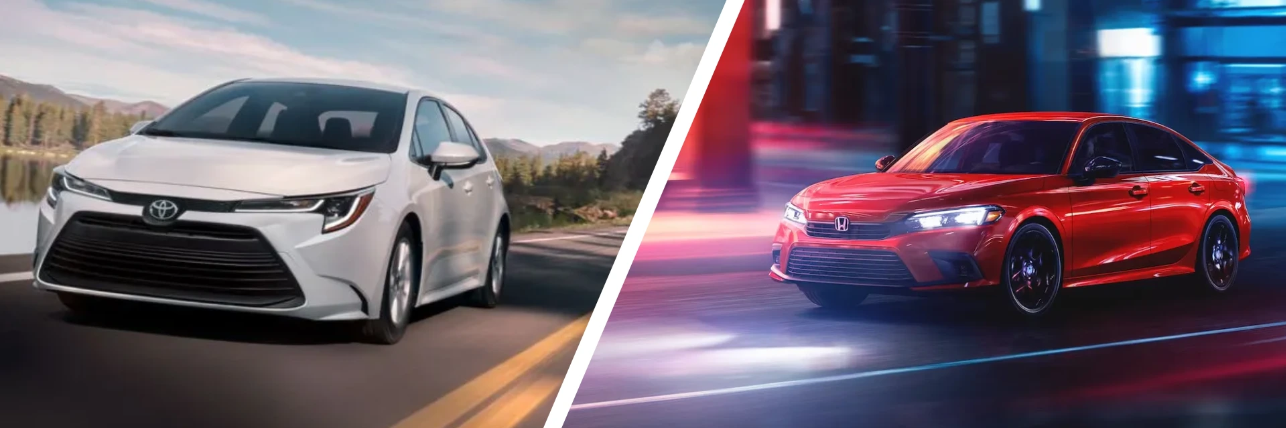
Compact sedans can look almost interchangeable until you pay attention to their attitudes. The Honda Civic tends to feel like it’s leaning into the driver’s world—responsive, communicative, eager to translate intent into action. The Toyota Corolla often projects a steadier aura—measured, comfort-forward, and quietly confident, as if it’s reassuring you that consistency is a virtue.
That isn’t marketing poetry. It shows up in the way each car responds to throttle input, how it settles through corners, and how it treats rough pavement. One can feel more nimble in the moment; the other can feel more composed over time. Both aim to make everyday driving effortless, but their methods differ.

Design: the first impression that refuses to fade
Design is the handshake, and both cars offer a confident one—but their styles gesture toward different priorities. The Civic’s visual language often feels more sculpted, with contours that look ready to catch light and attention. It has a sporty posture that can make it feel slightly more animated even when it’s parked.
The Corolla, by contrast, leans into coherence. Its styling tends to emphasize clarity and proportion, giving it an appearance of practical refinement. The result is less “look at me” and more “I’ll blend into your life perfectly—and still look good doing it.”
Once you’re inside, the design story continues. Materials, sightlines, and the general sense of spatial intention can shift the mood of the cabin. And mood matters. It changes how long a drive feels, and how quickly time moves when you’re behind the wheel.
Cabin atmosphere and ergonomics
A compact sedan shouldn’t feel like a compromise dungeon. The Civic generally cultivates a driver-focused environment, often putting controls where they’re easy to reach and making the dashboard feel like a cockpit rather than a waiting room. Seats can feel supportive, and the overall layout can encourage a subtle sense of engagement.
The Corolla frequently leans toward calm. Ergonomics can feel thoughtfully arranged for routine use, with an emphasis on ease and everyday usability. It’s the kind of cabin that doesn’t demand attention—until you realize everything is where it should be.
Here’s where perspective shifts: rather than asking which car has “more features,” ask which one reduces friction. Less friction means fewer micro-annoyances. Less friction means you arrive at work with your energy still intact.
Powertrains: performance that feels, not just performance that measures
Both models offer engines that aim for efficiency while still providing adequate propulsion. Yet their personalities can diverge. The Civic often feels more eager to react to changes in speed. It can deliver a sensation of momentum that makes overtakes and merging feel smoother, even when traffic gets unpredictable.
The Corolla typically prioritizes steady acceleration. The experience can be pleasantly linear, with fewer dramatic surges. When you spend time on highways and city streets alike, that steadiness can become a kind of psychological comfort.
Transmission behavior—whether automatic or CVT depending on the trim—also plays a role in how the car “reads” the driver. Some drivers interpret the feel of gear changes as part of the driving enjoyment; others interpret it as needless theatrics. Choose based on your own tolerance for dynamism.
Ride quality: the battle between sharpness and serenity
Ride quality is where many comparisons become unexpectedly personal. The roads you drive—battered pavement, smooth boulevards, uneven expansions at intersections—determine what “good” feels like. The Civic can deliver a more taut, controlled feel that many drivers interpret as confidence. It can feel slightly more keyed-in, as if the car is keeping track of the road’s mood.
The Corolla often aims for comfort first, smoothing out irregularities with a measured composure. You might find it easier to relax into longer commutes, especially when the daily route has its share of harsh interruptions.
This is where your shift in perspective matters most: you’re not just choosing suspension settings—you’re choosing the tone of your life on wheels. Do you want the road to be more vivid, or more muted?
Handling and steering: how each one speaks through corners
Steering feel is a language, and compact sedans speak it in distinct dialects. The Civic frequently communicates through a more direct connection between driver input and vehicle movement. When you turn into a curve or thread between lanes, the car can feel like it’s keeping pace with your intentions.
The Corolla can feel less confrontational. It may emphasize a calm, predictable trajectory rather than a spirited response. For drivers who prioritize stress reduction, that can be a major advantage.
Neither approach is automatically superior. The “right” feel depends on your driving habits. If you enjoy spirited backroads or frequently navigate curvy commutes, the Civic’s responsiveness can feel rewarding. If you’re navigating daily traffic with a desire for effortless correctness, the Corolla’s composure might align perfectly.
Technology and infotainment: convenience versus clarity
Modern sedans don’t just move—they manage your attention. Infotainment systems, driver-assist menus, and smartphone integrations can either streamline your day or become a recurring distraction.
The Civic tends to offer a cockpit that can feel more driver-centric, which often results in intuitive access to key controls. Toyota’s approach with the Corolla often emphasizes usability and straightforward operation. Menus are frequently designed for quick comprehension rather than elaborate flourish.
It’s worth asking: do you want tech that feels like a command center, or tech that stays out of the way? Curiosity here isn’t superficial. It determines whether your interface becomes a tool or a time sink.
Safety and driver assistance: reassurance with boundaries
Driver-assist features have matured, but the experience still varies by how seamlessly the systems integrate into real driving. Both Honda and Toyota offer safety technologies that can help with collision avoidance, lane monitoring, and adaptive guidance. The key difference often emerges in how the car “acts” when you’re distracted, uncertain, or fatigued.
Some drivers prefer assistance that feels assertive yet predictable; others want a calmer presence that doesn’t draw attention. The best way to decide is to consider your own driving temperament.
Fuel economy and ownership mindset
Fuel economy matters, but ownership satisfaction is broader than miles per gallon. You’re considering how often you’ll visit the pump, yes—but also how confident you’ll feel about long-term maintenance, parts availability, and the general durability of the vehicle’s design decisions.
Both the Civic and the Corolla typically rank well in mainstream reliability expectations, and that’s not a trivial point. It means you can plan your finances without constant uncertainty. It also means the car’s value proposition stays resilient when life changes.
And value isn’t only monetary. It’s psychological—the relief that comes from knowing your transportation won’t require constant vigilance.
Which one is right for you? A practical curiosity checklist
To resolve the Civic versus Corolla question, don’t anchor on one headline number. Anchor on a pattern of experiences. Consider these prompts:
1) Do you want the car to feel more lively? If yes, the Civic’s responsiveness can feel like an invitation.
2) Do you crave calm consistency? If yes, the Corolla’s composed demeanor may match your rhythm.
3) What matters more on your daily route? If ride comfort on uneven streets is paramount, compare how each one attenuates the road.
4) How do you interact with tech? If driver-centric layouts excite you, the Civic can feel more engaging. If clarity and ease matter more, the Corolla often lands comfortably.
5) Are your driving moods consistent or variable? If you change styles often, responsiveness can be useful. If you prefer predictability, steady behavior may win.
The final perspective: not a winner, a match
Here’s the truth that makes this choice satisfying: the Civic and Corolla aren’t adversaries. They’re reflections. They each embody a philosophy—one tends toward spirited immediacy, the other toward steady reassurance. Your best outcome isn’t about picking the “stronger” name. It’s about recognizing which temperament will keep you comfortable, confident, and curious about the next mile.
Drive both. Feel the steering language. Listen to the cabin. Notice how the car treats your daily route, not your theoretical one. When the right sedan clicks into place, the decision becomes less about comparison—and more about belonging.