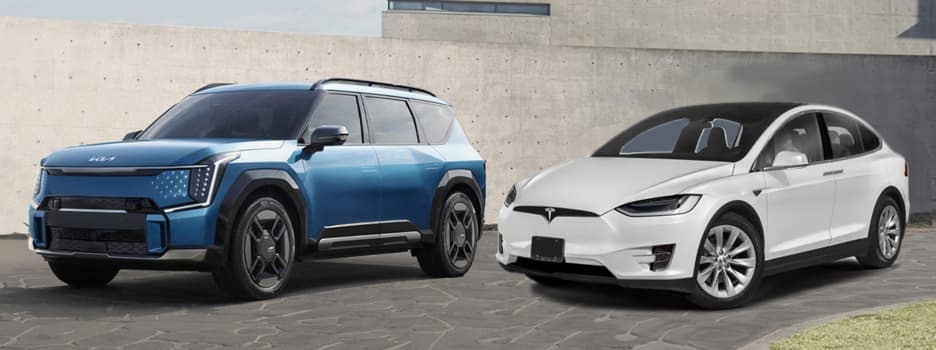
There’s a moment many drivers recognize—the instant the idea of “bigger” stops meaning volume and starts meaning possibility. A three-row electric SUV isn’t simply a vehicle with extra seats. It’s a rolling proposition: space for the family, calm for the commute, and momentum for the road ahead. Yet two names keep surfacing whenever conversations turn to all-electric, long-range comfort—Kia’s EV9 and Tesla’s Model X. On paper, they’re both designed to carry more than people. In practice, they invite a shift in perspective. One asks you to reconsider comfort as architecture. The other challenges you to see innovation as an atmosphere.
What follows isn’t a checklist meant to crown a winner. It’s a guided comparison that teases out the nuance—how each SUV’s philosophy changes the way you experience daily life, road trips, and the quiet rituals of ownership. Curiosity should feel rewarded here, not rushed. Because in the realm of three-row electrics, the differences aren’t always loud. Sometimes they’re subtle enough to slip past a test drive—and then reappear on the first long drive home.
Setting the Stage: What “Three-Row Electric” Truly Promises
A three-row EV must do more than move mass. It has to manage human realities: the choreography of getting in and out, the acoustics of a crowded cabin, and the steady performance of a battery system under real-world demand. The rear seats are only part of the equation. The real test is whether the SUV feels composed when the day gets complicated—when errands stack up, kids need snacks, and the trunk becomes a temporary storage depot for everything from strollers to sports gear.
The promise, in this segment, is not merely range. It’s predictability. The kind that makes detours feel optional and charging stops feel planned rather than panicked. And both the Kia EV9 and Tesla Model X aim for that sense of ease—though they approach it from different angles.
Kia EV9: Comfort as a Design Language
The EV9’s presence is deliberate. Its styling suggests breadth even before you step inside. The cabin, when you finally enter, leans into a “space-first” mentality. Think of it as a living room scaled up with purpose—materials chosen to reduce visual noise, and a layout that encourages a smoother flow through the car’s length.
Where the EV9 tends to stand out is the way it balances spaciousness with restraint. Seats feel positioned for lived-in comfort rather than showroom poses. In the third row, the conversation becomes more honest: you don’t just ask whether it fits. You ask whether it feels usable on a typical afternoon. The EV9’s overall ergonomics are built to keep that usability from turning into compromise.
There’s also an emotional quality to how it moves. Electric torque gives instant response, but the EV9’s ride approach often feels composed, designed to soften the edges of imperfect roads. It’s the difference between a vehicle that simply goes forward and one that seems to smooth the journey itself.
Tesla Model X: Dramatic Flexibility and High-Profile Technology
The Model X carries a reputation that travels ahead of it. Even people who haven’t sat in one tend to recognize its visual signature, especially with its distinctive entry style that can transform the first moment of use into a minor event. But beyond the theatrics lies a more practical promise: the Model X is built for rapid adaptation—gear up, rearrange, and continue.
Inside, the Tesla experience leans into a digital-forward ethos. The cabin can feel like a command center, where controls are consolidated and information is presented in a way that rewards attention. Some drivers find this invigorating. Others may need a moment to acclimate. Either way, the Model X doesn’t whisper; it communicates.
The third-row experience is shaped by the vehicle’s overall packaging philosophy. When everything aligns—positioning, entry, and cargo strategy—the Model X can feel remarkably flexible. When the day demands frequent access to the rear seats, the process becomes part of the choreography you learn quickly. It’s not just about capacity. It’s about the rhythm of movement.
Performance and Drive Character: Torque Is Only the First Chapter
Both EVs deliver electric immediacy, but the character of that immediacy differs. Kia’s EV9 often aims for a balanced demeanor—stable, controlled, and tuned for everyday confidence. Acceleration can surprise without turning the ride into a roller-coaster. It’s performance with manners, designed for passengers as much as for drivers.
The Model X tends to emphasize the exhilarating side of electric driving. It can feel quick in a way that’s almost conversational—like the vehicle is responding to your intent before you fully phrase it. This can make highway merges feel effortless. It can also make you notice how seamlessly the car translates power into motion.
Handling and stability matter in three-row SUVs, especially when the cargo is not empty. The way each vehicle manages weight and traction can change how stress feels during bad weather. The goal isn’t simply speed. It’s calm control, the kind that keeps everyone comfortable even when conditions aren’t.
Range, Charging, and the Reality of Road Trips
On paper, range numbers can seduce. In real life, range is a behavior—how you drive, how the weather behaves, and how quickly you decide to move on with your day. For three-row EV ownership, charging strategy becomes a lived skill.
The EV9’s approach often feels oriented toward practical planning. Charging can fit naturally into typical travel patterns. And when passengers are involved, the pacing of charging matters just as much as the minutes on a screen. The EV9’s emphasis on comfort pairs well with that rhythm, reducing the sense of disruption.
The Model X enters the conversation with its own confidence about charging and connectivity. For drivers who live within a tech ecosystem and like to stay in control of the travel flow, it can feel empowering. The car’s ability to handle route planning and charging logistics can make the process feel more integrated—less like a detour, more like a seamless extension of the journey.
In the end, your experience depends on your charging habits. The better question is: which SUV’s personality matches your life?
Interior Versatility: Seating, Space, and Cargo Orchestration
A three-row SUV is an inventory problem disguised as a family vehicle. The EV9 and Model X both confront this reality, but with distinct philosophies. The EV9 leans into a spacious cabin where shifting between passenger and cargo needs feels relatively intuitive. Its layout supports the daily ritual of transforming the interior—snacks become groceries, bags become parcels, and toys become temporary architecture.
The Model X offers a different brand of versatility. Its design supports rearrangement with a certain confidence, particularly when access is needed and the rear cabin must be used without turning the process into a puzzle. The experience can feel streamlined for those who prefer a more guided, system-driven approach.
Ultimately, the best SUV is the one that minimizes friction. It’s the one that turns a hectic day into a manageable one—with fewer steps between intention and execution.
Technology and Driver Experience: Screens, Software, and the Mood of Control
Technology isn’t merely convenience. It influences the tone of every drive. The EV9’s interface and features tend to support a more traditional usability—intuitive touchpoints, clear driver feedback, and a cabin that feels ready for conversation. That matters in families, where the driver is not the only one processing information.
On the other hand, the Model X feels like an evolving platform. It carries a sense of software momentum, which can be exciting for drivers who want improvement to arrive over time. The cabin’s digital density can heighten focus, and the vehicle’s integrated systems can make it easier to manage travel from within the cockpit.
Here’s the shift in perspective: technology should not just be present. It should match your expectations of control. Do you want tech to support you quietly, or do you want it to steer the experience?
Safety, Confidence, and Family-Centered Assurance
In the realm of three-row electric SUVs, safety is never an optional feature. It’s the baseline expectation. Both EV9 and Model X are built to address modern driver-assist needs, aiming to reduce workload and enhance awareness during everyday driving.
But beyond safety systems, there’s the feeling of security that comes from visibility, predictable braking behavior, and confidence on the road. Parents and caretakers rarely speak it aloud, but they sense it: whether the vehicle feels stable with passengers inside and whether it handles uncertainty without adding stress.
The right SUV makes safety feel natural, not performative.
Ownership Reality: Practicality, Value, and the Long View
Ownership is where optimism meets routine. Charging schedules, service experiences, tire wear, and software updates can all color the long-term impression of a vehicle. The EV9 tends to appeal to drivers seeking a balanced blend of comfort and capability—an SUV that feels welcoming from the first day and continues to feel relevant as the months pass.
The Model X often attracts drivers who value integrated technology and want a vehicle that feels like part of a broader digital ecosystem. For them, the long view can be exciting, especially when updates and connectivity enhance the experience.
The question becomes less about which brand offers more features and more about which ownership rhythm fits your lifestyle. When the novelty fades, the vehicle that remains easy to live with wins quietly.
Which One Fits You? A Curiosity-Driven Decision
Choose the Kia EV9 if your ideal electric SUV feels like a comfortable, spacious sanctuary—an environment engineered to support everyday life with minimal friction. Choose the Tesla Model X if you’re drawn to a high-tech, software-forward experience—an SUV that feels like a command center with room for the people who matter.
Both can serve as family vehicles, road-trip companions, and statement pieces. Yet their differences are the point. The EV9 often invites calm confidence. The Model X often invites energized curiosity. And your best match will depend on whether you want electric propulsion to feel like steady harmony or like a continuously unfolding experience.
Final Thoughts: The Future Feels Personal in a Three-Row EV
A three-row electric SUV is not just a transportation choice. It’s a preference statement about what matters—comfort, flexibility, technology, and how you want daily life to feel inside a moving space. The Kia EV9 and Tesla Model X each represent a distinct approach to that promise.
So let the decision be a little more than rational. Let it be reflective. Picture your next trip. Imagine loading the car without frustration. Hear the cabin quiet down as the drive begins. In that scene, one SUV will reveal itself—not as the “better” option, but as the one that matches your pace, your priorities, and your sense of what an electric future should feel like.