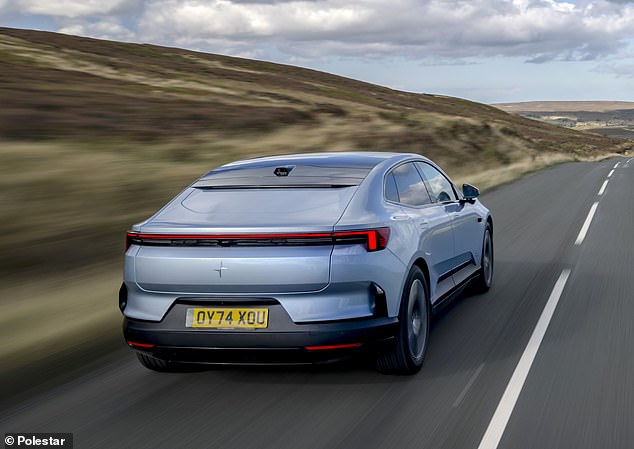
The first thing you notice about the Polestar 4 is not the paint, the stance, or even the tech. It’s the rear window—except, in a very literal sense, it’s not there the way you expect. This is a coupe SUV designed with a conspicuous omission: a rear window that feels almost absent. Many drivers would interpret that as a compromise. Yet on the road, that same absence becomes part of the car’s personality. It’s the kind of design choice that triggers a common observation—“Where’s the rear glass?”—and then, almost inevitably, invites a deeper question: why would a brand willingly reshape visibility, posture, and even silhouette perception?
Spend more than a few minutes with the Polestar 4 and the answer starts to reveal itself. The car doesn’t feel built to satisfy tradition. It feels engineered to make a statement quietly, like a conductor insisting on tempo rather than volume. The rearward look is more than style; it’s a design philosophy that rearranges how you experience the vehicle from inside and outside.
A Rear-Window Absence That Becomes a Feature
Most SUVs present their rear like a familiar storefront: glass, reflections, a clear sense of space behind you. The Polestar 4 breaks that expectation with a roofline that flows forward and then down in a way that visually compresses the cabin. The result is a coupe silhouette that reads as swift and intentional, even at rest.
That missing rear window can feel unsettling at first. Your brain expects mirrors and sightlines to behave in a particular pattern. But the car’s layout compensates for it with a blend of design work and practical technology. The rear visibility isn’t merely “there or not there.” It’s curated. You’re guided to trust mirrors, cameras, and the overall geometry of the hatchback-like tailgate.
In a world full of cars that try to be universally legible, the Polestar 4 is instead specific. It’s less about giving you what you’re used to and more about shaping a new kind of comfort. The deeper fascination begins when you realize the absence has consequences—and those consequences are being actively managed rather than ignored.
Design Language: Coupe Proportions, SUV Presence
From the outside, the Polestar 4 has a poised, almost athletic stillness. The proportions are carefully balanced: a lower roof arc, a wider shoulder line, and a stance that seems to press forward as if it’s already accelerating. The lack of a rear window contributes to that continuous glasshouse effect, where the cabin feels streamlined rather than compartmentalized.
Long sentences are easy when describing aesthetics, but the truth is simpler. The car looks like it belongs in motion even when it’s parked. That illusion is a subtle triumph. The body doesn’t just carry a design; it performs one.
And because the rear glass is minimized, reflections behave differently. Light plays across the tail and rear quarter with a distinctive shimmer. That changes how the car photographs and, more importantly, how it looks under different weather. In rain, the surfaces become more cinematic. In bright sun, the sculpted contours read sharper. It’s a style that doesn’t depend on a single condition to look convincing.
Cabin Experience: Sightlines, Atmosphere, and Adaptation
Inside, the story continues. The driver and front passenger sit within a cabin that feels airy, with design cues that emphasize forward motion. The rearward view is naturally less direct, but that limitation nudges you toward a more deliberate driving rhythm.
It’s easy to assume that fewer rear sightlines mean a less confident car. Yet the Polestar 4’s ergonomics encourage adaptation. Mirrors become more consequential. You develop a new mental map of the car’s length and the space behind it. After a short adjustment period, the absence of a conventional rear window fades from “problem” to “character.”
This is where the fascination deepens. The car subtly trains you. It changes your relationship with perception, making you less reliant on raw visual certainty and more reliant on measured signals. That’s not just technology doing the work—it’s design guiding attention.
Technology as a Safety Net (and a Confidence Builder)
Modern driver assistance features exist for more than comfort. They fill in the gaps created by unconventional design choices. In the Polestar 4, camera systems and sensor integration help translate blind zones into usable information. The result is that the car’s unusual geometry doesn’t leave you stranded. It leaves you informed.
There’s a particular kind of calm that emerges when a car communicates clearly. When you’re backing out of tight spaces, when traffic tightens around you, or when lane changes require precision, the system’s reliability becomes part of the driving experience. It’s not flashy. It’s quietly reassuring.
In that sense, the absence of the rear window becomes a kind of trade you willingly accept because the car completes the picture elsewhere. The road becomes less about looking behind you and more about understanding the environment around you.
Electric Performance: Smoothness, Weight Distribution, and Momentum
The Polestar 4 doesn’t just look engineered—it drives engineered. Electric torque arrives with an immediacy that transforms everyday actions: pulling away from lights feels effortless, overtaking becomes a near-instant decision, and climbing speed on the highway feels composed rather than strained.
EVs often deliver a distinct kind of confidence because their power delivery is predictable. The Polestar 4 benefits from that. It feels balanced in motion, with a stability that encourages you to press a little further without needing to concentrate on the car “keeping up.” The chassis design and suspension tuning work together to manage body motions that, in other vehicles, can feel floaty or unruly.
And since coupe silhouettes tend to emphasize aerodynamics, the way it cuts through the air matters. At higher speeds, the car feels less like a bluff SUV and more like a long-legged grand tourer trying to behave like a commuter.
Range, Efficiency, and the Real Meaning of “Everyday Use”
Range conversations can become abstract, especially when marketing numbers float above real life. The Polestar 4 makes efficiency feel tangible, thanks to the way it maintains momentum and reduces wasted energy. Temperate driving, smooth acceleration habits, and sensible speed choices translate into meaningful gains.
Efficiency isn’t only about maximizing range; it’s also about reducing anxiety. When an EV behaves predictably, charging stops become planning rather than panic. The coupe SUV form factor can complicate aerodynamics slightly compared with sleeker sedans, but the Polestar 4 still manages to feel reasonably efficient for daily use.
This practicality is part of the fascination. The car isn’t merely a design experiment. It behaves like a usable object—one that happens to be visually audacious.
Who the Polestar 4 Is For
The Polestar 4 is for drivers who want the familiar convenience of an SUV, but refuse the visual monotony that typically comes with it. It suits people who enjoy design with a point of view. If you’re the sort of buyer who reads a shape and immediately senses intent, the car will feel like it’s speaking your language.
It’s also for those who don’t mind learning a new way of perceiving the car behind them. The missing rear window is not a mere oddity; it’s a signal that the vehicle will ask you to trust its systems and its design logic. In return, you receive a cabin atmosphere and an exterior profile that stand apart from the crowd.
Final Thoughts: A Car That Refuses to Be Ordinary
The Polestar 4’s rear-window absence is the kind of detail people notice first. It’s the headline you can’t ignore. But what lasts isn’t the omission itself—it’s what the omission unlocks. The car becomes more aerodynamic, more sculpted, and more emotionally legible. It changes how you drive, how you perceive space, and how you interpret the vehicle’s intention.
Fascination, in this case, isn’t accidental. It’s engineered. The Polestar 4 doesn’t chase approval from tradition; it earns attention through coherence. Every time the rear glass should have been there, the design suggests a different question: what if the better view isn’t the one you’re used to, but the one the car helps you understand?