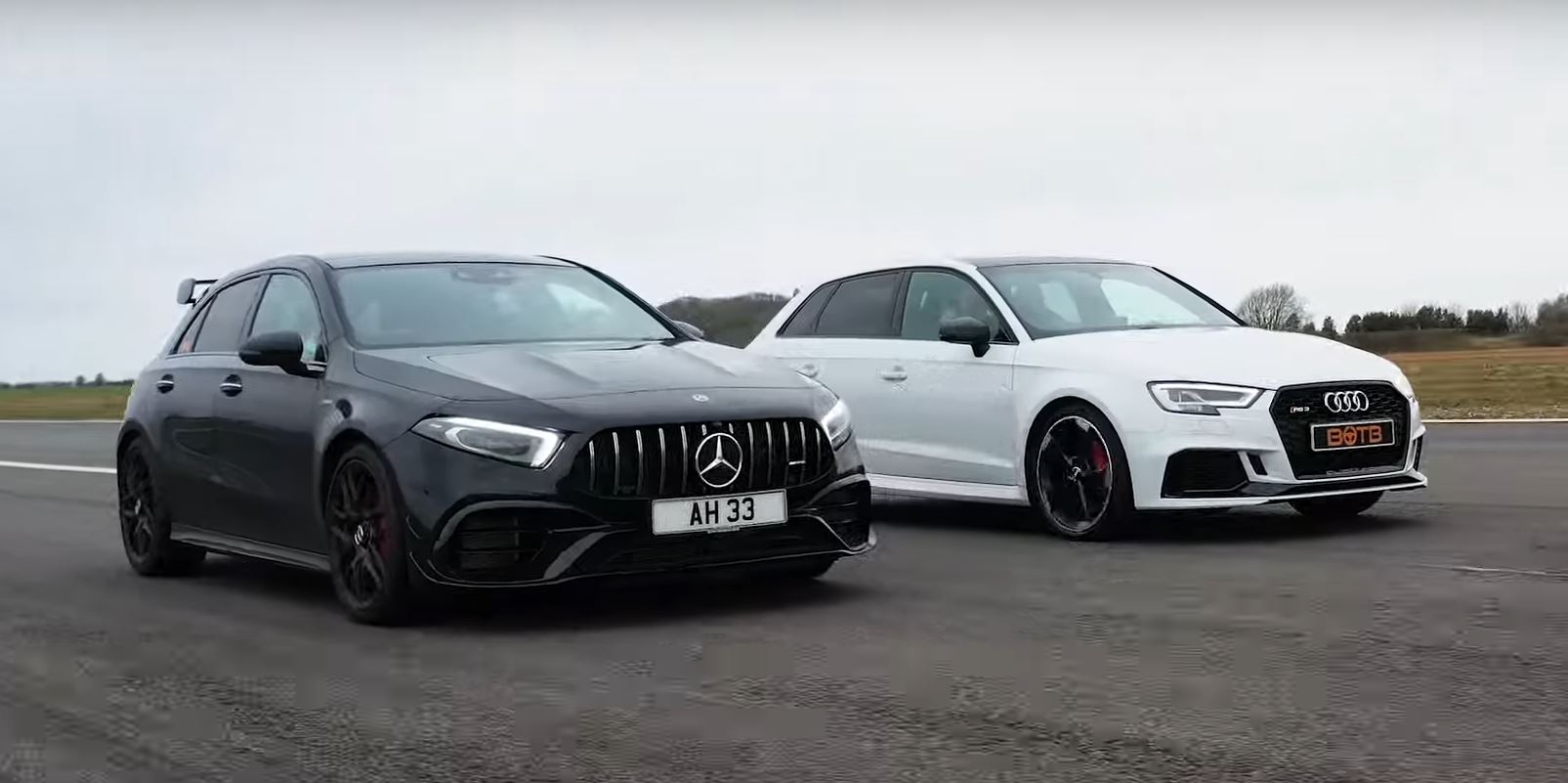
The drag strip has a particular way of stripping away romance. No sweeping corner entries, no cinematic downhill braking zones—just the sharp arithmetic of traction, torque delivery, and the moment the lights go green. In 2026, that arithmetic keeps drawing enthusiasts toward a familiar duel with a modern edge: the Audi RS3 facing off against the Mercedes-AMG CLA 45. On paper, both are forceful compact performance cars. In reality, their personalities diverge the instant a sprint begins—one leaning into a muscular, rotational kind of speed, the other sharpening its response like a drawn blade.
What follows is a practical, narrative walkthrough of what readers can expect in a drag race comparison of the 2026 Audi RS3 versus the Mercedes-AMG CLA 45. Consider this less a trivia list and more a guided tour of the forces that decide who wins the short race when seconds shrink into milliseconds.
Set the Stage: Why Compact Cars Feel So Alive on Launch
Drag racing is a study in micro-decisions. A compact hot hatch or compact sedan starts with less mass, but the physics don’t go easy. The first hundred feet—where tire temperature, drivetrain response, and launch technique all collide—becomes a battleground. The Audi RS3 and the AMG CLA 45 are engineered for everyday aggression, yet on a drag strip they behave like instruments tuned for different music.
Readers should expect discussions that go beyond horsepower numbers. This is where traction strategy matters: how the car calibrates wheel slip, how quickly it can build boost or torque without confusing the drivetrain, and how the chassis manages weight transfer before the car settles into a straight-line rhythm.
Engine Character: How Power Delivery Changes the Outcome
In a drag race, it’s rarely just peak power. It’s the shape of the torque curve and the way the car chooses to reach it. The 2026 Audi RS3 tends to feel engineered for a relentless surge—an attitude that many drivers describe as “ready now,” even before full build. Meanwhile, the Mercedes-AMG CLA 45 often carries a more reactive temperament, delivering urgency with a punchy immediacy that can make short sprints feel like snapping a taut string.
This isn’t merely emotional. Control systems in modern turbocharged machines can interpret throttle input, wheel speed, and traction conditions to decide when and how to feed torque. The result is that two cars with similar headline performance can race differently: one may dominate early by resisting wheelspin with patience, while the other may spike harder at the start and risk losing speed to slip at the wheels.
Launch and Traction: The Invisible Race Within the Race
Launch is where victory gets archived. Traction is not a single variable; it’s a choreography of tire compound, road surface, suspension geometry, and drivetrain distribution. A drag setup often encourages aggressive launches, but aggressive doesn’t always mean effective. The cars react differently under the sudden loading of acceleration.
In an RS3 vs CLA 45 sprint, expect readers to see emphasis on:
• Wheelspin management: how quickly the car regains grip if it breaks loose.
• Grip consistency: whether performance falls off as the tire heats or the track rubber evolves.
• Weight transfer timing: whether the nose dives or lifts in a way that enhances contact patch stability.
On certain track days, the better car isn’t the one with the greater “go” but the one that can convert “go” into forward motion without wasting it as heat.

Gearing and Sprint Stages: When Speeds Start to Split
As the race progresses, launch decisions pay dividends—or penalties. Gear ratios and shift logic determine whether the cars arrive in their strongest operating zones at the right time. The Audi RS3 can feel like it builds speed in a continuous, authoritative climb, while the CLA 45 frequently exhibits a sharper, more percussion-like cadence through acceleration.
Readers can expect a sprint-stage comparison that feels almost cinematic: the first burst off the line, the mid-run where turbo response and drivetrain efficiency matter most, and the final meters where aerodynamic stability and tire grip decide whether the last fraction of momentum stays intact or collapses.
In practical terms, a car that manages its torque better early can end up with a higher top speed later, even if it never appears to be “winning” visually on the start. Conversely, a car that spikes early but slips too much may look fast from the beginning and then fade as momentum becomes less about torque and more about traction resilience.
AMG CLA 45 Tactics: Agility, Urgency, and Heat Management
The AMG CLA 45 brings a distinctive sense of urgency, and in drag conditions that urgency can either become a weapon or a distraction. Expect talk about how the CLA 45’s calibration prioritizes quick throttle-to-torque delivery and how its traction systems keep the wheels from becoming spinning reminders that power alone isn’t enough.
There’s also the matter of tire temperature. In repeated runs, performance can shift. Some cars preserve grip better during back-to-back sprints; others become progressively less predictable as heat changes the tire’s behavior. On a drag day, that means the fastest car in the first pass might not be the fastest car in pass three.
So while early acceleration often becomes the highlight reel moment, a complete race story includes repeatability: how consistently the CLA 45 can recreate its launch authority when the track rubber pattern and surface conditions evolve.
Audi RS3 Approach: Relentless Pull and Mechanical Coherence
The 2026 Audi RS3, known for its balance of everyday civility and track-ready aggression, often reads like a machine built to stay mechanically coherent under stress. On the strip, that coherence can translate into fewer surprises. The torque delivery may feel less like a sudden lurch and more like a steady escalation—less snap, more surge.
Expect readers to encounter details that highlight how the RS3 maintains traction as speed climbs, how it handles the transition from initial acceleration to mid-run momentum, and whether it can “hold the line” against a car that might be faster in the first few seconds.
In a drag comparison narrative, the RS3 often becomes the benchmark for stability: a car that may not always look like it launches the hardest, but keeps its forward motion composed. That composure can be the difference between a narrow win and a heartbreaking photo-finish loss.
Driver Technique: The Human Variable No Spec Sheet Captures
Even with identical launch settings, two drivers can produce different outcomes. Drag racing rewards precise throttle modulation, consistent staging, and the ability to synchronize the car’s traction response with the exact moment the wheels begin to load. The RS3 and CLA 45 both benefit from careful technique, but their personalities may invite different driving styles.
Readers should expect an exploration of how technique interacts with each car’s character:
• Staging and reaction: how the driver manages the car before launch to avoid premature torque delivery.
• Throttle profile: whether the car prefers a smoother squeeze or an immediate, assertive pedal command.
• Launch repeatability: how consistent each car feels after multiple runs with the same driver.
This is where the drag race becomes more than engineering—it becomes a duet between driver intent and machine logic.
How to Read a Drag Race Result: Beyond “Who Won”
A decisive win is the headline, but the deeper value is in the patterns. A faster car that’s slower in repeated launches can reveal underlying issues—traction inconsistency, heat sensitivity, or shift logic behavior. A car that wins early but loses later can reveal gearing or torque delivery constraints.
Expect comparisons that treat results like clues. A good write-up will discuss not only elapsed time and top speed, but also the “shape” of each run: where the advantage appears, how it changes, and what that implies about the car’s strengths.
Where the Duel Settles: Which Car Fits Which Kind of Driver
The ultimate question is less about absolutes and more about compatibility. The Audi RS3 can appeal to drivers who value mechanical coherence, continuous pull, and a confidence-in-control sensation. The Mercedes-AMG CLA 45 can appeal to drivers who chase immediacy, quick response, and the thrill of a punchy launch strategy.
On a drag strip, both are capable. The winner often depends on traction conditions, tire state, and how each vehicle converts torque into acceleration without waste. In other words, the race isn’t just “RS3 versus CLA 45.” It’s “grip versus power, and timing versus torque delivery.”
Final Word: The Real Victory Is Conversion
When the lights go green, the 2026 Audi RS3 and the Mercedes-AMG CLA 45 step into a world where engineering becomes choreography. The car that wins isn’t necessarily the one with the flashiest burst—it’s the one that converts energy into motion with fewer compromises.
Whether you’re drawn to the RS3’s steady authority or the CLA 45’s sharper urgency, the drag race story is ultimately about precision: traction that holds, torque that arrives in the right shape, and control systems that keep the sprint honest. For readers, that makes every pass worth watching twice—once for the winner, and once for the mechanics of how the win happened.