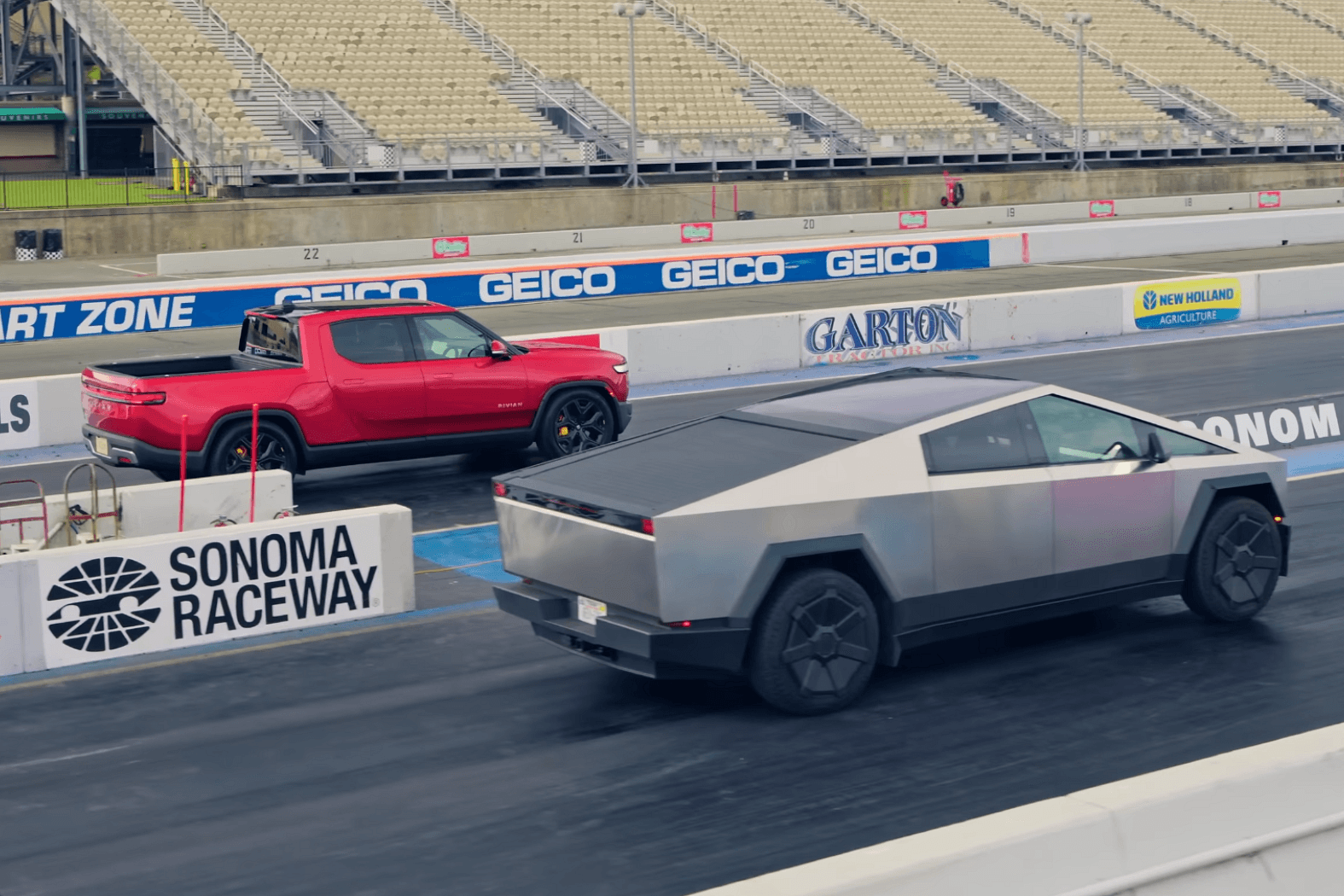
There’s a particular kind of electricity that gathers around a drag race. Not just the supercar-theater kind—this is harsher, more tactile. It’s about traction, throttle discipline, and the way torque behaves when the clock begins. In the spotlight of that moment sits the Tesla Cybertruck in Beast Mode, a machine that doesn’t merely accelerate—it recalibrates expectations. Across the line stands the Ford F-150 Raptor R, a bruiser engineered for off-road dominance, but tempting enough to chase a straight-line crown.
So what happens when these two philosophies collide—electric immediacy versus gasoline muscle; titanium swagger versus truck-based theatrics; conquest built for different terrains, yet measured by the same stopwatch? The drag strip becomes a laboratory. The results, meanwhile, read like a short story with high stakes and no room for hesitation.
Beast Mode Explained: What the Cybertruck Is Really Doing
Beast Mode isn’t simply a marketing phrase. It’s a performance posture—an aggressive recalibration of how the Cybertruck delivers power. The system emphasizes response time, modifies traction logic, and aims to keep acceleration consistent under load. Instead of thinking about “how fast can it go,” Beast Mode asks a more tactical question: “How ruthlessly can it maintain usable grip while torque arrives instantly?”
Electric torque is delivered with a kind of immediacy that can feel almost impolite. At the drag strip, that immediacy can be both a weapon and a liability. If traction breaks, the tires spin and the stopwatch punishes the error. Beast Mode’s job is to steer that torque into forward motion rather than wasted rotation.
Readers should expect content that breaks down not only speed, but also the mechanics of control: traction management, launch behavior, and the “shape” of acceleration from the start line through mid-track.

Raptor R’s Mission: Muscle, Method, and Momentum
The Raptor R carries a different heritage. It’s not a car pretending to be a truck. It’s a truck that learned performance grammar and then weaponized it. The Raptor R is designed around the idea that grip isn’t merely something you find—it’s something you harness and survive. Its engineering focuses on durability, power delivery, and confident handling in the chaos of uneven ground.
Drag racing strips away many variables that dominate off-road life. But the Raptor R doesn’t lose its identity. In a straight line, the truck’s strengths manifest as momentum. Launch technique becomes critical. The turbocharged thrust (and the way the power curve swells) can deliver impressive mid-range acceleration, especially when the tires hook up and the driver avoids the classic trap: spinning away potential.
This is where readers can expect a narrative shift from “spec sheets” to “execution.” On a drag strip, the driver’s timing is as important as the machine’s horsepower. In content comparisons, look for discussions about launch staging, throttle modulation, and how quickly the Raptor R can convert engine output into forward acceleration.
The Start Line: Launch Dynamics and Traction Drama
The first few seconds decide the entire story. Drag races rarely feel like a single sprint; they feel like a contest of micro-decisions. Who launches cleanly? Who maintains the tire-to-track interface? Who loses traction even briefly and pays for it with lost distance?
For the Cybertruck, Beast Mode’s calibrated aggression can translate into an explosive initial surge. But traction is king. The instant torque of an electric drivetrain means the tires must be ready. If grip is available, the Cybertruck can sprint forward like a drawn bow. If it isn’t, the truck may spend precious milliseconds scrabbling for traction.
For the Raptor R, launch performance tends to hinge on how effectively the power rises and how the vehicle prepares its driveline before full commitment. Trucks can be slow to settle, especially if weight distribution and tire behavior aren’t aligned. Yet when the Raptor R plants confidently, it can push hard and keep pulling without the torque “cliff” some powertrains fall victim to.
In well-rounded articles, you’ll also see attention paid to tire condition, track temperature, and even the subtle rhythm of pre-launch adjustments. These details aren’t glamorous, but they’re decisive.
Mid-Track Character: Where the Race Becomes a Riddle
After the initial surge, the race turns into a riddle with two answers. One is raw acceleration. The other is control under increasing speed. At mid-track, aerodynamics and drivetrain behavior start to matter more. Heat builds. Reactions dampen. The vehicle either stays coherent or begins to scatter its energy.
The Cybertruck’s electric system can provide stable thrust across its operational range, and that can be a major advantage if it avoids wheelspin early. Electric performance often feels like a smooth escalation—less “gear hunting,” more continuous application. The sensation is like a relentless wave rather than a series of kicks.
The Raptor R, meanwhile, fights for position with a different rhythm. As speed climbs, the turbocharged engine’s delivery can become increasingly potent, especially if the tires remain hooked and the suspension maintains stability. In narrative terms, the Raptor R often feels like it’s gearing up—less instantaneous, more determined.
Expect content that zooms into the mid-range: how the vehicles behave when the novelty of the start fades and physics takes over.
Top-End Reality: Measuring Who Holds Their Composure
Top-end on a drag strip doesn’t mean the race becomes gentle. It means the vehicles reveal how they handle sustained pull. At higher speeds, rolling resistance, drivetrain efficiency, and aerodynamic drag all tug at the outcome.
If the Cybertruck’s Beast Mode trajectory stays consistent—if traction stays faithful and power delivery remains unbroken—it can maintain momentum with frightening calm. Electric drivetrains can be notably repeatable, which matters in multi-run formats where memory and consistency become competitive weapons.
For the Raptor R, top-end performance often depends on how steadily it can keep translating engine output into wheel speed without slipping or losing composure. Trucks are tall and broad, and their aerodynamic profile can impose a tax at speed. But the Raptor R counters with power and stability, aiming to keep the acceleration ladder tall enough to reach the finish line first.
Readers should anticipate comparisons that address the entire run, not just the headline moment. The last stretch of track is where champions are separated from clever starters.
What the Results Mean: Beyond Numbers, Toward Philosophy
A drag race comparison isn’t only about who wins. It’s about what wins say. The Cybertruck in Beast Mode represents a philosophy of instant response and algorithmic aggression—performance as a controlled reaction. The Raptor R represents a philosophy of robust torque and visceral determination—performance built to endure and conquer.
The winner tells you something about the environment of speed. If the Cybertruck’s advantage manifests strongly, it underscores the electrified future of instant thrust. If the Raptor R answers back decisively, it highlights how traditional engineering, when paired with traction strategy and power delivery, can still stand toe-to-toe with new-world technologies.
In broader coverage, you may also see discussion around repeatability—whether the vehicles can replicate launches, whether performance holds across runs, and how driver confidence shapes the outcome.
How to Read This Kind of Content: Your Practical Checklist
If you want to extract maximum meaning from drag race coverage, focus on more than final times. Look for breakdowns that address launch behavior, wheelspin, and how each run compares to the previous one. Short sentences help here: the best comparisons are clear. They map cause to effect.
Also pay attention to track conditions. Temperature and surface texture can rewrite the script. A race that favors instantaneous torque on one day might look different under alternate grip. Even measurement style matters—some articles emphasize reaction time, others emphasize peak acceleration, and the emphasis changes what feels “dominant.”
Finally, consider the intent behind the vehicles. The Cybertruck may be optimized for rapid response and straight-line intimidation. The Raptor R may be optimized for controllable power and confident stability under stress. A drag strip is a narrow stage. That narrowness reveals strengths—but it also limits what the vehicles can express.
Final Thoughts: A Finish Line as a Crossroads
Beast Mode turns the Cybertruck into a brief, electric storm—tight, sudden, and intent on rewriting the rules of acceleration. The Raptor R, meanwhile, remains a heavyweight contender—less abrupt, more methodical, built to keep pressing even when conditions demand patience.
When the two meet, the drag strip becomes a crossroads between eras. The stopwatch decides the immediate winner. But the deeper truth is more interesting: each vehicle showcases a different kind of confidence. One arrives with instantaneous thrust. The other arrives with engineered grit and momentum. Either way, the race is less about choosing a favorite and more about appreciating how power can be expressed in radically different dialects.
At the finish line, you don’t just remember the time. You remember the feeling—how the road fought back, how the tires negotiated reality, and how two icons made the same question sound entirely new.