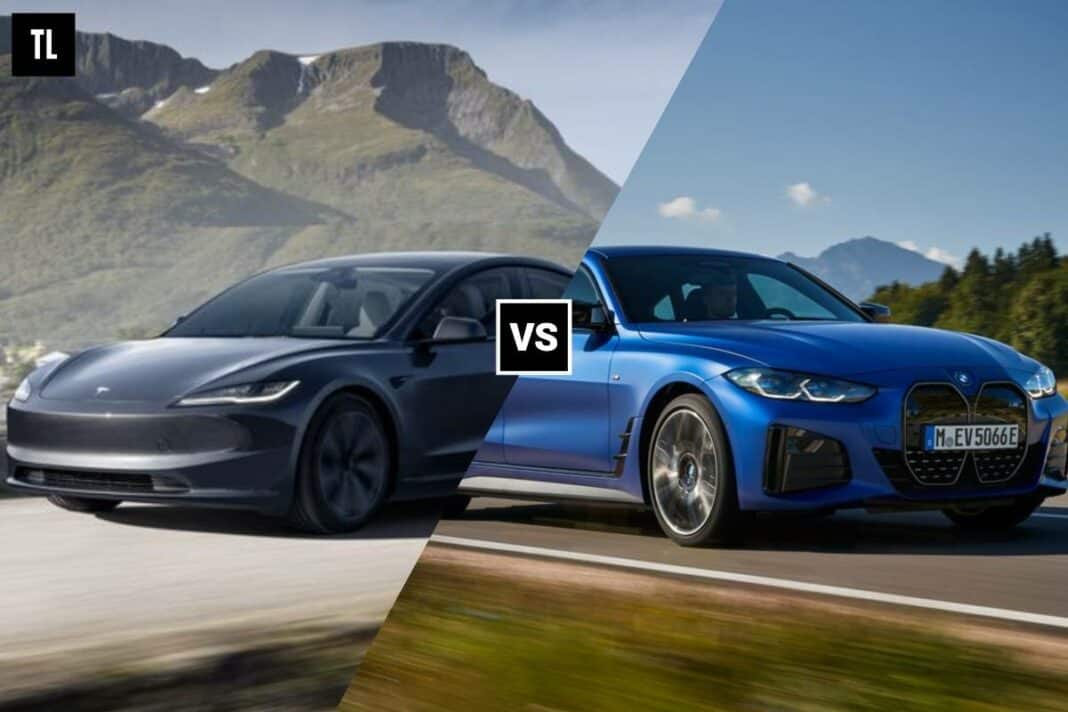
Two electric sedans stand at the same crossroads, both wearing the sleek mask of futurism. Yet beneath that glassy calm lies a different temperament. The Tesla Model 3 Performance and the BMW i4 M50 aren’t merely competing for lap times or spec-sheet bragging rights. They’re wrestling with a more intangible prize: how electricity should feel when it becomes motion—how speed turns into a sensation, and how confidence is manufactured in silence.
Think of the Model 3 Performance as a sharpened compass needle. It doesn’t wander. It points—hard—toward acceleration, toward the next horizon of torque. Now picture the BMW i4 M50 as a pianist with precision hands. It doesn’t just play fast; it shapes dynamics, holds tension, and delivers rhythm with a cultivated flourish. Both are electric. Both are thrilling. But they speak different languages of performance.
First impressions: the silhouette of intent
From a distance, the Tesla Model 3 Performance looks like intention made visible. Its low, smooth stance suggests aerodynamic discipline, as if the car is already anticipating the slipstream. The BMW i4 M50 carries a different kind of presence—more poised, more “built,” with the recognizable BMW design language that feels engineered rather than merely stylized.
Street light reflections glide across each body panel, but the atmosphere changes. In the Tesla, the mood is minimalist, almost monastic. In the i4, the mood is theatrical, as though every angle is staged for the viewer. None of this is superficial. Design signals character, and character influences the driver’s expectations before the first press of the pedal.

Power delivery: torque as philosophy
In electric cars, acceleration is not an act—it’s an attitude. The Model 3 Performance tends to feel like an instantaneous command. The power arrives with a linear, urgent clarity. There’s little drama in the delivery; instead, the car seems to “snap” forward, like a rubber band released from a grip that never tightened slowly.
The BMW i4 M50 often feels like it’s orchestrating the surge. The result is still quick, still forceful, but with a slightly more layered progression. Where the Tesla can feel like a lightning strike, the i4 can feel like a controlled storm—wind first, then the full downpour of thrust.
Neither approach is objectively better. The question is what kind of exhilaration you crave. Pure immediacy can be intoxicating. Meanwhile, a more modulated shove can feel more composed, especially in real-world traction-limited scenarios.
Handling and balance: stability versus agility
Performance isn’t only about going fast in a straight line. It’s about staying coherent while speed tries to turn everything into chaos. The Model 3 Performance typically emphasizes quick responsiveness. Its driving demeanor can feel crisp, almost reactive—like the car interprets steering input a fraction of a moment earlier than expected.
The i4 M50 brings BMW’s traditional obsession with balance. There’s often a sense of planted confidence, as if the chassis is holding a quiet conversation with the pavement. The car can feel more composed through transitions, absorbing the road’s mood without turning the cabin into a drum.
Imagine the difference: the Tesla is a drawn bow, pulling you forward with sharpened intent. The BMW is a guided rail, encouraging you to carve corners with measured momentum. Both can be quick. One prioritizes immediacy, the other prioritizes poise.
Braking feel and regen behavior: how deceleration becomes emotion
Regenerative braking is the quiet magician of electric driving. It transforms slowing down into something that can feel like control, anticipation, or even a slight kind of thrill. The Model 3 Performance often shines in its smoothness and predictability, especially when driver settings align with your rhythm. Lifting off the pedal can feel like the car is “listening” for your intention.
The i4 M50 also delivers regenerative control with a sense of BMW polish. The transition between coast, regen, and friction braking can feel carefully calibrated. In practice, both cars aim to make everyday driving effortless. Yet the Tesla’s approach can feel more immediate and seamless, while the BMW can feel more ceremonially tuned.
If you enjoy one-pedal driving as a meditative craft, the Model 3 can feel like a well-written instrument. If you prefer a more traditional cadence with modern regeneration, the i4 may align better with your muscle memory.
Interior atmosphere: minimal cockpit versus driver-centric theater
Step inside the Tesla and the cabin feels like a clean interface. Everything is arranged with purpose, and the overall experience is streamlined, almost futuristic in its restraint. The simplicity can be calming. It can also be exhilarating, because your attention is freed from visual noise and placed where it belongs: the road, the acceleration, the horizon.
Enter the BMW i4 M50 and you feel the presence of craftsmanship. Materials often feel more familiar, more tactile, more “premium in the hand.” The layout tends to invite the driver into a cockpit rather than a tablet-like command center. The cabin can feel like a tailored suit—less about minimalism, more about refinement.
Both interiors carry distinct emotional tones. The Tesla often evokes clarity and immediacy. The BMW often evokes comfort with a performance wink.
Technology and usability: screens as tools, not distractions
In modern EVs, software can be either a distraction or a superpower. The Model 3 Performance benefits from a system designed around quick navigation and responsive controls. Menus and driving information typically feel integrated, as though the vehicle wants to become an extension of your routine.
The BMW i4 M50 often leverages a system known for driver-friendly organization, with an emphasis on ergonomics and familiar navigation patterns. It’s less about stripping everything down and more about presenting information in a structured, comprehensible manner.
In short: Tesla can feel like a digital cockpit that moves at your pace. BMW can feel like a refined command center that anticipates your needs without demanding your constant attention.
Sound and silence: the acoustic personality
Electric vehicles can be unnervingly quiet, yet the silence doesn’t mean sameness. Tires make their own music. Wind becomes a narrator. Acceleration changes the timbre of everything around you.
The Model 3 Performance often highlights the sensation of speed through the intensity of shove and the relative calm of the cabin. The BMW i4 M50 can offer a more “composed” acoustic experience, sometimes with driving modes that shape how the vehicle communicates with you. In that communication lies character—whether the car feels like a stealth racer or a confident grand tourer.
Silence is never truly empty. It’s filled with meaning.
Efficiency and range: practicality without surrender
Performance cars in the electric era must also negotiate reality: charging schedules, highway consumption, and the everyday calculus of range. The Model 3 Performance is often celebrated for its efficiency relative to its speed, balancing spirited driving with a pragmatic sense of endurance.
The BMW i4 M50 can also deliver strong range performance, and its touring-friendly nature can make long trips feel less like logistical battles and more like planned journeys. Efficiency isn’t only about numbers; it’s about how confidently you can plan. Both cars aim to make the battery feel like a dependable asset rather than a looming variable.
When electricity is treated with respect, performance becomes usable.
Who wins? It depends on what you chase
Choosing between the Tesla Model 3 Performance and the BMW i4 M50 is like choosing between two thrilling metaphors. The Tesla is speed as a decisive weapon—direct, sharp, and hungry for immediate feedback. The BMW is speed as elegance—engineered balance, refined presence, and a confidence that feels cultivated.
If you want acceleration that arrives like a sudden revelation, the Model 3 Performance is likely to feel like your best match. If you want performance wrapped in premium composure and a driving experience that feels traditionally BMW—yet unmistakably electric—the i4 M50 can feel like the more harmonious companion.
Final perspective: electrified character
In the end, both cars prove a compelling truth: electric performance is not one thing. It’s a spectrum of intentions. One car can make you feel like you’re steering a bolt of lightning. The other can make you feel like you’re piloting a finely tuned instrument that happens to move with incredible force.
Whichever you choose, the thrill is real. The road becomes a page, and your inputs become the handwriting. The Tesla Model 3 Performance and BMW i4 M50 may chase similar goals, but they deliver their victories in different dialects of electricity.