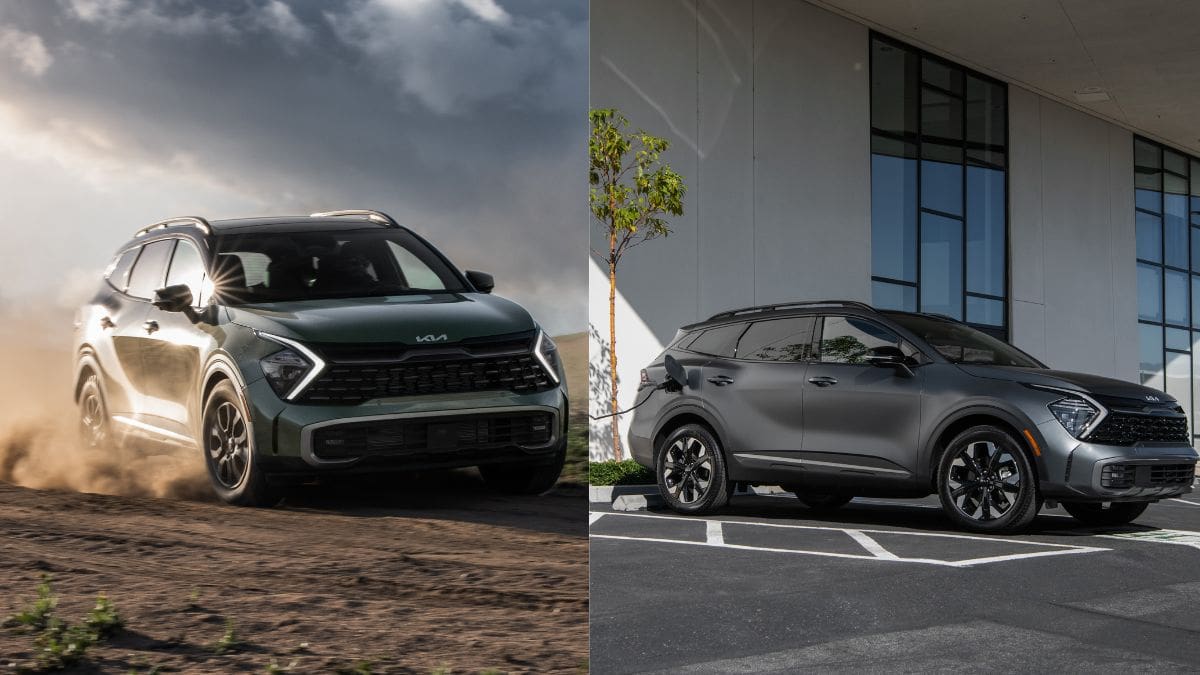
There’s a particular kind of curiosity that follows you into the driveway when you’re considering the Kia Sportage Hybrid and its plug-in counterpart. It starts with a simple question—why does one option look so practical while the other looks slightly more daring? On paper, they share the same badge of ambition: electrification with a familiar SUV stance. Yet the deeper you dig, the more the two approaches diverge in how they deliver power, manage daily usage, and fit into the rhythms of real life. The result is not just a choice between trim levels. It’s a choice between two philosophies of energy.
It’s also a common observation that buyers casually compare them as if they’re interchangeable. “Isn’t a plug-in just a hybrid with a larger battery?” That question makes sense. But fascination grows when you realize the answer is more nuanced. A plug-in system changes your commute calculus, your fueling habits, and even your sense of control. The hybrid, meanwhile, leans into convenience—charging happens for you, quietly, like a background process you never have to think about. Both paths can be excellent. The question is which path matches your life.
Let’s walk through the decision with the kind of clarity that makes showroom conversations feel less like guesses and more like conclusions.
Hybrid vs Plug-In: The Quiet Difference That Changes Everything
The first split is structural. A traditional hybrid (the Sportage Hybrid) relies on a combination of an internal combustion engine and an electric motor. Its battery charges primarily through regenerative braking and the hybrid system’s own energy management. You do not need a charging cable. You simply drive, and the car works out the rest.
A plug-in hybrid (the Sportage Plug-In) adds a larger battery and a charging port. This isn’t just “more capacity.” It’s a shift in where the energy comes from. If you regularly charge at home (or reliably access public charging), the plug-in can often cover more of your daily miles on electricity alone. When you don’t charge, it behaves closer to a conventional hybrid—still capable, but with a different efficiency profile.
Daily Commute: Where the Choice Becomes Personal
Think about your routine with almost forensic attention. How far do you drive most weekdays? Do you return home within a predictable window? Do you have a driveway, garage, or access to charging indoors? These are not small questions. They are the hinge points where the plug-in shines or merely performs.
If your typical day falls within an electric-friendly range and you can top up at home, the plug-in can feel like you’ve unlocked a new kind of smoothness. Electric propulsion delivers immediate torque. Stop-and-go traffic becomes calmer. The car’s engine may stay asleep longer. It’s not fantasy—it’s a measurable reduction in fuel usage when electricity is available.
But if your schedule is irregular, charging isn’t dependable, or you often park away from convenient power, the hybrid’s simplicity can be more satisfying. The hybrid doesn’t require a “charging plan.” It rewards spontaneity. It’s the commuter’s equivalent of a Swiss Army knife.
Fueling and Charging: The Psychology of Control
Here’s where fascination deepens. Some drivers love the discipline of charging. Plug-in ownership can create a ritual—plug in after dinner, check energy flow, anticipate tomorrow’s commute. That routine can turn energy usage into something tangible rather than abstract. It can even feel empowering, like steering your efficiency with intention.
Other drivers want the opposite: minimal intervention. They want the car to handle everything while they focus on the road. In that scenario, the hybrid’s “charge by driving” approach is less about saving fuel in theory and more about eliminating decision fatigue in practice.
Consider a simple rule: if you can consistently charge, the plug-in offers a bigger chance to reduce fuel. If you can’t, the hybrid’s predictability becomes the better bargain.
Performance Feel: Smoothness vs Contextual Power
Both versions provide an electric-assist character, but the experience differs. The plug-in often has more battery reserves available during the early portion of your drive when freshly charged. That can translate into stronger electric-only moments, particularly during initial acceleration and low-speed maneuvers.
The hybrid, by contrast, is designed to be efficient across a broader variety of conditions without requiring you to think about battery state of charge. It may blend electric and engine power frequently, adjusting seamlessly. The result can feel less like an “electric day” and more like a continually optimized compromise.
Neither approach is inherently more “fun.” Instead, they create different emotional textures. Plug-in driving can feel more sudden, more responsive at the margins. Hybrid driving often feels steady—like a metronome keeping your efficiency in rhythm.
Long Trips and Flexibility: Confidence on the Horizon
Long journeys reveal another difference. A plug-in hybrid’s advantage depends partly on how and when you charge. If you plan to stop at a charger on the road, the plug-in can extend its electric contribution. If you don’t, it still functions, but its battery may deplete and the system will rely more on the engine, similar to a hybrid.
The hybrid’s advantage is consistency. Without needing to find charging infrastructure, it can deliver a uniform driving experience across short and long routes alike. There’s a certain freedom in that. You’re not navigating not only roads, but also energy availability.
So the better question isn’t “which is better for long trips?” It’s “how do you like to travel?” Planning-friendly travelers often fall hard for the plug-in. Spontaneous travelers often prefer the hybrid’s off-the-shelf reassurance.
Cost of Ownership: The Numbers Behind the Narrative
Buying decisions should never be purely emotional, even when the emotional payoff is real. The cost equation depends on purchase price differences, energy costs, maintenance expectations, and—most importantly—how you use the vehicle.
If you can charge at home, the plug-in may reduce your fuel expenditure meaningfully. Even if electricity prices vary by region, home charging typically provides more favorable unit costs than frequent public charging. Over time, that can offset the higher upfront cost often associated with plug-in models.
Conversely, if you rarely charge, the plug-in’s potential savings may shrink. Meanwhile, the hybrid’s simpler approach can keep ownership straightforward and predictable. You may pay more at the pump than the plug-in could have, but you may avoid the recurring complexity of charging habits.
In both cases, it helps to create a mock scenario: estimate your weekly mileage, assume a conservative share of electric driving for the plug-in, and compare annual fuel versus electricity costs. The “best” option emerges from your actual behavior rather than generic assumptions.
Practicality and Everyday Living: The SUV Reality Check
An SUV is chosen for its everyday utility—family schedules, errands, weather, and the occasional detour. Hybrid and plug-in systems both fit into that story, but in different ways.
Plug-in models usually offer more electric travel potential for daily tasks like school runs and grocery trips. That can be particularly satisfying in dense neighborhoods where idling and stop-start driving amplify fuel use in non-electrified systems.
Hybrids often deliver an “always ready” experience. You don’t need to coordinate your life around charging availability. For households that juggle multiple drivers, different schedules, or parking constraints, that may matter more than any headline efficiency figure.
Deeper Reasons for Fascination: Why This Choice Feels Bigger Than It Is
Some decisions are binary. This one rarely is. The Sportage Hybrid and the plug-in version represent two different relationships with modern energy. One is seamless and auto-regulated. The other is intentional and interactive.
Drivers don’t just buy powertrains. They buy a way of thinking. Hybrid buyers often like the idea of minimal friction—progress without choreography. Plug-in buyers often want participation—the chance to shape their energy consumption actively, to earn electric miles through a daily ritual.
That’s why the question “Which to buy?” lingers. It’s not only about specs. It’s about identity: what kind of ownership experience feels right.
How to Decide: A Straightforward Checklist
Use a practical checklist that reflects real constraints:
Choose the plug-in if you can charge regularly, your daily distances are often manageable on electricity, and you’re comfortable integrating charging into your routine.
Choose the hybrid if charging access is inconsistent, your driving is unpredictable, you want maximum simplicity, or you frequently travel away from convenient charging.
Choose based on honesty: assume you might be busy on some weeks. If you still would charge often enough, the plug-in can reward you. If you wouldn’t, the hybrid will feel effortlessly right.
Final Thoughts: The Better Car Is the One You’ll Actually Use
Kia’s electrified Sportage lineup is designed to meet different lives, not just different buyers. The hybrid is compelling because it reduces effort. It offers electrification without requiring you to manage a charging schedule. The plug-in is compelling because it adds agency. It can transform everyday driving into electric-forward movement—when you supply the electricity.
In the end, the best purchase is the one that matches your patterns, your access, and your willingness to participate. Whether you choose the hybrid’s effortless balance or the plug-in’s energized involvement, the right Sportage will feel less like a compromise and more like a natural next step.