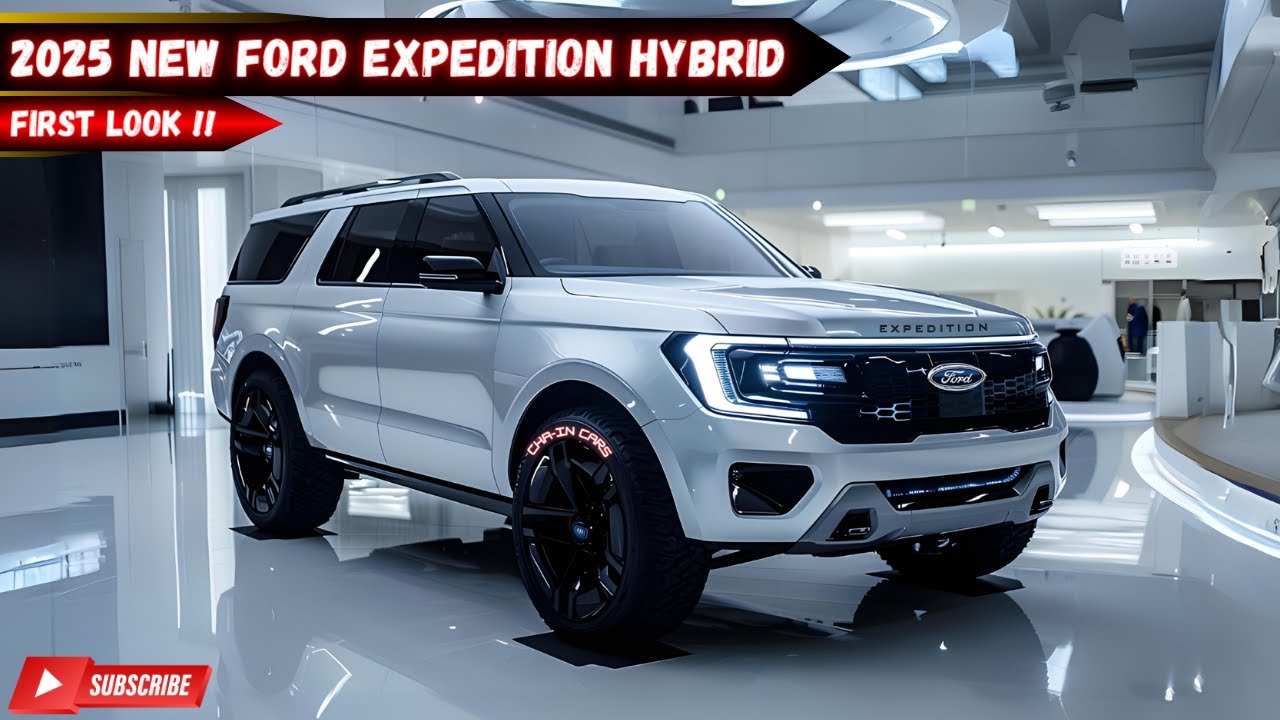
The Ford Expedition has always carried itself like a promise—big shoulders, confident stance, and the kind of presence that makes parking lots feel a little smaller. Yet, in a world where combustion is no longer the default assumption, the next chapter of this full-size icon seems to be rewriting the rules. Rumors and forward-looking signals point toward a new hybrid powertrain, arriving with the intention of changing not just how the Expedition moves, but how drivers think about what a large SUV can be.
Consider the shift in perspective this implies. For years, “hybrid” suggested compromises: a muted response, a constrained driving personality, a distant sense of urgency. But today’s hybrid systems are increasingly designed to feel like they belong to the moment—quicker off the line when it matters, smoother under everyday loads, and more efficient without draining the soul from the drive. The Expedition, if it follows that trajectory, won’t simply become cleaner. It may become sharper in ways that are difficult to measure at a spec sheet’s edge.
What’s especially intriguing is the narrative tension: the Expedition is known for its capability—towing, hauling, long-distance comfort—while hybrid engineering speaks a different language: energy management, seamless torque blending, and a kind of digital restraint that prevents waste. Put those together, and the outcome could feel less like an upgrade and more like a transformation.
A hybrid powertrain that aims to redefine “full-size”
Size has always been the Expedition’s signature. Body volume for families, cargo room for weekend chaos, and the mechanical confidence to handle the long stretch of interstate miles. But hybrid technology introduces a new logic under the hood. Instead of brute force being the only answer, there’s an orchestration of forces—electric assistance, regenerative braking, and an intelligent engine strategy that tries to use energy more wisely.
In practical terms, the promise is a SUV that remains big on capability while becoming more composed in real-world driving. Short trips, stop-and-go commutes, and frequent starts—areas where traditional engines often feel taxed—could turn into moments of efficiency. Not because the Expedition becomes smaller, but because it becomes more strategic.
Imagine rolling away from a stoplight: the response should ideally feel immediate, with the motor adding torque while the engine falls into a supportive rhythm. The result can be a sensation of effortless propulsion—quick when you ask, calm when you don’t.

Efficiency is a common headline, but it doesn’t automatically translate into better driving. The Expedition’s temperament matters. People buy these vehicles not only for practicality, but for a particular kind of assurance: the confidence to merge at speed, the stability for crosswinds and curves, the ability to carry weight without drama.
A well-designed hybrid system can preserve that temperament by reducing the lag that sometimes appears when an engine is forced to do everything at once. Electric torque can fill gaps, smoothing transitions and making acceleration feel less mechanical. The engine may run less frequently at certain loads, but when it does operate, it can do so more efficiently—closer to its optimal operating window.
This is where curiosity deepens. How will Ford balance the Expedition’s need for power with the hybrid system’s thirst for optimal efficiency? How will the vehicle communicate its intentions—through throttle mapping, shift strategy, and brake feel—so it feels natural rather than “computer-managed”?
If that integration lands correctly, the Expedition could become a SUV that feels both modern and familiar. One that doesn’t ask drivers to relearn their habits, but quietly improves the rhythm of every drive.
Regenerative braking is the subtle hero of most hybrid experiences. It turns deceleration from wasted motion into recoverable energy, storing it for later use. For a heavy, full-size SUV, the question becomes especially interesting: can regenerative systems manage the mass effectively without making the braking process feel unnatural?
Done well, regeneration can change the texture of driving. City traffic becomes less about constant friction and more about controlled slowing with energy recovery. Mountain descents become opportunities rather than exhaustion. The driver still feels in command—while the vehicle quietly recaptures momentum behind the scenes.
There’s also the matter of brake blending. Drivers dislike abrupt transitions between electric deceleration and friction braking. The ideal setup would make the handoff nearly invisible, as though the Expedition has always been this smooth. The promise isn’t just savings—it’s refinement.
The Expedition isn’t just an urban cruiser. It’s built for vacations with luggage that somehow multiplies, for trailers that don’t negotiate, and for roads that stretch past the last convenient charging opportunity. If a hybrid powertrain truly belongs in this vehicle, it must be capable under load.
Towing and hauling complicate the hybrid equation. The vehicle must supply strong, sustained torque while managing battery temperatures, maintaining system reliability, and ensuring consistent performance. That means hybrid engineering isn’t only about city efficiency. It’s about resilience—how the system behaves when demand rises and when the engine must cooperate with the motor to keep motion steady and controlled.
The curious part? Energy management at scale. A hybrid Expedition could, in theory, use electric assistance to reduce strain on the engine during demanding moments, while also maintaining battery health for later use. The goal would be a driving experience that stays confident whether the SUV is lightly loaded or carrying everything at once.
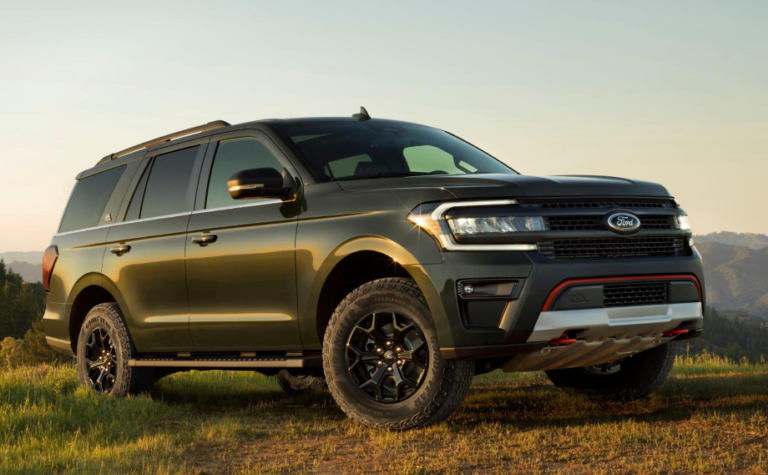
Hybrid powertrains often influence packaging decisions—battery placement, cooling routes, and underbody structure. That can ripple into the design language. The Expedition’s next visual iteration, as suggested by concept imagery and redesign speculation, points toward a more cohesive, aerodynamic attitude with updated styling cues that feel tuned for modern performance.
Where some redesigns chase novelty, a technology-driven transformation tends to feel purposeful. If new cooling hardware, airflow optimization, and component placement are handled elegantly, the vehicle could achieve improved efficiency while retaining the commanding stance drivers expect.
Powertrains are more than numbers. They shape the sensation of the vehicle—its responsiveness, its smoothness, its willingness to surge. A new hybrid system in the Expedition would likely modify key inputs that drivers notice immediately.
Throttle response could become sharper. Transitions between acceleration and cruising might feel more fluid, with less perceived engine effort. Start-stop behavior—if present—could be rethought to reduce annoyance, especially in a vehicle where comfort and confidence are core expectations.
Even cabin acoustics might benefit. Hybrid systems can operate differently at low loads, potentially reducing the engine’s dominance during gentler driving. That’s not merely a noise change. It’s an atmosphere change—one that can turn everyday driving into something smoother, calmer, and more composed.
When a major SUV leans into hybrid technology, it rarely stops at the engine bay. It invites a broader reimagination of priorities: how the vehicle balances performance and efficiency, how it communicates with drivers, and how it handles real-world energy use across seasons and terrains.
Curiosity becomes a compass here. Will the Expedition’s hybrid system prioritize stealthy efficiency for daily life, or athletic readiness for weekend demands? Will it offer modes that let drivers choose how the system behaves—ranging from quietly optimized driving to more responsive, performance-oriented character?
And perhaps most importantly, will it change expectations? If the Expedition delivers hybrid refinement without diluting its identity, it could help normalize the idea that large SUVs don’t have to be fuel-hungry to be emotionally satisfying.
Conclusion: a new Expedition, viewed differently
The Ford Expedition has always been a vehicle of certainty. The upcoming hybrid powertrain promise suggests a different kind of certainty—one built on smarter energy use, smoother torque delivery, and a more deliberate connection between engine and electric propulsion.
If the integration is as seamless as the concept implies, drivers may find themselves looking at the Expedition with fresh eyes. Not just as a bigger SUV, but as a more intelligent one—capable, confident, and unexpectedly efficient. The horizon ahead feels less like an arrival of features and more like the beginning of a new driving philosophy.