What happens when a legend refuses to sit quietly? In the case of the Volkswagen Golf GTI, the answer is a familiar kind of rebellion—one that still feels fresh, still mischievous, and still determined to blur the line between everyday practicality and full-throated fun. The hot hatch isn’t merely returning; it’s revisiting its own mythology with a new set of tools: sharper styling cues, more composed dynamics, and a refined sense of daily usability that doesn’t dilute the thrill.
Still, let’s pose a playful question that also doubles as a dare: Can a modern GTI keep its mischievous grin while navigating the strict etiquette of contemporary life—traffic, emissions, infotainment expectations, and the relentless logic of fuel economy? The challenge is real. It’s one thing to look like the hero in your imagination. It’s another to prove it every time the light turns green.
A Nameplate Built on Confidence, Not Nostalgia
The GTI story has always been less about reverence and more about confidence. It’s a car that invites you to drive it a little harder than you planned—without demanding you become a track instructor. That spirit lives on as the latest generation steps forward, carrying the essential DNA: that unmistakable compact stance, the sense of purposeful intent, and the “press-forward” posture that makes even a commute feel like a warm-up lap.
Yet the return isn’t only an echo. Modern regulations and customer expectations have changed the background scenery. What used to be purely mechanical drama now has to share the stage with advanced calibration, driver-assistance systems, and increasingly intelligent power delivery. The question becomes whether the car can stay characterful while still acting responsibly.
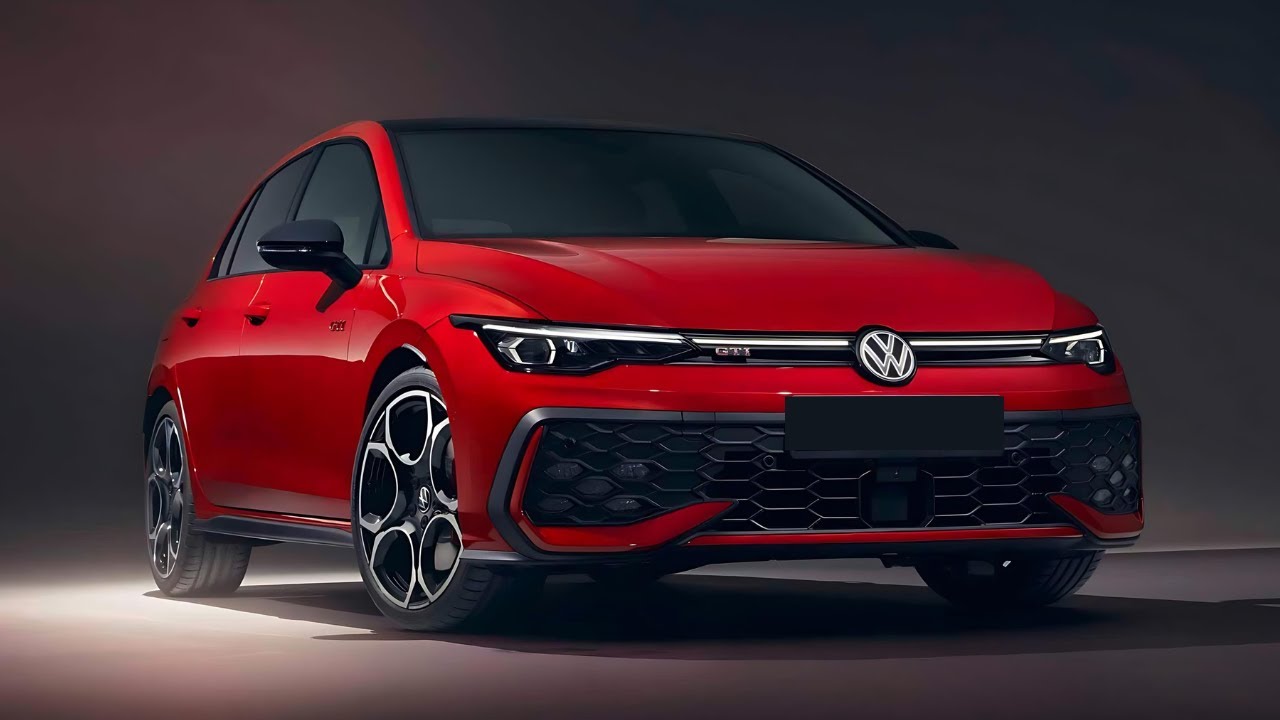
Look closely and the GTI’s design reads like a collection of inside jokes you’re finally in on. The front end typically carries a more assertive expression—grill details that feel purposeful, lighting signatures that add clarity rather than clutter, and aerodynamic flourishes that don’t just chase numbers on a brochure.
Side profiles tend to communicate readiness: tidy proportions, a stance that suggests stability at speed, and wheel designs that look like they’re already preparing to tackle an impromptu detour. Meanwhile, the rear usually finishes the story with a confident tailgate presence—distinct enough to be recognized in passing, restrained enough to remain tasteful when parked in real-world places.
And yes, it still feels like a car you can “get away with.” The GTI’s aesthetic has that rare balance: sporty but not cartoonish; vibrant but not loud for the sake of it.

Inside, the GTI tradition continues: a cabin that doesn’t just transport—it engages. The seats often deliver supportive comfort with a sporty contour, giving you the feeling of being held in place when the road gets enthusiastic. Materials and trim choices generally aim for a premium touch without forgetting that this is a driver’s car, not a glass museum.
Technology, too, has evolved. Modern infotainment layouts are typically more responsive and easier to live with, and driver displays often provide information at a glance. The trick is making sure the interface doesn’t steal attention at the worst possible moment. A GTI should feel intuitive—like muscle memory—rather than like a puzzle box.
There’s also the matter of sound and atmosphere. Even when modern insulation quietly does its job, the cabin still tends to amplify the sensations that matter: steering feedback, throttle response, and the satisfying immediacy of controls you can trust.
Does it remain playful? It can. If the calibration is right, the cabin becomes a cockpit of momentum instead of a sterile lounge.
The Golf GTI has never relied solely on brute force; it has relied on balance. It wants traction, responsiveness, and a power delivery that feels eager without being theatrical. The challenge for each new iteration is the same: keep the fun sharp while smoothing out the rough edges that modern engineering now considers non-negotiable.
Depending on the specific model year and market configuration, you can expect a powertrain tuned for lively acceleration with a sense of control through the rev range. The goal is not merely to go fast in a straight line, but to stay connected to the driver in every moment—when you’re threading traffic, when you’re leaving a corner, and when the road begins to invite a little enthusiasm.
The GTI’s transmission and drivetrain integration also matter. A hot hatch should feel like it’s reading your intent seconds ahead. That’s the difference between a car that performs and a car that participates.
Now comes the dare again: will the GTI’s performance still feel “human” in a world increasingly dominated by electronic guardians? A well-tuned GTI answers with confidence—systems that enhance driver feel rather than replace it.
Hot hatch legends are built on confidence in cornering, and the GTI typically earns that through a carefully staged mix of steering response, suspension tuning, and weight distribution that helps the car feel anchored. The steering isn’t usually just direct; it’s communicative. It tells you what the front tires are doing—subtle, not dramatic.
Under spirited driving, the balance is expected to reduce drama. You want a chassis that feels predictable, that allows mid-corner adjustments without scolding you. Grip should build progressively. The car should reward smoothness rather than punish it.
Modern advancements can improve comfort too. That matters because the best hot hatches aren’t only for weekends. The GTI’s mission is to make daily life more interesting—so the suspension should keep composure over imperfect pavement, not just on curated roads.
The modern GTI operates in a complex ecosystem of stability control, traction management, and braking support. Far from being a threat to the driving experience, these systems can create a safety net that lets the driver explore the car’s limits more confidently.
The question is calibration. If electronics are too intrusive, the car becomes numb. If they’re well tuned, they behave like patient co-pilots—subtle interventions that keep momentum alive without flattening the sense of engagement.
In short: the GTI’s electronics should enable play, not extinguish it.
All fun eventually meets the real world: groceries, school runs, commuting, rain, and the occasional long stretch of highway where concentration matters. The GTI’s design usually aims to keep those scenarios painless. Cabin ergonomics, visibility, and ride comfort become the unsung heroes.
Driver-assistance features—such as adaptive cruise control and lane-keeping aids, depending on trim—can reduce fatigue. But the best implementations don’t turn the driver into a spectator. They should reduce workload while preserving authority.
Comfort and convenience also include storage practicality, climate control usability, and the feel of the controls. A hot hatch should still work like a hot hatch, which means the driver’s routine should remain delightfully straightforward.
Price always changes the conversation. A GTI typically asks for a premium compared with less performance-focused Golf trims. The justification, however, often lives in the details: the drivetrain refinement, the chassis tuning, the sporty cabin character, and the sense of cohesion between styling, performance, and usability.
The best way to evaluate value is to ask a more emotional question: Would you choose this car on a day you don’t “need” it? If the answer is yes, then the GTI is doing its job. If the answer is no, the challenge becomes clear—find what matters more: pure efficiency, maximum tech features, or uncompromised performance.

Here’s the real test: the GTI must remain an object of desire in a time when cars are often expected to be appliances. It has to stay approachable without becoming bland, exciting without becoming exhausting, and advanced without becoming detached.
The most successful hot hatch return is the one that doesn’t just look like the past—it behaves like the future. It should make you grin at ordinary speeds. It should make a back road feel like a secret you’re allowed to share. And on the days when life is mundane, it should still feel like you’re driving something with a pulse.
So, consider that challenge again: when the GTI returns to your driveway—will it still feel like a legend reborn, or will it feel like a compromise wrapped in modern packaging? The answer depends on the car’s ability to keep its soul, not just its specs.
Final Thoughts: A Legend Reborn, Ready for the Next Green Light
The Volkswagen Golf GTI returning is more than a product launch—it’s a promise. A promise that compact performance can still be clever, that daily life can still contain a spark, and that driving pleasure doesn’t have to be reserved for perfect weather or empty roads.
One light changes, one corner arrives, and suddenly you remember why the GTI became a legend in the first place: it makes the mundane feel negotiable. And if it truly keeps that playful mischievousness intact, the hot hatch world has gained something more than a comeback—it has gained a renewed reason to look forward.